




- Lior mor
- •
- 7 Min Read
- •
- 4 hours ago


Key Points
- Rising U.S. Treasury yields are renewing interest in the traditional 60% stocks and 40% bonds portfolio strategy.
- Higher bond income may help cushion portfolios against further price declines, although inflation and interest-rate risks remain.
- Investors are diversifying their fixed-income allocations, favoring short-term government debt and floating-rate products over some corporate and high-yield bonds.
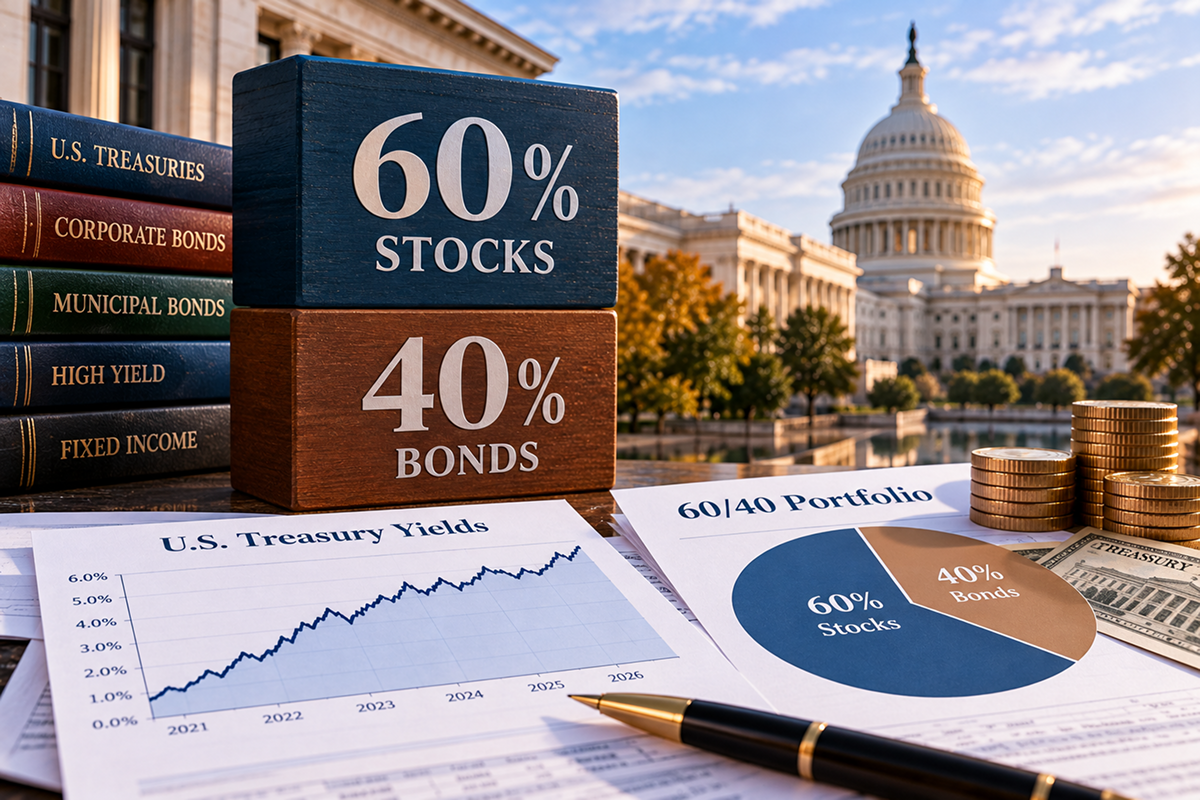
The recent selloff in government bonds is prompting U.S. investors to reconsider the traditional 60/40 portfolio, as higher Treasury yields offer more attractive income and potentially stronger future returns. After years in which ultra-low interest rates reduced the appeal of fixed income, the changing market environment is encouraging investors to reassess the role bonds can play in balancing portfolio risk and generating returns.
Higher Yields Restore the Appeal of Fixed Income
The 60/40 portfolio, which traditionally allocates 60% of assets to equities and 40% to bonds, lost some of its appeal following the 2008 financial crisis. Persistently low interest rates left investors with limited income from government debt, encouraging some to increase their equity exposure in pursuit of higher returns.
The recent rise in yields has changed that calculation. With yields exceeding 5% across parts of the U.S. Treasury curve, bonds can provide a more substantial income stream than during the low-rate period. That income may help offset some losses if bond prices decline further, although it does not eliminate the risk of capital losses when yields rise.
For investors, the renewed interest in fixed income reflects a reassessment of the balance between potential returns and portfolio volatility. Higher starting yields can improve the income component of bond investments and potentially strengthen future returns, depending on subsequent interest-rate movements and the prices at which securities are purchased.
Traditional Diversification Faces New Challenges
The appeal of the 60/40 strategy also depends on how stocks and bonds behave relative to one another. Historically, government bonds have often helped cushion portfolios when equities declined. However, inflation shocks and rising interest rates have challenged that relationship, as stocks and bonds have sometimes fallen simultaneously.
Reuters calculations showed that the rolling 36-month correlation between global equities and government bonds stood at approximately 0.59 at the end of September, compared with an average of minus 0.24 between 2009 and 2021. This change highlights why investors cannot assume that a conventional bond allocation will always offset equity-market losses.
Nevertheless, higher yields may improve the prospective income contribution from fixed income. The central question is whether the bond allocation can provide sufficient income and diversification to support a portfolio through different market conditions.
Investors Favor Selective Income Opportunities
Recent fund flows suggest that investors are approaching the bond market selectively rather than increasing exposure across all fixed-income categories. LSEG Lipper data showed that investors allocated $14.5 billion to short-term U.S. government bond funds and $4.9 billion to loan-participation funds in September.
Over the same period, investors withdrew $4.9 billion from corporate bond funds and $4.5 billion from high-yield funds. The contrasting flows suggest that demand is concentrating on particular income strategies, including shorter-duration government debt and floating-rate credit products that generally have lower sensitivity to changes in market interest rates.
The 40% Allocation Is Evolving
The modern interpretation of the 60/40 portfolio increasingly extends beyond Treasury securities and investment-grade corporate bonds. Investors are considering municipal bonds, securitized assets, preferred securities and floating-rate instruments, including leveraged loans and highly rated collateralized loan obligations.
These assets have different credit, liquidity and interest-rate risks, meaning they are not interchangeable with government bonds. However, a broader fixed-income allocation may give investors more ways to balance income generation and risk exposure.
Going forward, the sustainability of the renewed 60/40 strategy will depend on inflation, Treasury yields and the relationship between equity and bond returns. Investors will also monitor whether current income levels prove durable and whether diversification across different fixed-income assets improves portfolio resilience. The debate is increasingly less about whether the traditional allocation remains relevant and more about how its bond component should evolve as financial conditions change.
Comparison, examination, and analysis between investment houses
Leave your details, and an expert from our team will get back to you as soon as possible
* This article, in whole or in part, does not contain any promise of investment returns, nor does it constitute professional advice to make investments in any particular field.
To read more about the full disclaimer, click here
- omer bar
- •
- 5 Min Read
- •
- ago 3 hours
SKN | Goldman Sachs Beats Quarterly Profit Estimates as Equities Revenue Surges
Goldman Sachs delivered a stronger-than-expected third quarter as robust equities activity and steady dealmaking helped offset weakness in fixed
- ago 3 hours
- •
- 5 Min Read

Goldman Sachs delivered a stronger-than-expected third quarter as robust equities activity and steady dealmaking helped offset weakness in fixed

- Arik Arkadi Sluzki
- •
- 7 Min Read
- •
- ago 4 hours
SKN | Fed’s Williams Sees No Need for 2027 Rate Hike as Inflation Gradually Cools
New York Federal Reserve President John Williams said he currently sees no need for additional interest-rate increases in 2027,
- ago 4 hours
- •
- 7 Min Read
New York Federal Reserve President John Williams said he currently sees no need for additional interest-rate increases in 2027,
- omer bar
- •
- 7 Min Read
- •
- ago 4 hours
SKN | PIMCO Warns U.S. Treasury Yields May Have Further Room to Rise as Fed Tightening Could Continue
U.S. Treasury yields may not have reached their peak, with the Federal Reserve potentially having room for one or
- ago 4 hours
- •
- 7 Min Read

U.S. Treasury yields may not have reached their peak, with the Federal Reserve potentially having room for one or

- sagi habasov
- •
- 7 Min Read
- •
- ago 8 hours
SKN | Fund Managers Want 10-Year Treasury Yields at 5.9% Before Switching From Stocks to Bonds, BofA Survey Finds
Treasury Yields Continue to Challenge Investors The rapid rise in bond yields has not yet reached the level that fund
- ago 8 hours
- •
- 7 Min Read

Treasury Yields Continue to Challenge Investors The rapid rise in bond yields has not yet reached the level that fund
