




- sagi habasov
- •
- 7 Min Read
- •
- 6 hours ago


Key Points
- Vanguard Global Chief Economist Joe Davis says short-term rates would likely need to move materially above 4% before the impact on earnings and economic activity becomes significant, with rates above 5% representing a more concerning zone.
- Vanguard now expects one additional Fed rate hike in 2026, potentially taking the federal funds target range to 4%–4.25% by year-end.
- Rising Treasury yields are already tightening financial conditions, with the 10-year Treasury yield reaching 5.11% on September 23, while inflation remains above the Federal Reserve's 2% objective.
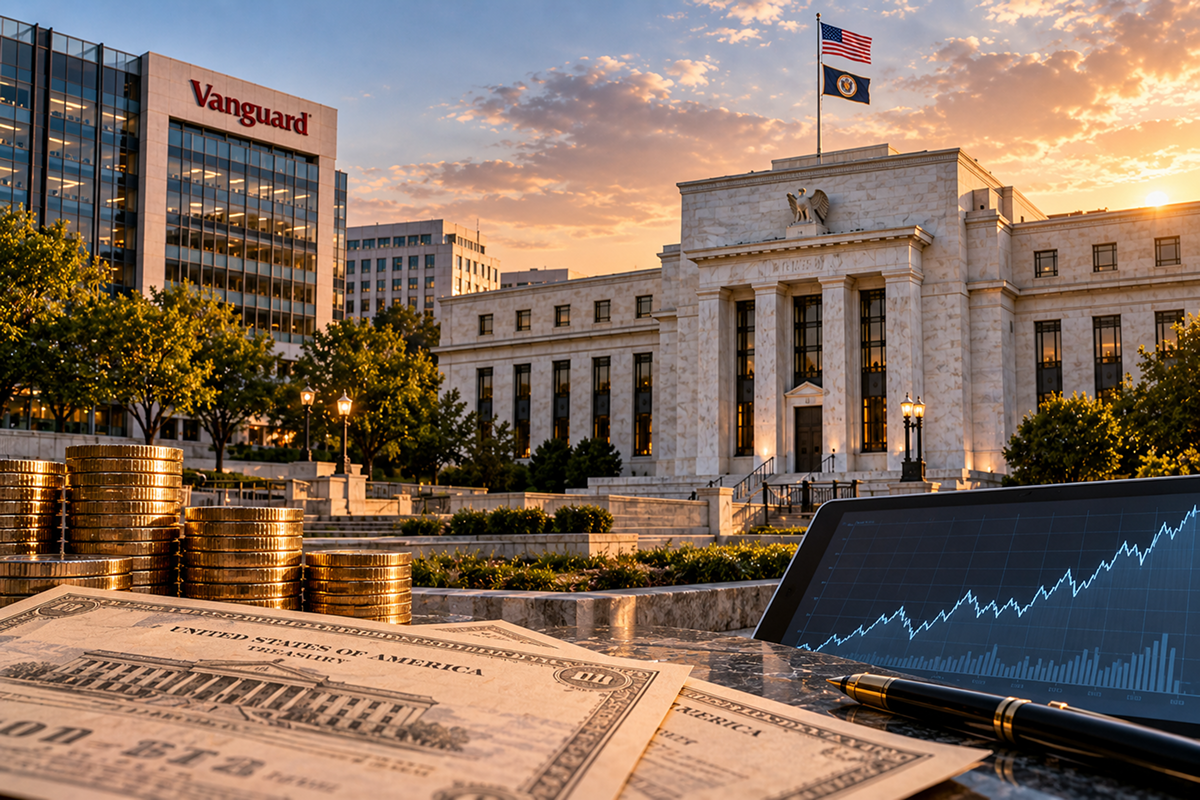
Federal Reserve policy has moved back toward the center of global market attention as inflation remains elevated and Treasury yields continue to rise. Vanguard’s latest assessment provides a specific reference point for investors: Global Chief Economist Joe Davis said short-term interest rates would likely need to move above 5% before policymakers’ tightening begins to create a significant downturn in earnings potential and economic activity, while emphasizing that this is not Vanguard’s baseline scenario.
Vanguard Raises Its 2026 Rate Forecast
The Federal Reserve raised its target federal funds range by 25 basis points to 3.75%–4% at its September 16 meeting, its first rate increase since 2023. The central bank said economic activity was expanding at a solid pace, domestic spending remained resilient and productivity growth and capital investment were strong, while also noting that inflation remained elevated.
Against that backdrop, Vanguard now expects one further rate increase before the end of 2026, which would place the target range at 4%–4.25%. Vanguard Senior U.S. Economist Josh Hirt described the expected move as a recalibration of monetary policy and removal of prior accommodation rather than the beginning of a sustained tightening cycle.
Why 5% Matters for the Market
Davis’s assessment draws an important distinction between the current policy environment and a substantially more restrictive scenario. He said short-term rates would need to move materially higher than the roughly 4% level reached after the September decision, with rates above 5% representing territory where Vanguard would begin discussing a significant decline in earnings potential and economic activity. Davis also stressed that such an outcome is not Vanguard’s baseline expectation.
The distinction is important because financial conditions are already tightening through longer-term bond markets. TheStreet reported that the 10-year Treasury yield closed at 5.11% on September 23, its highest close since July 2007. Vanguard has identified several forces behind the broader rise in global bond yields, including elevated energy prices, persistent inflation, more hawkish central banks, government fiscal concerns and increased demand for capital associated with the AI investment cycle.
Inflation Remains the Key Constraint
The policy debate is being shaped by inflation that has not yet returned to the Federal Reserve’s 2% objective. U.S. CPI increased 3.4% over the 12 months through August, while core CPI, excluding food and energy, rose 2.4%. The August monthly increase was 0.4%, with gasoline accounting for more than one-third of the overall monthly rise.
The persistence of inflation means that another rate increase remains part of the policy discussion even as economic activity remains resilient. Vanguard’s analysis suggests that the more important market threshold would be a sequence of materially more aggressive hikes driven by renewed inflation pressure and potentially tighter labor-market conditions. Until that scenario develops, Vanguard expects financial markets and the broader economy to retain resilience over the next six to 12 months.
For global investors, including those in Israel with exposure to U.S. equities, dollar assets and international bonds, the interaction between Fed policy, Treasury yields, inflation and corporate earnings will remain central. The next major policy test comes at the Federal Reserve’s October 27–28 meeting, while the trajectory of energy prices and upcoming inflation data will help determine whether the current rate path remains consistent with Vanguard’s baseline or moves toward the more restrictive scenario outlined by Davis.
Comparison, examination, and analysis between investment houses
Leave your details, and an expert from our team will get back to you as soon as possible
* This article, in whole or in part, does not contain any promise of investment returns, nor does it constitute professional advice to make investments in any particular field.
To read more about the full disclaimer, click here
- sagi habasov
- •
- 8 Min Read
- •
- ago 9 hours
SKN | U.S. and China Reach Tariff Consensus on $30 Billion in Goods: Could Trade Tensions Enter a New Phase?
The United States and China have reached a new trade understanding covering approximately $30 billion of non-sensitive goods in
- ago 9 hours
- •
- 8 Min Read

The United States and China have reached a new trade understanding covering approximately $30 billion of non-sensitive goods in

- Arik Arkadi Sluzki
- •
- 7 Min Read
- •
- ago 12 hours
SKN | Falling Oil Prices Offer Relief to Bond Markets After Treasury Yields Hit Multi-Decade Highs
US Treasury yields stabilized on Friday after reaching multi-decade highs earlier in the session, with falling oil prices providing
- ago 12 hours
- •
- 7 Min Read

US Treasury yields stabilized on Friday after reaching multi-decade highs earlier in the session, with falling oil prices providing
- sagi habasov
- •
- 7 Min Read
- •
- ago 13 hours
SKN | Fed’s Hammack Warns Persistent Inflation Could Weaken Price Expectations
Federal Reserve Bank of Cleveland President Beth Hammack said Friday that persistent inflation remains a significant risk to the
- ago 13 hours
- •
- 7 Min Read
Federal Reserve Bank of Cleveland President Beth Hammack said Friday that persistent inflation remains a significant risk to the
- sagi habasov
- •
- 7 Min Read
- •
- ago 1 day
SKN | Wall Street Awaits Jobs and Inflation Data as Investors Reassess Fed Rate Path
Wall Street is entering a critical week as investors prepare for fresh employment and inflation data that could influence
- ago 1 day
- •
- 7 Min Read

Wall Street is entering a critical week as investors prepare for fresh employment and inflation data that could influence
