




- omer bar
- •
- 9 Min Read
- •
- 7 seconds ago


Key Points
- U.S. data center construction spending reached an annualized $85 billion in August, up 73% from a year earlier and marking the strongest year-over-year increase shown in the latest data.
- Since the beginning of 2021, annualized data center construction spending has increased by approximately $76 billion, or 823%, reflecting the scale of the AI infrastructure buildout.
- Traditional office construction is moving in the opposite direction, with spending falling to approximately $46 billion, creating a record $39 billion gap between data centers and general offices.
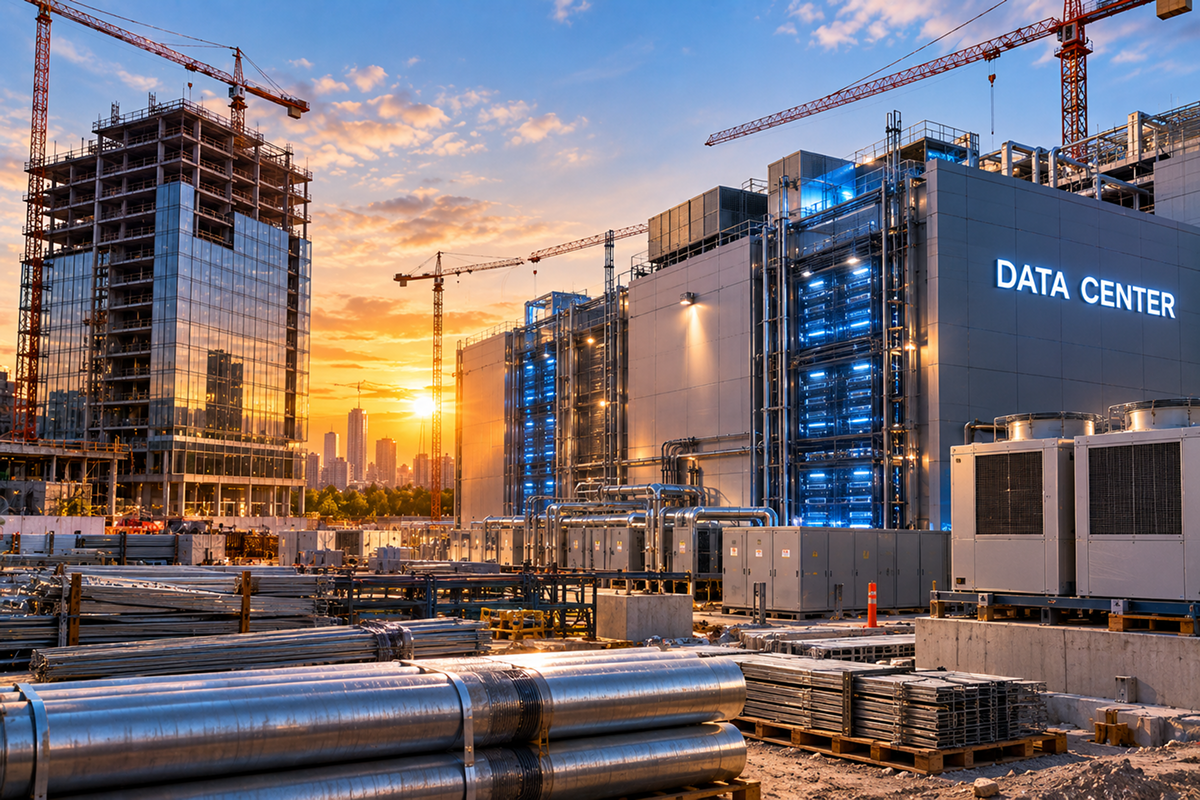
The latest U.S. construction data illustrate a major shift in where corporate capital is being deployed. Data center construction has surged to an annualized rate of roughly $85 billion, driven by the rapid expansion of artificial intelligence and cloud infrastructure, while traditional office construction remains under pressure from structural changes in workplace demand.
The divergence is occurring within a broader construction market that remains mixed. Total U.S. construction spending increased 0.9% in August to a seasonally adjusted annual rate of $2.203 trillion, although it remained 1.7% below August 2025 levels. Private nonresidential construction rose 1.0% from July, making the composition of spending increasingly important to understanding the underlying investment cycle.
AI Infrastructure Has Become a Major Construction Engine
The scale of the data center increase is significant. According to the latest figures shown in the attached data, spending reached approximately $85 billion on an annualized basis in August, representing a 73% year-over-year increase. KPMG’s analysis of the Census Bureau data similarly reported that data center construction spending reached a record $85 billion annualized rate and increased 73.2% from a year earlier.
The increase reflects more than the construction of server buildings themselves. AI infrastructure requires large investments in power systems, cooling equipment, electrical components, networking infrastructure and specialized industrial equipment. As hyperscalers and other technology companies expand computing capacity, the resulting capital expenditure is increasingly flowing through the broader construction and industrial supply chain.
The growth is particularly notable because it has occurred at a pace far beyond the traditional construction cycle. Since the beginning of 2021, the attached figures show annualized data center construction spending increasing by approximately $76 billion, or 823%. This suggests that AI is not simply generating demand for additional computing hardware but is influencing the physical allocation of capital across the U.S. economy.
The Office Construction Market Is Moving in the Opposite Direction
The contrast with traditional office construction is equally important. General office construction spending fell to approximately $46 billion on an annualized basis in August, according to the attached data. The figure is approximately 10% below the previous year and represents one of the lowest levels in the series since 2015.
The divergence reflects a fundamental change in the economics of commercial real estate. Hybrid and remote work have reduced demand for conventional office space in many markets, while high vacancy rates and uncertainty over future workplace requirements have constrained new development. As a result, capital that once supported conventional office construction is increasingly being directed toward infrastructure associated with computing, energy and digital services.
The result is a record $39 billion gap between annualized data center and general office construction spending. The gap is significant because it illustrates how technological change can alter the physical economy: buildings designed to support artificial intelligence are attracting substantially more incremental construction capital than buildings designed primarily for traditional office employment.
The AI Investment Cycle Extends Beyond Technology Companies
The construction figures also show why the AI investment cycle should not be viewed solely through the performance of semiconductor and software companies. Data centers require large amounts of electricity, specialized cooling systems, generators, transformers, construction machinery and other physical infrastructure. The spending boom therefore creates potential demand across a much wider group of industrial and infrastructure suppliers.
Energy infrastructure is becoming particularly important as developers encounter limitations in grid connections. Reuters recently reported that demand for smaller gas turbines is increasing as data center developers seek faster sources of behind-the-meter electricity while waiting for permanent grid capacity. The research cited by Reuters projects nearly 30 gigawatts of behind-the-meter gas generation could be added by 2030, with data centers accounting for the vast majority.
This creates an important distinction between AI investment and AI-related construction. The first involves computing equipment and software, while the second encompasses the physical infrastructure required to operate those systems. Together, they represent a much broader capital-spending cycle with implications for construction, utilities, industrial equipment and energy markets.
Going forward, the key question is whether the current pace of data center investment can remain economically justified as spending reaches unprecedented levels. The market will need to monitor AI demand, data center utilization, electricity availability, financing costs and the returns generated by increasingly large infrastructure investments. For the U.S. economy, the widening gap with traditional office construction already demonstrates that AI is changing not only the technology sector but also the allocation of physical capital across the broader economy.
Comparison, examination, and analysis between investment houses
Leave your details, and an expert from our team will get back to you as soon as possible
* This article, in whole or in part, does not contain any promise of investment returns, nor does it constitute professional advice to make investments in any particular field.
To read more about the full disclaimer, click here
- Ronny Mor
- •
- 8 Min Read
- •
- ago 28 minutes
SKN | US and China Money Supply Reaches Record Levels: Is Global Liquidity Entering a New Expansion Cycle?
U.S. and Chinese money supply has reached unprecedented nominal levels, reinforcing the importance of liquidity conditions for global financial
- ago 28 minutes
- •
- 8 Min Read

U.S. and Chinese money supply has reached unprecedented nominal levels, reinforcing the importance of liquidity conditions for global financial

- sagi habasov
- •
- 7 Min Read
- •
- ago 29 minutes
SKN | Nvidia Leads a Decade of Extraordinary Gains as Nike Becomes the Dow’s Biggest Loser
The performance of individual Dow Jones Industrial Average components over the past decade illustrates how dramatically leadership within U.S.
- ago 29 minutes
- •
- 7 Min Read

The performance of individual Dow Jones Industrial Average components over the past decade illustrates how dramatically leadership within U.S.

- Lior mor
- •
- 7 Min Read
- •
- ago 29 minutes
SKN | Micron at $1,069: How AI Demand Has Transformed the Memory Chip Market
Micron Technology's rapid rise has become one of the clearest examples of how artificial intelligence is reshaping the semiconductor
- ago 29 minutes
- •
- 7 Min Read

Micron Technology's rapid rise has become one of the clearest examples of how artificial intelligence is reshaping the semiconductor

- omer bar
- •
- 7 Min Read
- •
- ago 6 hours
SKN | Fed’s Hammack Signals More Time to Weigh the Next Interest Rate Move
Federal Reserve Bank of Cleveland President Beth Hammack said the U.S. central bank still has time to evaluate incoming
- ago 6 hours
- •
- 7 Min Read

Federal Reserve Bank of Cleveland President Beth Hammack said the U.S. central bank still has time to evaluate incoming
