




- orshu
- •
- 8 Min Read
- •
- 2 minutes ago


Key Points
- Israeli equities suffered another sharp decline on November 5, with the Tel Aviv-35 falling 3.69% to 3,823.18 and the Tel Aviv-125 dropping 3.38% to 3,719.05.
- Selling pressure extended across the market, with the Tel Aviv-90 declining 2.23% and the Tel Aviv-SME60 losing 3.52%. The Tel Aviv-125 recorded 104 declining securities against just 18 advancing.
- Stock turnover surged to approximately NIS 19.39 billion, substantially exceeding the previous session's NIS 5.39 billion. ICL gained 5.67%, while Camtek fell 8.63%.
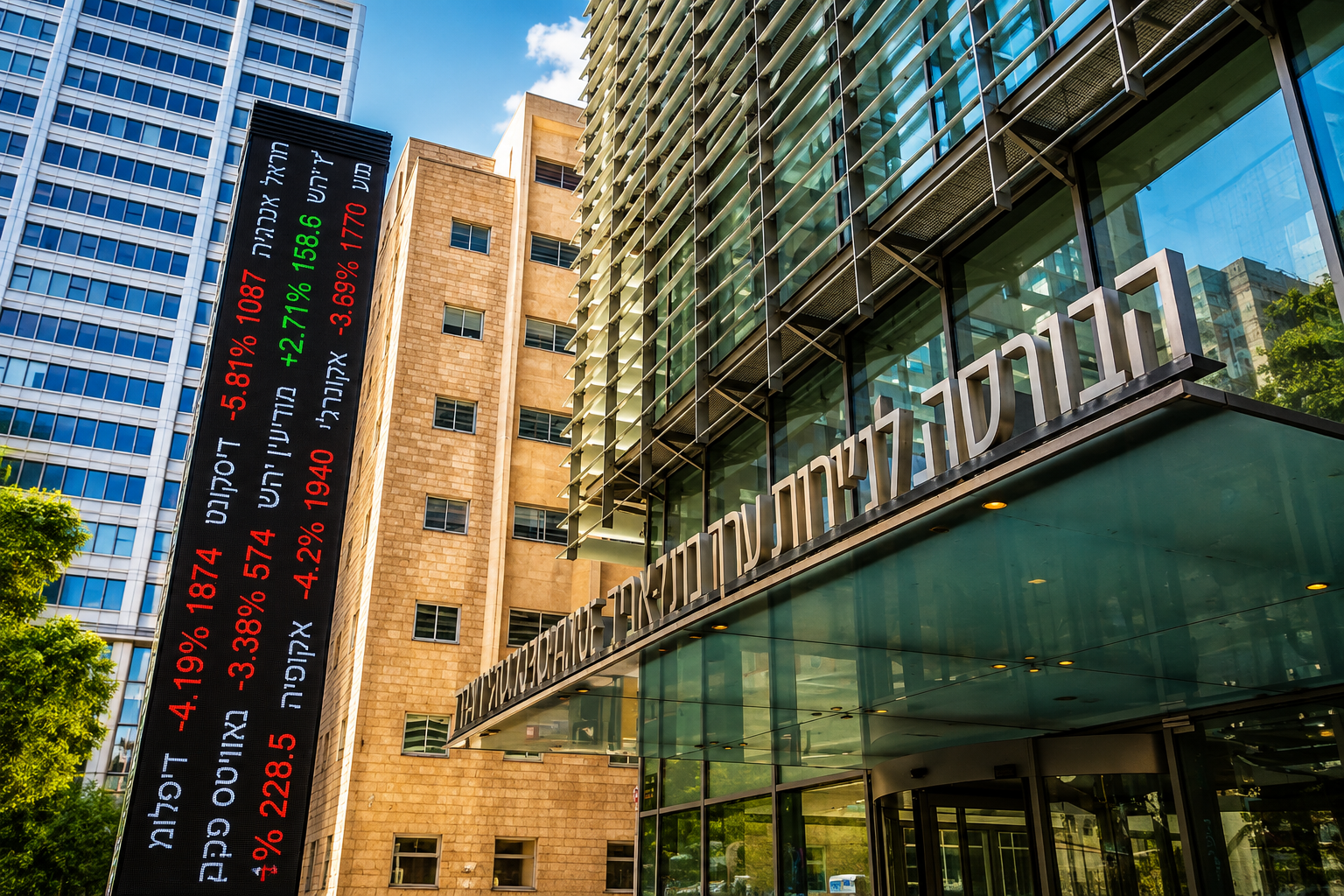
Israeli Equities Experience Another Sharp Sell-Off
The Tel Aviv Stock Exchange recorded a substantial decline on November 5, extending the recent downturn across Israeli equities. The Tel Aviv-35 dropped 3.69% to 3,823.18, while the broader Tel Aviv-125 declined 3.38% to 3,719.05. The Tel Aviv-90 also weakened, falling 2.23% to 3,407.17.
The latest session followed losses across all major benchmarks on November 4. The continued decline pushed the Tel Aviv-35 further below 4,000, while the Tel Aviv-125 moved deeper below 3,800. The magnitude of the latest losses indicates that selling pressure remained pronounced across the principal market indices.
Other benchmarks recorded similarly negative performances. The Tel Aviv-SME60 fell 3.52% to 1,126.87, while the Tel Aviv-200 declined 2.77% to 3,569.47. The Tel Aviv Sector-Balance index lost 2.90% to 4,256.94. The Tel Aviv-90 and Banks index dropped 2.47% to 3,643.75, while the Tel Aviv-20 declined 3.52% to 3,628.
All eight listed benchmarks finished lower, confirming that the sell-off extended across large-cap, mid-cap, and broader-market segments.
Market Breadth Confirms Widespread Selling
Advance-decline figures show that declining securities significantly outnumbered advancing securities across every listed benchmark.
The Tel Aviv-35 recorded just two advancing securities against 33 declining securities. Within the Tel Aviv-125, 18 securities advanced while 104 declined. The Tel Aviv-90 registered 16 advances compared with 71 declines.
The broader indices showed similar weakness. The Tel Aviv-200 recorded 25 advances and 168 declines, while the Tel Aviv-SME60 reported five advancing securities against 54 declining securities. The Tel Aviv Sector-Balance index had 16 advances and 80 declines. The Tel Aviv-20 recorded only one advancing security compared with 18 declining securities.
This market breadth indicates that the latest decline was broad-based rather than concentrated in a small number of large companies. The figures also show particularly pronounced weakness among the constituents of the Tel Aviv-35 and Tel Aviv-200.
Trading Turnover Surges to NIS 19.39 Billion
Stock turnover reached approximately NIS 19.39 billion, based on reported activity of NIS 19.386 billion. This represented a substantial increase from the approximately NIS 5.39 billion recorded on November 4.
Bond turnover totaled approximately NIS 4.50 billion, leaving equity trading activity significantly higher during the session.
The index-level turnover figures also highlight the scale of activity. The Tel Aviv-125 recorded approximately NIS 17.21 billion, while the Tel Aviv-200 registered around NIS 16.73 billion. The Tel Aviv Sector-Balance index generated approximately NIS 14.85 billion in turnover, and the Tel Aviv-35 recorded approximately NIS 10.75 billion.
These index-level figures may overlap and should not be added together to calculate total market turnover. Nevertheless, the reported market-wide stock turnover points to an exceptionally active trading session occurring alongside substantial index declines.
Nature recorded approximately NIS 1.97 billion in individual turnover, making it a notable trading figure during the session.
Individual Stocks Show Selective Strength
Despite the broad sell-off, ICL advanced 5.67% to 1,492, making it the strongest reported gainer among the notable Tel Aviv-125 movements. Camtek declined 8.63% to 30,180, recording the largest reported decrease.
The divergence demonstrates that individual securities continued to experience sharply different trading outcomes even as the broader market weakened. ICL’s gain stood out against the widespread declines, while Camtek’s loss exceeded the percentage declines recorded by the major indices.
The supplied figures do not identify the specific catalysts behind these individual movements or the exceptional increase in equity turnover.
What Investors Should Watch Next
The next trading sessions will be important in determining whether the latest decline begins to stabilize or develops into further weakness. The Tel Aviv-35’s close at 3,823.18 and the Tel Aviv-125’s level of 3,719.05 provide important reference points for monitoring near-term market direction.
Investors may also focus on whether the exceptionally high equity turnover continues and whether market breadth begins to improve. A reduction in declining securities, accompanied by stabilization in the leading benchmarks, could indicate that selling pressure is easing. Continued negative breadth alongside elevated turnover would suggest that market uncertainty remains pronounced.
The performance of the Tel Aviv-90 and the banking-related index will also be relevant in assessing whether weakness remains widespread across different segments of the Israeli equity market.
Closing Insights
The November 5 session marked a particularly severe decline for Israeli equities, with all eight listed benchmarks falling and declining securities overwhelmingly outnumbering advancing ones. Stock turnover surged to approximately NIS 19.39 billion, highlighting the exceptional level of trading activity during the sell-off. Although ICL recorded a notable advance, the broader market remained under substantial pressure. The next sessions will be critical in assessing whether the market can establish stability following consecutive days of declines.
Comparison, examination, and analysis between investment houses
Leave your details, and an expert from our team will get back to you as soon as possible
* This article, in whole or in part, does not contain any promise of investment returns, nor does it constitute professional advice to make investments in any particular field.
To read more about the full disclaimer, click here
- orshu
- •
- 6 Min Read
- •
- ago 2 hours
SKN | US Markets Face Broad Pressure as Nasdaq Leads Decline Amid Risk-Off Trading
US financial markets were under pressure on November 5, with the latest session showing a clear deterioration in risk
- ago 2 hours
- •
- 6 Min Read
US financial markets were under pressure on November 5, with the latest session showing a clear deterioration in risk

- Lior mor
- •
- 9 Min Read
- •
- ago 2 hours
SKN | Global Markets Diverge as AI Stocks Slide and Oil Rebounds After Sharp Selloff
AI Infrastructure Concerns Weigh on Semiconductor Stocks Global markets delivered mixed signals on Thursday as investors assessed the implications of
- ago 2 hours
- •
- 9 Min Read

AI Infrastructure Concerns Weigh on Semiconductor Stocks Global markets delivered mixed signals on Thursday as investors assessed the implications of
- Lior mor
- •
- 6 Min Read
- •
- ago 2 hours
SKN | Nasdaq Futures Slip as Chip Weakness Offsets S&P 500 Gains After Midterm Rally
U.S. stock futures presented a mixed picture on Thursday, with Nasdaq futures declining as semiconductor and data center-related stocks
- ago 2 hours
- •
- 6 Min Read

U.S. stock futures presented a mixed picture on Thursday, with Nasdaq futures declining as semiconductor and data center-related stocks
- orshu
- •
- 6 Min Read
- •
- ago 7 hours
SKN | Asian Markets Mixed on November 5, 2026 as Hang Seng Surges 3.67% and KOSPI Plunges 5.28%
Asian Markets Deliver Sharp Contrasts Asian markets recorded a highly divergent performance on November 5, 2026, as strong advances in
- ago 7 hours
- •
- 6 Min Read

Asian Markets Deliver Sharp Contrasts Asian markets recorded a highly divergent performance on November 5, 2026, as strong advances in
