





- Arik Arkadi Sluzki
- •
- 7 Min Read
- •
- 8 minutes ago


Key Points
- The S&P 500 financial sector fell 2% on September 22, while the S&P 500 bank index declined 3% as investors reassessed earnings and competitive pressures.
- Charles Schwab fell 6.1%, while Ameriprise Financial declined 4.4% and Raymond James lost more than 3%, making financial stocks among the session’s weakest performers.
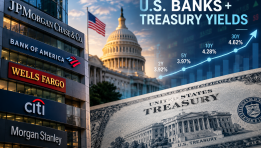
- The two-year/10-year Treasury yield spread reached its flattest level since March 2025, adding to concerns about the outlook for financial-sector earnings and market liquidity.

U.S. financial stocks came under renewed pressure on Tuesday as investors weighed the growing impact of artificial intelligence on financial services alongside a significant flattening of the Treasury yield curve. The weakness contrasted with strength in technology shares, underscoring an increasingly uneven market in which investors are reassessing which industries stand to benefit from AI-driven productivity and which could face disruption.
Financial Sector Bears the Brunt of the Selloff
The S&P 500 Financial index finished the session down 2%, while the benchmark bank index fell 3%. Money managers and brokerage firms were among the largest decliners, with Charles Schwab falling 6.1%, Ameriprise Financial losing 4.4% and Raymond James declining more than 3%.
The moves came as investors considered whether financial companies could face softer revenue conditions in addition to longer-term structural changes caused by AI. Earlier comments from senior banking executives had already pointed toward slower earnings and revenue growth compared with the previous quarter, adding to caution around the sector. Reuters also reported that major banks including JPMorgan Chase and Wells Fargo were down nearly 4% during Tuesday trading.
AI Creates Both Efficiency and Competitive Pressure
The AI issue is particularly relevant for financial companies because the technology can affect both costs and competitive dynamics. Automated research, financial analysis, customer service and portfolio-management functions could eventually reduce the need for some traditional processes, while firms capable of integrating AI effectively could potentially improve productivity.
However, investors are also considering the implications for companies exposed to the broader AI investment cycle. Uncertainty surrounding AI-related initial public offerings and the sustainability of elevated technology valuations can influence capital-market activity, trading volumes and investor sentiment. The contrast between technology stocks and financial shares therefore reflects more than a one-day sector rotation: it highlights differing expectations about where future growth and profitability may be concentrated.
Flattening Yield Curve Adds Pressure to the Outlook
The bond market provided another source of concern. The spread between two-year and 10-year Treasury yields reached its flattest level since March 2025, an important development for banks and other financial institutions because the shape of the yield curve influences lending economics, funding costs and expectations for future monetary policy.
A flatter curve does not automatically signal an economic downturn, but it can reduce the relative advantage financial institutions receive from borrowing at shorter maturities and lending or investing over longer periods. The development is particularly relevant following the Federal Reserve’s recent rate increase and continued signals that inflation remains a policy concern. Reuters reported that traders were assigning a 53.1% probability to another rate increase of at least 25 basis points in October.
Financial Stocks Face a More Complex Earnings Environment
The combination of AI disruption, uncertain capital-market activity and a flatter yield curve creates a more complicated earnings environment for banks, brokers and asset managers. While higher rates can support some forms of financial income, tighter financial conditions can also pressure loan demand, investment activity and market-sensitive businesses.
Investors will be watching upcoming financial-sector earnings for evidence of whether the weakness reflects temporary positioning or a broader reassessment of revenue expectations. The evolution of Treasury yields, the Federal Reserve’s policy path, AI adoption across financial services and activity in equity and debt markets will remain important indicators. For global investors, including those monitoring U.S. financial exposure from Israel, the divergence between technology leadership and financial-sector weakness offers an important signal about how markets are pricing the next stage of the U.S. economic and monetary cycle.
Comparison, examination, and analysis between investment houses
Leave your details, and an expert from our team will get back to you as soon as possible
* This article, in whole or in part, does not contain any promise of investment returns, nor does it constitute professional advice to make investments in any particular field.
To read more about the full disclaimer, click here
- sagi habasov
- •
- 7 Min Read
- •
- ago 9 minutes
SKN | Fed’s Barkin Says U.S. Economy Is Firming as Inflation Broadens Beyond Energy and Tariffs
Federal Reserve officials continue to face a difficult policy balance as resilient U.S. demand collides with inflation that remains
- ago 9 minutes
- •
- 7 Min Read
Federal Reserve officials continue to face a difficult policy balance as resilient U.S. demand collides with inflation that remains

- omer bar
- •
- 6 Min Read
- •
- ago 32 minutes
SKN | XLF Underperforms as a Flattening Yield Curve Signals Pressure on Financial Stocks
XLF Is Losing Relative Momentum The chart shows a clear deterioration in XLF's recent performance after a prolonged period of
- ago 32 minutes
- •
- 6 Min Read
XLF Is Losing Relative Momentum The chart shows a clear deterioration in XLF's recent performance after a prolonged period of

- orshu
- •
- 8 Min Read
- •
- ago 57 minutes
SKN | Treasury Cash Could Enter Repo Market as Participants Back More Efficient Liquidity Management
Market participants have given preliminary support to the idea of the U.S. Treasury periodically investing part of its cash
- ago 57 minutes
- •
- 8 Min Read

Market participants have given preliminary support to the idea of the U.S. Treasury periodically investing part of its cash
- sagi habasov
- •
- 6 Min Read
- •
- ago 3 hours
SKN | Could Fed Officials’ Inflation Warnings Keep Treasury Yields Near 5%?
Treasury Yields Hold Near Elevated Levels U.S. Treasury yields were broadly stable Tuesday as investors waited for additional commentary from
- ago 3 hours
- •
- 6 Min Read

Treasury Yields Hold Near Elevated Levels U.S. Treasury yields were broadly stable Tuesday as investors waited for additional commentary from

