




- Arik Arkadi Sluzki
- •
- 8 Min Read
- •
- 24 seconds ago


Key Points
- The AI Big 10 — the Magnificent Seven plus Broadcom, AMD and Micron — have reached roughly 41% of U.S. stock-market capitalization, according to data from BofA Global Investment Strategy, GFD Finaeon and Bloomberg.
- The current concentration is comparable with peaks associated with historical market themes, including the 41% concentration of TMT stocks during the dot-com era and the 44% share reached by Japan in the historical comparison.
- The concentration highlights a central market question: whether AI earnings, investment and productivity growth can continue expanding rapidly enough to support the dominant position of AI-linked companies.
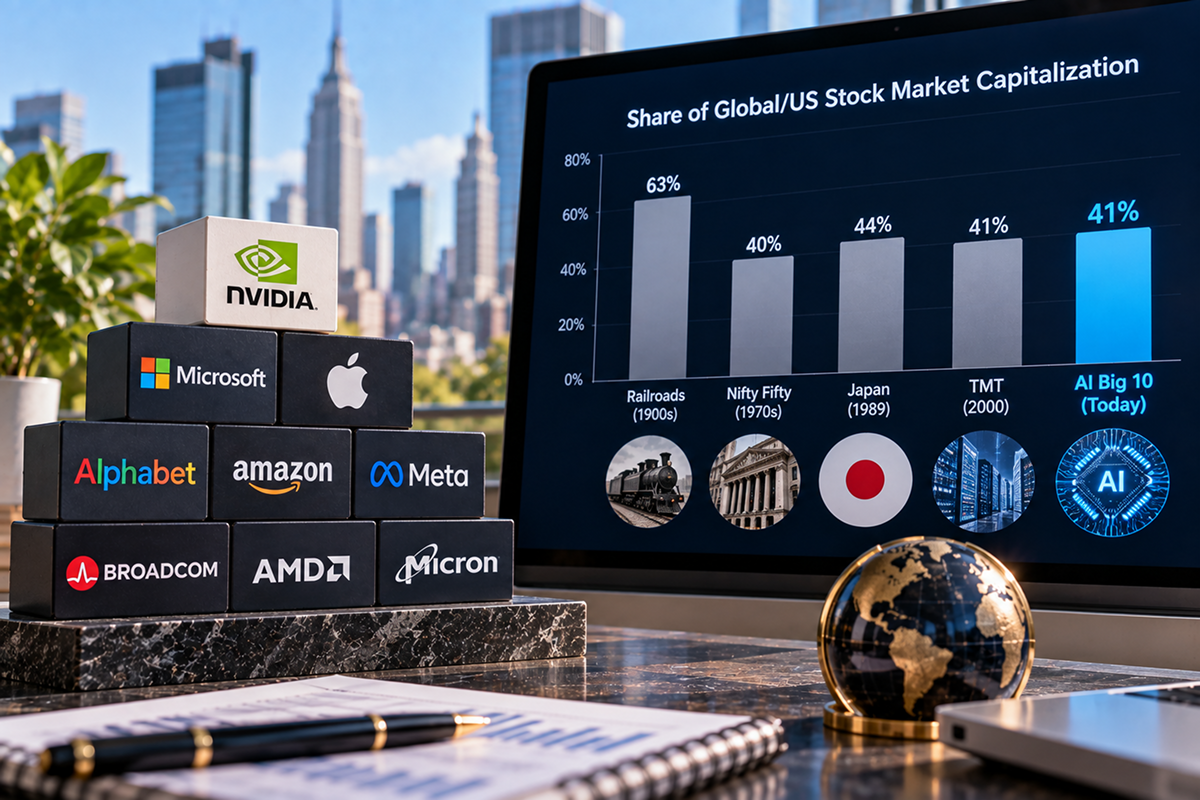
The U.S. equity market is entering a period in which a relatively small group of AI-linked companies accounts for an unusually large share of total market capitalization. According to the Bloomberg and BofA-sourced data shown in the attached chart, the AI Big 10 has reached approximately 41% of U.S. stock-market capitalization, placing today’s concentration within the range observed during several major historical market episodes.
AI Concentration Has Reached a Historically Significant Level
The AI Big 10 consists of the Magnificent Seven plus Broadcom, AMD and Micron. The combined group has expanded its influence as investors have assigned higher valuations to companies positioned across the semiconductor, cloud-computing, software and AI infrastructure ecosystem. The attached BofA chart compares this concentration with earlier market episodes and shows the AI group approaching the 40% threshold that has historically marked several periods of unusually narrow market leadership. The underlying source is identified as BofA Global Investment Strategy, GFD Finaeon and Bloomberg.
The comparison is notable because the historical episodes were driven by very different economic narratives. Railroads reached approximately 63% of U.S. market capitalization in the historical series, the Nifty Fifty reached about 40%, Japan represented approximately 44% of global equity capitalization at its peak, and the TMT group associated with the dot-com period reached approximately 41%. The chart therefore illustrates the scale of concentration rather than establishing that the current AI market is identical to any previous bubble.
The AI Economy Is Real, but Market Concentration Creates a Separate Risk
The comparison with previous cycles does not by itself demonstrate that AI valuations are unsustainable. AI investment has already produced substantial revenue growth for semiconductor manufacturers, cloud providers and technology platforms, while companies continue to commit significant capital to data centers and computing infrastructure. Bank of America itself has said that AI investment remained an important driver of economic growth and that it expected AI investment to continue expanding in 2026, while distinguishing that view from the question of whether market valuations have become excessive.
What the concentration data does demonstrate is market sensitivity to a small number of companies. When these companies rise, their large market weights can disproportionately support major U.S. indexes. Conversely, a broad reassessment of AI earnings expectations, capital expenditure or valuation multiples could have an outsized effect on index performance because of the same concentration.
This dynamic has already become visible in individual technology names. AMD, for example, crossed the $1 trillion market-capitalization threshold in September 2026 as investor expectations around its role in AI computing strengthened. Reuters reported that AMD’s shares had risen sharply during 2026 as the company expanded its position in AI systems and data-center computing.
Earnings and Capital Spending Will Test the AI Leadership
The next stage of the AI market will depend increasingly on whether enormous corporate spending translates into durable financial returns. Hyperscalers and semiconductor companies are investing heavily in computing capacity, while investors are increasingly examining revenue growth, operating margins, free cash flow and the return generated from AI infrastructure spending.
This creates a distinction between technological adoption and equity valuation. AI can continue to transform corporate productivity and consumer services even if individual AI stocks experience periods of weaker performance. Similarly, a company can report strong operational growth while its shares become more sensitive to expectations if its market capitalization has already incorporated substantial future expansion.
For investors in Israel and global markets, the concentration also has implications for portfolio construction and international market exposure. U.S. equity indexes are widely used as benchmarks by global institutions, pension funds and investment products, meaning that exposure to the AI leaders can become significant even when investors are not making an explicit thematic allocation to artificial intelligence.
Going forward, the most important indicators will be AI-related revenue growth, hyperscaler capital expenditure, semiconductor demand, free-cash-flow generation and valuation multiples. The historical comparisons in the BofA chart do not establish what happens next, but they highlight how unusual today’s concentration has become. Whether the current leadership broadens, remains concentrated or eventually reverses will depend increasingly on the ability of AI-linked companies to convert extraordinary investment and technological momentum into sustained earnings and cash-flow growth.
Comparison, examination, and analysis between investment houses
Leave your details, and an expert from our team will get back to you as soon as possible
* This article, in whole or in part, does not contain any promise of investment returns, nor does it constitute professional advice to make investments in any particular field.
To read more about the full disclaimer, click here
- omer bar
- •
- 8 Min Read
- •
- ago 28 minutes
SKN | AI Stocks Have Left Global Equities Behind: What Is Driving the Widening Market Gap?
Artificial intelligence has become one of the defining forces in global equity markets, with AI-linked companies substantially outperforming broader
- ago 28 minutes
- •
- 8 Min Read

Artificial intelligence has become one of the defining forces in global equity markets, with AI-linked companies substantially outperforming broader

- Ronny Mor
- •
- 8 Min Read
- •
- ago 1 hour
SKN | Nvidia’s AI Ecosystem Investment Could Exceed $100 Billion: How Deep Is Jensen Huang’s Strategic Bet?
Nvidia is increasingly using its balance sheet to deepen its position across the artificial intelligence supply chain, with CEO
- ago 1 hour
- •
- 8 Min Read
Nvidia is increasingly using its balance sheet to deepen its position across the artificial intelligence supply chain, with CEO

- sagi habasov
- •
- 8 Min Read
- •
- ago 2 hours
SKN | U.S. Tech Valuations Hit Dot-Com Era Levels Relative to Defensive Stocks: How Wide Can the Gap Become?
U.S. equity markets are entering a period in which the valuation difference between technology-oriented companies and traditionally defensive sectors
- ago 2 hours
- •
- 8 Min Read

U.S. equity markets are entering a period in which the valuation difference between technology-oriented companies and traditionally defensive sectors

- Ramil
- •
- 8 Min Read
- •
- ago 18 hours
SKN | AI’s $10.3 Trillion Buildout Faces a New Challenge: Financing, Power and Data Center Risk
The scale of the U.S. artificial intelligence infrastructure buildout is reaching a level that could reshape capital markets, energy
- ago 18 hours
- •
- 8 Min Read

The scale of the U.S. artificial intelligence infrastructure buildout is reaching a level that could reshape capital markets, energy
