





- orshu
- •
- 6 Min Read
- •
- 2 hours ago


Key Points
- The TA Banks 5 index rose 5.13% over the week to 8,908.43, extending its one-year gain to approximately 23.18%.
- The index remains close to its 52-week high of 9,632.01, although the latest advance has not eliminated the risk of a near-term pullback.
- Interest-rate expectations, credit quality, domestic economic conditions and geopolitical risks will remain important drivers of Israeli bank shares.
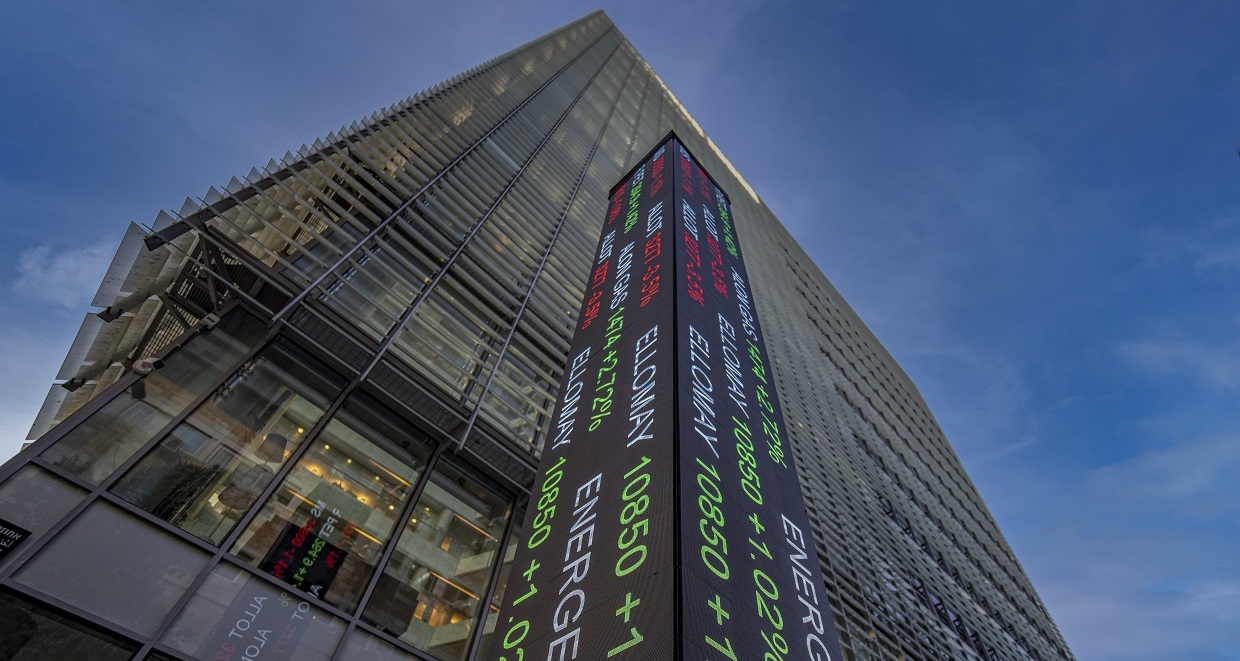
The TA Banks 5 index recorded a strong weekly advance, rising 5.13% to 8,908.43, according to the supplied market data. The gain reinforces the banking sector’s position as a significant contributor to the Israeli equity market, while placing renewed attention on the relationship between bank profitability, interest-rate expectations and the broader economic outlook.
Weekly Momentum Strengthens the Sector’s Performance
The index gained 68.86 points, or 0.78%, in the latest session shown, closing at 8,908.43 compared with a previous close of 8,839.57. The weekly increase of 5.13% was accompanied by a reported trading volume of approximately 5.2 million units. Despite the positive momentum, volume remained below the three-month average of approximately 9.37 million, suggesting that the advance should be assessed alongside participation and liquidity rather than price performance alone.
The broader performance figures also indicate substantial longer-term appreciation. The index gained 6.28% over three months and 23.18% over one year, while its five-year increase reached approximately 195.16%. These returns highlight the banking sector’s strong historical performance, but they do not establish that the same pace can continue. After an extended advance, expectations for earnings, credit conditions and future interest rates may become increasingly important to the sustainability of valuations.
Interest Rates and Credit Quality Remain Central
Israeli bank earnings are influenced by the spread between lending and deposit costs, loan demand, capital-market activity and borrowers’ ability to service debt. Interest-rate changes can affect net interest income in different ways, depending on how quickly loan and deposit pricing adjusts. A lower-rate environment could support households and businesses by easing financing costs, but it may also put pressure on lending margins if deposit costs and asset yields adjust unevenly.
Credit quality is another important consideration. Slower economic activity, elevated financing costs or renewed geopolitical disruption could increase repayment pressure on businesses and households. Banks may then need to allocate more resources to provisions for potential loan losses, reducing the benefit of otherwise resilient operating income. The supplied chart does not provide earnings or credit-quality data, so the index’s price increase alone cannot establish whether fundamentals have improved at the same rate.
Outlook: Can the Rally Sustain Its Momentum?
The index’s 52-week range of 7,108.13 to 9,632.01 places the latest close toward the upper portion of its annual trading range. This reflects strong momentum but also leaves the sector exposed to changes in investor expectations. A sustained move higher would likely require continued confidence in bank earnings, manageable credit losses and a relatively stable domestic economic environment. Conversely, disappointing financial results, shifts in interest-rate expectations, shekel volatility or a renewed geopolitical risk premium could prompt profit-taking and sharper price fluctuations.
For the coming week, investors will be watching bank earnings guidance, credit-loss provisions, monetary-policy signals and developments affecting Israel’s economic outlook. The sector’s recent performance provides a constructive starting point, but its durability will depend on whether earnings and balance-sheet resilience can justify current market expectations.
Comparison, examination, and analysis between investment houses
Leave your details, and an expert from our team will get back to you as soon as possible
* This article, in whole or in part, does not contain any promise of investment returns, nor does it constitute professional advice to make investments in any particular field.
To read more about the full disclaimer, click here
- sagi habasov
- •
- 6 Min Read
- •
- ago 2 hours
SKN | TA-RealEstate Rallies 8.95% in a Week, but Longer-Term Weakness Keeps Israeli Property Stocks Under Pressure
The TA-RealEstate Index recorded a strong weekly recovery, rising 8.95% to 1,382.39, with the latest session adding 34.86 points,
- ago 2 hours
- •
- 6 Min Read

The TA-RealEstate Index recorded a strong weekly recovery, rising 8.95% to 1,382.39, with the latest session adding 34.86 points,

- Ronny Mor
- •
- 6 Min Read
- •
- ago 2 hours
SKN | TA-SME60 Rallies 5.25% in a Week, but Small-Cap Stocks Still Face a Valuation Test
The TA-SME60 index recorded a strong weekly recovery, rising 5.25% to 1,282.90, including a 1.71% gain in the latest session.
- ago 2 hours
- •
- 6 Min Read

The TA-SME60 index recorded a strong weekly recovery, rising 5.25% to 1,282.90, including a 1.71% gain in the latest session.

- omer bar
- •
- 7 Min Read
- •
- ago 3 hours
SKN | KOSPI Composite Index (^KS11) Advances 2.05% Daily to 5,668.05 as 11.22% Weekly Pullback Holds Above 3,728 Support
The KOSPI Composite Index (^KS11) finished the trading session on October 16, 2026, higher, advancing 2.05% (113.83 points) to
- ago 3 hours
- •
- 7 Min Read

The KOSPI Composite Index (^KS11) finished the trading session on October 16, 2026, higher, advancing 2.05% (113.83 points) to

- Lior mor
- •
- 6 Min Read
- •
- ago 4 hours
SKN | Japanese Yen Currency Index (^XDN) Softens 0.04% Daily to 63.28 as 0.18% Weekly Gain Holds Above 60.98 Support
The Japanese Yen Currency Index (^XDN) finished the trading session on October 16, 2026, slightly lower, dropping 0.04% (0.02
- ago 4 hours
- •
- 6 Min Read

The Japanese Yen Currency Index (^XDN) finished the trading session on October 16, 2026, slightly lower, dropping 0.04% (0.02

