





- Ronny Mor
- •
- 6 Min Read
- •
- 27 seconds ago


Key Points
- The Hang Seng Index rose 1.79% to 24,211.35 in the latest session, gaining 425.56 points after a sharp midweek sell-off.
- The five-day chart shows a steep decline on October 8 and a pronounced rebound on October 9, highlighting continued volatility and a rapid shift in market sentiment.
- The near-term outlook will depend on Chinese economic momentum, policy support, global interest-rate expectations, and investor appetite for Asian equities.
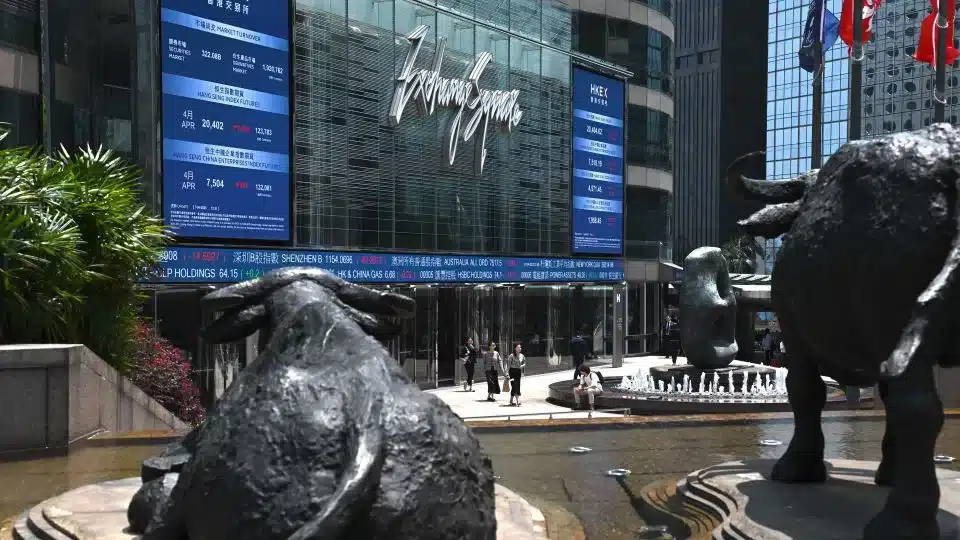
The Hang Seng Index staged a notable recovery during the week, finishing at 24,211.35 after a volatile period that included a sharp sell-off and a subsequent rebound. The latest session’s 1.79% gain suggests buyers returned following the decline, although the rapid swings indicate that confidence in Hong Kong equities remains sensitive to changing economic expectations and global risk appetite.
Sharp Midweek Decline Followed by a Strong Recovery
The five-day chart shows the index initially trading around the 24,200–24,300 area before weakening, with selling pressure intensifying on October 8. The index briefly fell toward the 23,700–23,800 region on October 9 before reversing higher and recovering much of the lost ground. The latest close of 24,211.35 compares with the previous close of 23,785.80, representing a daily advance of 425.56 points.
This pattern suggests that demand emerged after the sell-off, but it does not establish that the broader market has entered a sustained recovery. Sharp reversals can reflect bargain-hunting, short covering, or changes in expectations, and the available chart alone cannot identify which factors dominated trading. The week’s price action therefore points to improving short-term momentum alongside persistent uncertainty.
China’s Economic Outlook Remains Central to Market Direction
Hong Kong equities are closely linked to expectations for mainland China’s economy, corporate earnings, consumer demand, and policy support. Measures that improve confidence in domestic spending, property-sector stability, or private-sector investment could help support valuations. Conversely, weaker economic indicators or disappointing company guidance could limit the durability of the rebound, particularly if investors had already priced in a stronger recovery.
Global conditions also matter. Interest-rate expectations in the United States influence international capital flows and the relative attractiveness of Asian equities, while changes in the US dollar can affect regional financial conditions. For Israeli investors with exposure to Hong Kong through international funds or exchange-traded funds, currency movements and differences between local-market returns and fund-level returns remain important considerations.
Volatility Keeps the Near-Term Outlook Uncertain
The index’s reported 52-week range of 22,518.00 to 28,056.10 places the latest close within a broad trading band, underscoring the distance between current levels and the year’s high. The rebound is constructive in the short term, but the chart does not provide enough evidence to confirm a lasting change in trend. The supplied data also reports zero volume for the latest session, so volume-based confirmation of the recovery cannot be assessed from this snapshot.
Looking ahead, investors will monitor whether the Hang Seng Index can hold its recovery and build on the latest gains, alongside upcoming Chinese economic data, corporate earnings, policy announcements, and shifts in global bond yields. A sustained advance could indicate improving risk appetite, while renewed selling would suggest that uncertainty remains unresolved. For global and Israeli asset allocators, the key question is whether the rebound is supported by stronger fundamentals or primarily reflects a short-term reaction to the week’s losses.
Comparison, examination, and analysis between investment houses
Leave your details, and an expert from our team will get back to you as soon as possible
* This article, in whole or in part, does not contain any promise of investment returns, nor does it constitute professional advice to make investments in any particular field.
To read more about the full disclaimer, click here
- omer bar
- •
- 6 Min Read
- •
- ago 26 minutes
SKN | Euro Currency Index Slips 0.46% Over Five Days as Sharp Midweek Decline Keeps Currency Momentum in Check
The Euro Currency Index ended the latest session at 112.02, down 0.08 points, or 0.07%, while the five-day chart
- ago 26 minutes
- •
- 6 Min Read

The Euro Currency Index ended the latest session at 112.02, down 0.08 points, or 0.07%, while the five-day chart

- Arik Arkadi Sluzki
- •
- 6 Min Read
- •
- ago 57 minutes
SKN | British Pound Currency Index Holds Near 132.33 as Weekly Trading Reveals Limited Momentum
The British Pound Currency Index (^XDB) ended the latest session at 132.33, up 0.03 points, or 0.02%, from the
- ago 57 minutes
- •
- 6 Min Read

The British Pound Currency Index (^XDB) ended the latest session at 132.33, up 0.03 points, or 0.02%, from the

- Lior mor
- •
- 6 Min Read
- •
- ago 1 hour
SKN | Euronext 100 Rebounds 0.53% on Friday, but Weekly Losses Signal Persistent Pressure on European Equities
The Euronext 100 Index (^N100) ended the latest session at 1,859.81, advancing 9.82 points, or 0.53%, according to the
- ago 1 hour
- •
- 6 Min Read
The Euronext 100 Index (^N100) ended the latest session at 1,859.81, advancing 9.82 points, or 0.53%, according to the

- sagi habasov
- •
- 7 Min Read
- •
- ago 2 hours
SKN | CAC 40 (^FCHI) Advances 0.95% Daily to 7,803.33 as 1.19% Weekly Pullback Holds Above 7,505 Support
The CAC 40 Index (^FCHI) finished the trading session higher, advancing 0.95% (73.64 points) to settle near 7,803.33 Euros.
- ago 2 hours
- •
- 7 Min Read

The CAC 40 Index (^FCHI) finished the trading session higher, advancing 0.95% (73.64 points) to settle near 7,803.33 Euros.

