




- Lior mor
- •
- 8 Min Read
- •
- 11 seconds ago


Key Points
- Long-term government bond yields across major economies have climbed sharply, with the 10-year U.S. Treasury yield moving above 5.2% and the UK 10-year gilt reaching 5.36%, according to the Bloomberg-sourced data in the attached report.
- Japan's 10-year government bond yield has approached 3%, while French 10-year OAT yields have risen above 4%, highlighting a broad repricing across developed sovereign debt markets.
- The synchronized rise in yields could have implications for borrowing costs, currencies, equity valuations, government financing and global capital allocation.
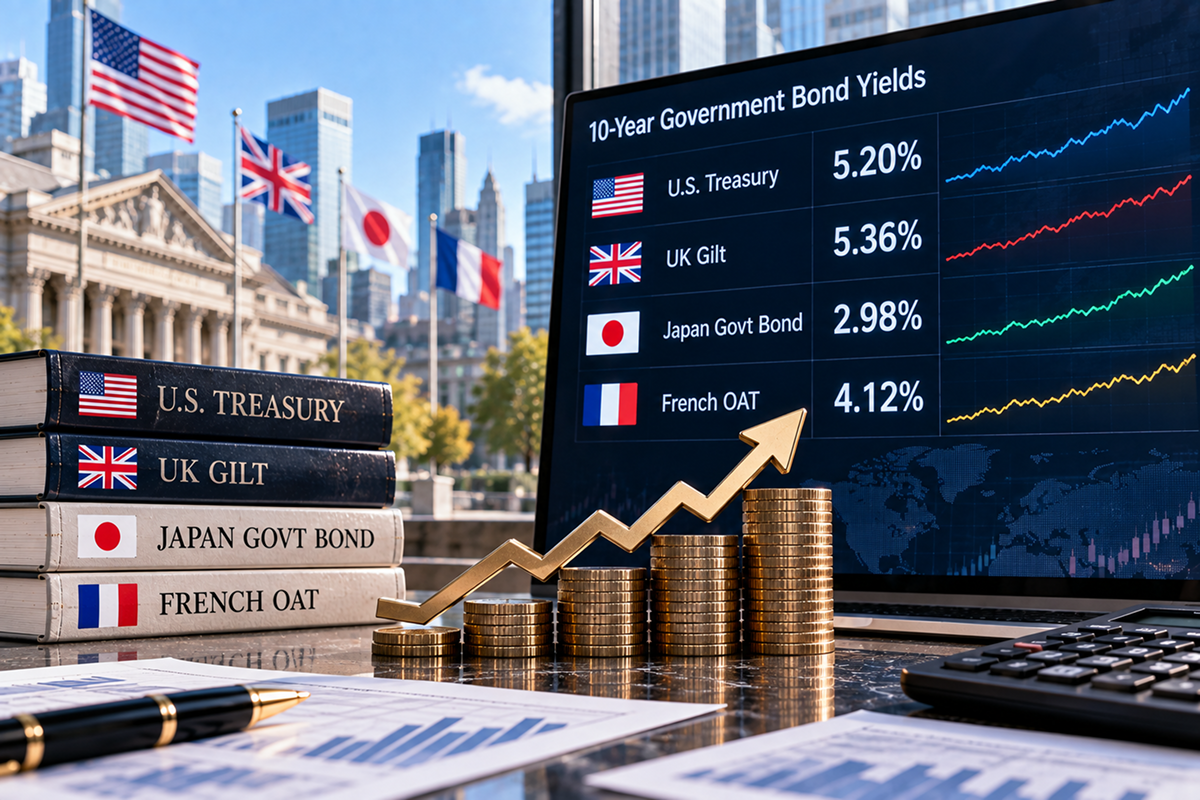
Global bond markets are undergoing a significant repricing as long-term government yields across major economies move toward levels not seen in decades. The latest Bloomberg data shows the increase extending from the United States and United Kingdom to Japan and France, raising questions over whether financial markets are entering a structurally different interest-rate regime after years of exceptionally low borrowing costs.
Long-Term Yields Are Rising Across Major Economies
The scale of the move is notable because it is occurring across several of the world’s largest government bond markets simultaneously. The 10-year U.S. Treasury yield has moved above 5.2%, according to the attached Bloomberg-sourced data, while the comparable UK gilt yield has reached approximately 5.36%, its highest level since 2007 based on the source. French 10-year OAT yields have also moved above 4%, while Japan’s 10-year government bond yield has climbed toward 3%.
Such movements matter because long-term government bonds serve as important reference rates for global financial markets. When sovereign yields rise, the increase can feed into corporate borrowing costs, mortgages and other forms of credit, while also changing the relative attractiveness of assets such as equities and corporate bonds. Bloomberg has previously highlighted how rising long-term sovereign yields can influence demand for both government debt and equities as investors reassess the return available from relatively lower-risk fixed-income assets.
Japan Represents an Important Shift in Global Bond Markets
The Japanese bond market is particularly important in assessing the broader move. Japan spent decades operating with extremely low interest rates and subdued government bond yields, making Japanese institutions significant participants in global fixed-income markets. A 10-year yield approaching 3% represents a substantial change from the environment that dominated international markets for much of the post-financial-crisis period.
The shift is also occurring alongside a more restrictive monetary-policy environment. The Bank of Japan raised its policy rate to 1.25% in September 2026 and signaled openness to further tightening as inflation remained persistent. That policy transition can affect Japanese investor demand for overseas bonds, including U.S. Treasuries and European sovereign debt, potentially contributing to changes in global capital flows.
Higher Yields Create Pressure Beyond the Bond Market
The implications extend well beyond fixed income. Higher long-term yields increase the discount rate used to value future corporate cash flows, which can place pressure on equity valuations, particularly for companies whose expected earnings are concentrated further into the future. At the same time, higher government borrowing costs can increase the fiscal burden for countries carrying large amounts of public debt.
The European market presents an additional dimension. France’s rise in 10-year borrowing costs comes against a backdrop of fiscal and political uncertainty, while the UK continues to face the combination of elevated inflation sensitivity and substantial government financing requirements. Rising yields therefore reflect not only expectations for monetary policy but also investor assessments of inflation, fiscal sustainability, economic growth and sovereign debt supply.
For investors in Israel and global markets, the development is particularly relevant because Israeli financial conditions are influenced by global interest rates, currency movements and international risk premiums. A sustained increase in U.S. and European sovereign yields can affect the relative pricing of Israeli government bonds, corporate credit and equities, while shifts in global capital flows can also influence the shekel and demand for local assets.
Looking ahead, the key question is whether the latest rise in long-term yields represents a temporary adjustment or the beginning of a more durable change in global fixed-income markets. Investors will be watching inflation data, central-bank policy, government borrowing requirements, bond auctions and economic growth closely. If yields remain elevated, the effects could gradually extend across credit markets, currencies and equity valuations, making the long end of the global bond market an increasingly important indicator of broader financial conditions.
Comparison, examination, and analysis between investment houses
Leave your details, and an expert from our team will get back to you as soon as possible
* This article, in whole or in part, does not contain any promise of investment returns, nor does it constitute professional advice to make investments in any particular field.
To read more about the full disclaimer, click here
- sagi habasov
- •
- 7 Min Read
- •
- ago 18 hours
SKN | Vanguard Economist Says Fed Rate Above 5% Could Begin to Pressure Markets
Federal Reserve policy has moved back toward the center of global market attention as inflation remains elevated and Treasury
- ago 18 hours
- •
- 7 Min Read

Federal Reserve policy has moved back toward the center of global market attention as inflation remains elevated and Treasury
- sagi habasov
- •
- 8 Min Read
- •
- ago 20 hours
SKN | U.S. and China Reach Tariff Consensus on $30 Billion in Goods: Could Trade Tensions Enter a New Phase?
The United States and China have reached a new trade understanding covering approximately $30 billion of non-sensitive goods in
- ago 20 hours
- •
- 8 Min Read

The United States and China have reached a new trade understanding covering approximately $30 billion of non-sensitive goods in

- Arik Arkadi Sluzki
- •
- 7 Min Read
- •
- ago 23 hours
SKN | Falling Oil Prices Offer Relief to Bond Markets After Treasury Yields Hit Multi-Decade Highs
US Treasury yields stabilized on Friday after reaching multi-decade highs earlier in the session, with falling oil prices providing
- ago 23 hours
- •
- 7 Min Read

US Treasury yields stabilized on Friday after reaching multi-decade highs earlier in the session, with falling oil prices providing

- omer bar
- •
- 8 Min Read
- •
- ago 1 day
SKN | Data Center IPO Candidates Face Tougher Market as Investors Demand Clearer AI Economics
Data center companies seeking public listings are entering a more demanding US IPO market as investors reassess the economics
- ago 1 day
- •
- 8 Min Read

Data center companies seeking public listings are entering a more demanding US IPO market as investors reassess the economics
