





- orshu
- •
- 6 Min Read
- •
- 2 hours ago
Key Points
- AMD's MI355X reportedly delivers a lower cost per token than Nvidia's B200 across much of the practical AI inference performance range, according to the benchmark shown.
- The comparison suggests Nvidia maintains an advantage at the highest levels of throughput, while AMD appears increasingly competitive in mainstream enterprise workloads.
- Growing software optimization efforts and collaborations with OpenAI and Anthropic could strengthen AMD's position in the rapidly expanding AI infrastructure market.
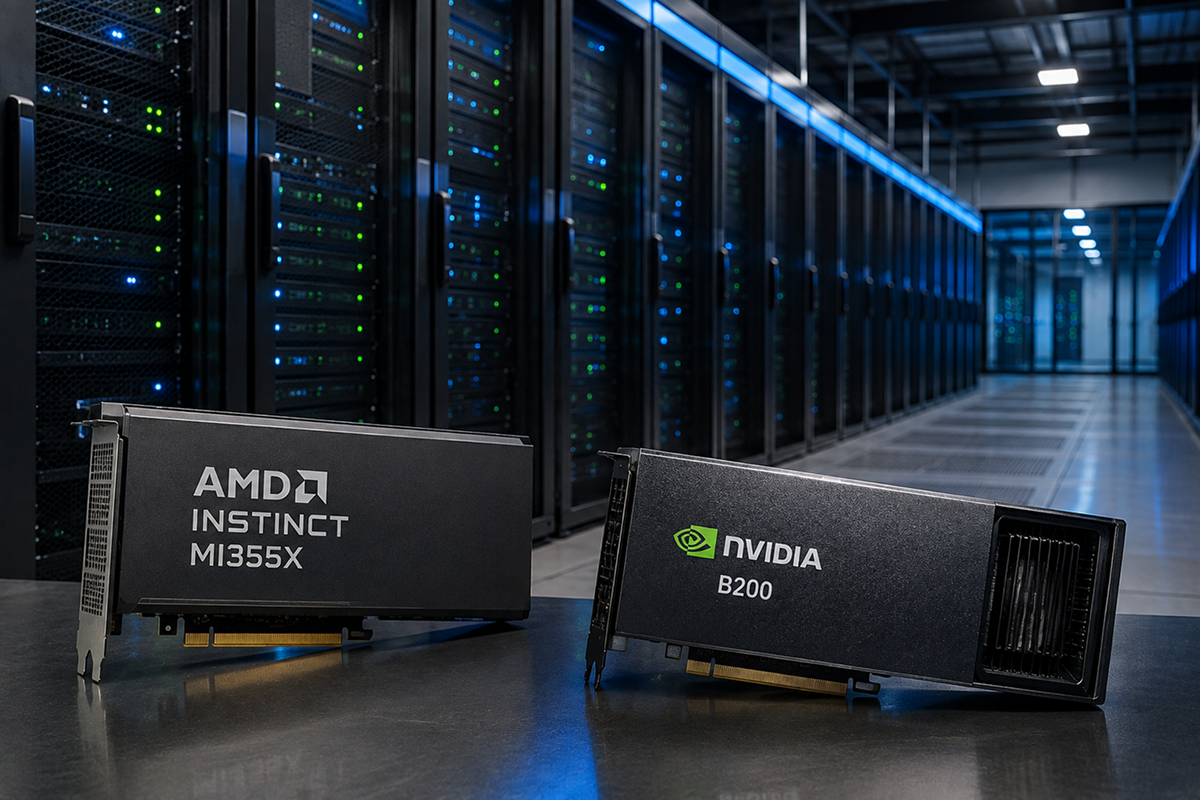
The race to dominate artificial intelligence infrastructure is expanding beyond raw chip performance to include deployment efficiency and operating costs. According to the benchmark and commentary shown above, AMD’s MI355X accelerator demonstrates lower inference costs than Nvidia’s B200 across much of the practical performance range, highlighting how competition in AI hardware is increasingly shifting toward real-world economics rather than peak benchmark results alone.
As hyperscale cloud providers continue investing billions of dollars in AI infrastructure, improvements in cost per token have become an increasingly important metric for enterprise customers seeking to optimize large language model deployments.
Inference Economics Become a Key Competitive Battleground
The chart compares the cost per million tokens against inference interactivity for AMD’s MI355X and Nvidia’s B200. Based on the benchmark presented, AMD appears to provide lower operating costs across much of the performance spectrum that enterprises are likely to utilize in production environments. Nvidia’s B200 continues to demonstrate an advantage at the highest throughput levels, but that performance may exceed the requirements of many commercial AI workloads.
As AI inference becomes a larger portion of enterprise spending, organizations are increasingly evaluating hardware based not only on speed but also on total cost of ownership, including power consumption, utilization rates, and infrastructure efficiency.
Software Ecosystems Continue to Shape Market Leadership
While hardware capabilities remain critical, software has become an equally important competitive differentiator. The commentary accompanying the benchmark argues that AMD has significantly narrowed the gap through continued improvements to its software stack and networking capabilities, areas where Nvidia has historically maintained a substantial competitive advantage through its mature CUDA ecosystem.
The report also notes that OpenAI and Anthropic are collaborating with AMD on open-source optimization initiatives. Although the long-term commercial impact remains uncertain, broader software compatibility could improve enterprise adoption and reduce barriers for customers evaluating alternatives to Nvidia’s ecosystem.
Implications for the AI Infrastructure Market
The AI semiconductor industry remains one of the fastest-growing segments of the technology sector, with cloud providers and enterprise customers continuing to increase spending on AI infrastructure. As capital expenditures rise, purchasing decisions are expected to become increasingly influenced by operating efficiency rather than hardware specifications alone.
For Israeli investors and technology companies participating in the global AI ecosystem, stronger competition among chip manufacturers could improve hardware availability, encourage pricing competition, and accelerate innovation across AI infrastructure deployments. However, it is important to note that the performance comparisons shown originate from third-party analysis and should not be viewed as definitive across every workload or deployment environment.
Looking ahead, investors will closely monitor independent benchmarking results, software ecosystem maturity, hyperscaler purchasing decisions, and future product launches from both AMD and Nvidia. The next phase of AI competition is likely to be determined not only by processing power but also by which platforms deliver the strongest combination of performance, efficiency, scalability, and total operating cost.
Comparison, examination, and analysis between investment houses
Leave your details, and an expert from our team will get back to you as soon as possible
* This article, in whole or in part, does not contain any promise of investment returns, nor does it constitute professional advice to make investments in any particular field.
To read more about the full disclaimer, click here
- Ronny Mor
- •
- 6 Min Read
- •
- ago 48 minutes
SKN | SpaceX Faces Critical First Public Earnings Test as Investors Look for Improving Profitability
Space Exploration Technologies Corp. (SpaceX) is preparing to release its second-quarter 2026 earnings, a closely watched event that represents
- ago 48 minutes
- •
- 6 Min Read

Space Exploration Technologies Corp. (SpaceX) is preparing to release its second-quarter 2026 earnings, a closely watched event that represents

- orshu
- •
- 6 Min Read
- •
- ago 14 hours
SKN | Robinhood’s Prediction Markets Become a Major Growth Engine as Q2 Revenue Overtakes Crypto Trading
Robinhood Markets continues to expand beyond its origins as a commission-free stock brokerage, with prediction markets emerging as one
- ago 14 hours
- •
- 6 Min Read

Robinhood Markets continues to expand beyond its origins as a commission-free stock brokerage, with prediction markets emerging as one

- Arik Arkadi Sluzki
- •
- 5 Min Read
- •
- ago 15 hours
SKN | Can Ondas Holdings Close the Gap Between Its Market Price and Analyst Expectations?
Ondas Holdings has emerged as one of several small-cap technology companies attracting investor attention due to the widening gap
- ago 15 hours
- •
- 5 Min Read
Ondas Holdings has emerged as one of several small-cap technology companies attracting investor attention due to the widening gap

- Lior mor
- •
- 6 Min Read
- •
- ago 16 hours
SKN | Has Netflix Become a High-Quality Business the Market Has Left Behind?
Netflix has re-emerged as a focal point in discussions about valuation after data highlighted a significant divergence between the
- ago 16 hours
- •
- 6 Min Read

Netflix has re-emerged as a focal point in discussions about valuation after data highlighted a significant divergence between the


