




- Ronny Mor
- •
- 9 Min Read
- •
- 35 seconds ago


Key Points
- Oracle's five-year credit default swap (CDS) spread reportedly reached a record 261 basis points, while Broadcom's rose to 136 basis points, reflecting increased demand for protection against potential credit losses.
- Oracle's CDS pricing has been associated with an implied five-year default probability of approximately 20.4% under the assumptions used in the source's calculation. This is a market-based estimate, not a prediction that the company will default.
- The widening spreads highlight growing scrutiny of the financing costs, debt levels and expected returns associated with large-scale artificial intelligence infrastructure investment.
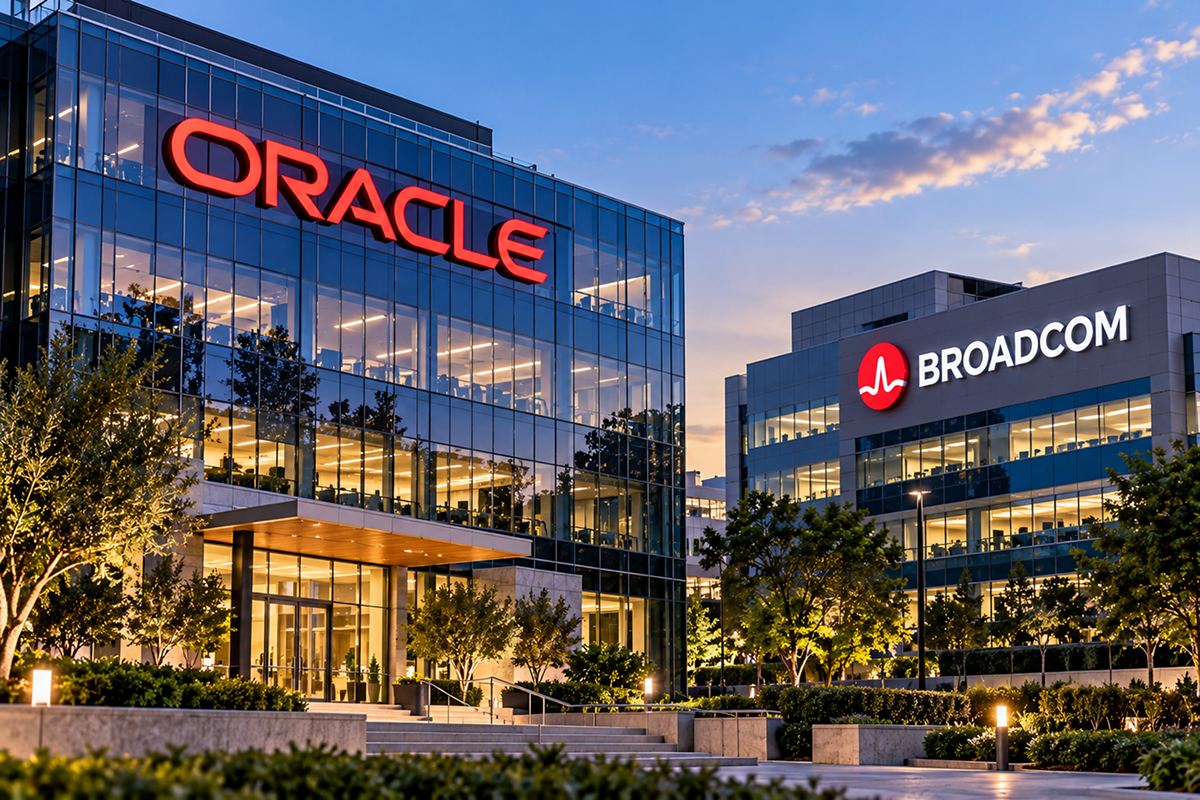
Credit markets are sending a more cautious signal about the cost of financing the artificial intelligence boom, with Oracle and Broadcom experiencing sharp increases in the price of insuring against potential debt defaults. The reported records in their five-year credit default swap spreads suggest that investors are demanding greater compensation for credit exposure as AI infrastructure spending, borrowing requirements and uncertainty over future returns attract increased attention.
Oracle’s CDS Spread Reaches a Record High
According to the attached report, Oracle’s five-year CDS spread climbed to 261 basis points, meaning the annual premium for protection is equivalent to approximately 2.61% of the insured notional amount. Broadcom’s five-year spread reached 136 basis points, or 1.36% annually. These levels indicate a substantial repricing of credit risk, although CDS spreads can also reflect liquidity, hedging demand and broader market conditions.
A credit default swap is a financial contract that provides protection against specified credit events involving a borrower. The buyer pays a premium to the seller, who agrees to compensate the buyer if a covered event occurs under the contract’s terms. When the spread widens, the cost of obtaining that protection increases, generally signaling that the market perceives greater credit risk or is demanding more compensation to bear it.
The source also cites an implied five-year default probability of approximately 20.4% for Oracle. Such estimates depend on the methodology used, including assumptions about recovery rates and the conversion of CDS spreads into default probabilities. They are not equivalent to an objectively measured probability of default, and they do not mean that a default is expected to occur.
AI Infrastructure Spending Raises Financing Questions
The widening spreads come as technology companies commit substantial capital to data centers, cloud infrastructure, advanced semiconductors and AI computing capacity. These projects can require large upfront investments before the resulting services generate sufficient cash flow to cover construction costs, operating expenses and financing obligations.
Oracle has become a prominent focus of credit-market scrutiny because of its expanding role in cloud infrastructure and AI-related computing agreements. Investors are assessing whether future cloud revenue and demand for AI capacity will generate returns sufficient to support the scale of its investment and borrowing requirements. Broadcom, meanwhile, operates across semiconductor and infrastructure software markets and is exposed to the capital-spending cycle associated with AI systems and data-center expansion.
The concern is not simply whether demand for AI will continue to grow. It is whether the economic benefits will accrue quickly enough, and at sufficient margins, to justify the cost of building the required infrastructure. If revenues and cash flows fall short of expectations, companies may face pressure to refinance debt, reduce discretionary spending or delay projects. Conversely, strong utilization, recurring customer commitments and improved operating cash flow could help offset the financial burden.
What Rising Credit Spreads Mean for the Technology Sector
Rising CDS spreads can affect a company’s financing environment even before any payment difficulties emerge. Wider spreads may be accompanied by higher yields on newly issued corporate bonds, more expensive credit protection and greater scrutiny from lenders and rating agencies. If the repricing persists, companies that rely heavily on external financing may find that future expansion becomes more expensive.
The implications also extend to the broader AI investment cycle. Data-center development depends on a network of technology providers, semiconductor suppliers, energy companies, lenders and infrastructure operators. A sustained increase in financing costs could influence the timing and scale of projects across this ecosystem. However, higher CDS spreads do not establish that AI demand is weakening, nor do they demonstrate that all technology companies face the same credit pressures.
For investors, the distinction between equity risk and credit risk is important. Equity valuations depend heavily on expected growth and future earnings, while credit markets place greater emphasis on a company’s ability to meet its contractual obligations. The divergence between these perspectives can provide useful information about how investors are assessing the financial sustainability of the AI expansion.
Looking ahead, the key indicators will be Oracle’s and Broadcom’s borrowing costs, debt issuance, cash-flow generation, credit ratings and evidence that AI-related investments are translating into durable revenue. Investors will also monitor whether CDS spreads stabilize or widen further across other major technology borrowers. If cash flows keep pace with investment, current credit concerns may ease; if borrowing expands faster than operating performance, financing pressure could intensify. The central question is whether the AI infrastructure boom can deliver sufficient economic returns to support the debt used to finance it.
Comparison, examination, and analysis between investment houses
Leave your details, and an expert from our team will get back to you as soon as possible
* This article, in whole or in part, does not contain any promise of investment returns, nor does it constitute professional advice to make investments in any particular field.
To read more about the full disclaimer, click here
- orshu
- •
- 8 Min Read
- •
- ago 19 hours
SKN | From a $1.65 Billion Acquisition to a Digital Advertising Powerhouse: How YouTube Transformed Google’s Business
Google's acquisition of YouTube in October 2006 stands as a defining transaction in the evolution of digital media, transforming
- ago 19 hours
- •
- 8 Min Read

Google's acquisition of YouTube in October 2006 stands as a defining transaction in the evolution of digital media, transforming

- omer bar
- •
- 6 Min Read
- •
- ago 20 hours
SKN | Telecom Stocks Slide as SpaceX Spectrum Deal Raises New Competitive Threat
U.S. and European telecommunications stocks came under pressure on Friday after SpaceX’s acquisition of low-band spectrum intensified concerns that
- ago 20 hours
- •
- 6 Min Read

U.S. and European telecommunications stocks came under pressure on Friday after SpaceX’s acquisition of low-band spectrum intensified concerns that

- Ronny Mor
- •
- 6 Min Read
- •
- ago 20 hours
SKN | Nvidia Weighs Deeper Investment or Acquisition of Reflection AI as AI Competition Intensifies
Nvidia is exploring a deeper relationship with Reflection AI, including the possibility of acquiring the open-source artificial intelligence startup,
- ago 20 hours
- •
- 6 Min Read
Nvidia is exploring a deeper relationship with Reflection AI, including the possibility of acquiring the open-source artificial intelligence startup,

- sagi habasov
- •
- 6 Min Read
- •
- ago 20 hours
SKN | Venezuela Authorizes Starlink to Operate as SpaceX Expands Satellite Internet Reach
Venezuela has authorized Starlink, the satellite internet service operated by Elon Musk’s SpaceX, to begin operating in the country,
- ago 20 hours
- •
- 6 Min Read

Venezuela has authorized Starlink, the satellite internet service operated by Elon Musk’s SpaceX, to begin operating in the country,
