


- Arik Arkadi Sluzki
- •
- 7 Min Read
- •
- 9 seconds ago
Key Points
- The Japanese Yen Currency Index (^XDN) concluded the trading week at 62.81, registering a measured 5-day net contraction of 0.28% as it continues to operate near its 52-week historical lows.
- This persistent downward pressure likely reflects a strategic institutional consensus pricing in sustained sovereign yield differentials between the Bank of Japan (BoJ) and other major global central banks.
- For global and Israeli asset allocators, this price action necessitates a probability-based review of cross-border currency exposure, balancing the mechanics of global carry trades against the rising risk of sudden, policy-driven FX interventions.

The Japanese Yen Currency Index (^XDN) navigated a highly turbulent trading week, ultimately settling at 62.81 to record a marginal multi-day net decline of 0.28%. This persistent suppression within the global foreign exchange market highlights a complex macroeconomic environment where institutional capital actively weighs the BoJ’s highly accommodative monetary policy trajectory against the gravitational pull of elevated, restrictive interest rates abroad.
Deciphering Intraday Volatility and Technical Compression
Trading activity across the Yen benchmark was characterized by acute intraday fluctuations, illustrating a market actively probing for a structural floor. Chart data reveals a highly volatile sequence: after climbing toward the 63.00 threshold by May 20th, the index experienced a rapid, localized distribution phase that pushed valuations down to an intraday trough near 62.80 on May 21st. Closing the Friday session with a daily drop of 0.11 points (0.17%), the index remains compressed near the bottom boundary of its expansive 52-week range of 62.31 to 70.16. From a technical perspective, this erratic multi-day consolidation indicates that market participants may be probability-testing near-term support levels, remaining highly sensitive to the threat of unannounced FX interventions by Japanese financial authorities rather than committing to a sustained structural breakout.
Macroeconomic Headwinds and Sovereign Yield Differentials
As a traditional global safe-haven and primary funding currency, the performance of the Yen is intrinsically linked to forward-looking real yield differentials and domestic fiscal health. While the nominal 0.28% weekly contraction reflects near-term stabilization, this equilibrium must be carefully weighed against structural downside risks. The currency remains acutely vulnerable to further valuation compression if global central banks, particularly the U.S. Federal Reserve, delay anticipated rate cuts, thereby maintaining wide interest rate gaps. Furthermore, a complex domestic fiscal outlook in Japan, fluctuating energy import costs, and the delicate balance of unwinding yield curve control (YCC) represent significant vulnerabilities that could catalyze sudden capital flows and broad-based currency repricing.
Cross-Border Synergies and Shekel Volatility
For globally diversified investors and the interconnected Tel Aviv financial ecosystem, navigating these Asian currency fluctuations is a critical component of strategic asset allocation. The prolonged weakness of the Yen heavily influences global carry trade dynamics and cross-border manufacturing supply chains, which can indirectly impact shekel volatility and domestic import trajectories. Israeli institutional allocators must balance the potential portfolio benefits of utilizing low-cost Yen funding against elevated regional geopolitical premiums and shifting foreign capital flows. Strategic cross-border exposure requires highly disciplined currency hedging, as a sudden, aggressive BoJ tightening cycle could spark a rapid Yen appreciation, increasing friction for domestic corporate importers and complicating localized risk models.
Looking forward, the immediate structural trajectory centers on whether the Japanese Yen Currency Index can successfully defend the critical 62.30 technical support floor or if it will face accelerated mean-reversion driven by institutional short-covering. Market participants must remain highly attentive to upcoming Japanese consumer inflation prints, verbal interventions from the Ministry of Finance, and shifting global sovereign yield curves, which are likely to serve as the primary catalysts for the currency’s next major directional move. The broader macroeconomic landscape presents a highly conditional outlook; while current momentum remains subdued, asset allocators must maintain a rigorous, probability-based approach, actively managing downside-risk exposure and monitoring cross-border liquidity vulnerabilities to optimize long-term portfolio stability in the upcoming financial quarters.
Comparison, examination, and analysis between investment houses
Leave your details, and an expert from our team will get back to you as soon as possible
* This article, in whole or in part, does not contain any promise of investment returns, nor does it constitute professional advice to make investments in any particular field.
To read more about the full disclaimer, click here
- sagi habasov
- •
- 7 Min Read
- •
- ago 33 minutes
SKN | KOSPI Advances 4.41% Weekly: Are South Korean Equities Pricing in an Export-Led Stabilization Amid Regional Headwinds?
The KOSPI Composite Index (^KS11) navigated a highly dynamic trading week, ultimately settling at 7,847.71 to record a structural
- ago 33 minutes
- •
- 7 Min Read

The KOSPI Composite Index (^KS11) navigated a highly dynamic trading week, ultimately settling at 7,847.71 to record a structural

- orshu
- •
- 6 Min Read
- •
- ago 1 hour
SKN | Hang Seng Index Retraces 1.37% Weekly: Is the Hong Kong Benchmark Consolidating Amid Persistent Macroeconomic Friction?
The Hang Seng Index (^HSI) navigated a highly volatile trading week, ultimately settling at 25,606.03 to record a structural
- ago 1 hour
- •
- 6 Min Read

The Hang Seng Index (^HSI) navigated a highly volatile trading week, ultimately settling at 25,606.03 to record a structural

- Ronny Mor
- •
- 6 Min Read
- •
- ago 2 hours
SKN | SSE Composite Edges Down 0.54% Weekly: Is the Chinese Benchmark Consolidating Amid Persistent Macroeconomic Headwinds?
The SSE Composite Index navigated a highly erratic trading week, ultimately settling at 4,112.90 to record a slight 5-day
- ago 2 hours
- •
- 6 Min Read

The SSE Composite Index navigated a highly erratic trading week, ultimately settling at 4,112.90 to record a slight 5-day

- omer bar
- •
- 7 Min Read
- •
- ago 2 hours
SKN | Nikkei 225 Advances 4.15% Weekly: Are Japanese Equities Pricing in a Durable Macroeconomic Shift Amid Currency Volatility?
The Nikkei 225 Index (^N225) navigated a highly dynamic trading week, ultimately settling at 63,339.07 to record a structural
- ago 2 hours
- •
- 7 Min Read
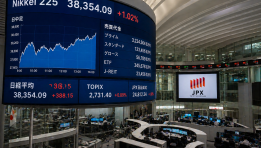
The Nikkei 225 Index (^N225) navigated a highly dynamic trading week, ultimately settling at 63,339.07 to record a structural


