


- Ronny Mor
- •
- 7 Min Read
- •
- 6 months ago
Key Points
- The Federal Reserve cut rates by 25 basis points to a 4.00%–4.25% range, its first move since December.
- Projections signal additional easing ahead, with another 50bps expected in 2025 and further cuts in 2026.
- Revised forecasts show stronger GDP growth but inflation is now projected to stay higher for longer.
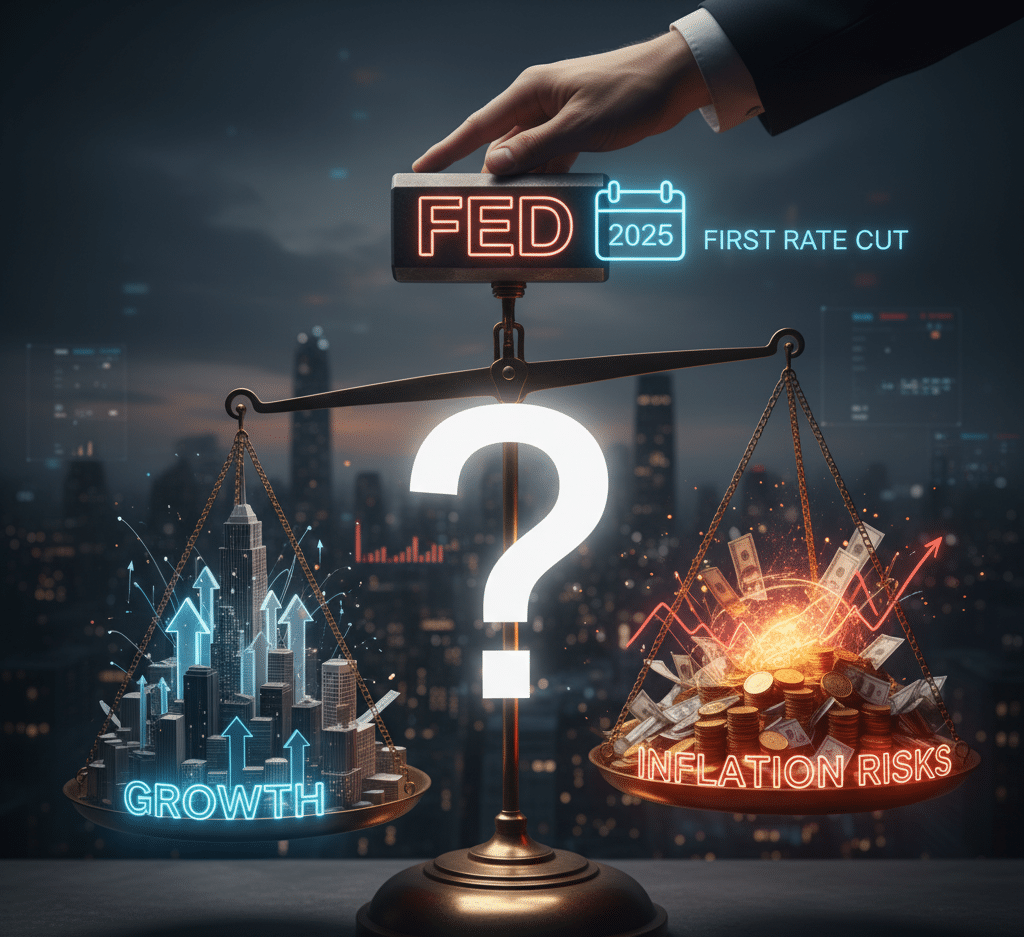
A Measured Shift in Monetary Policy
The Federal Reserve delivered a widely anticipated 25-basis-point cut in September 2025, lowering the federal funds rate to 4.00%–4.25%. The decision, supported by most policymakers, reflects a calculated pivot toward supporting growth after months of restrictive policy aimed at taming inflation. Newly appointed Governor Stephen Miran stood apart, advocating for a more aggressive 50bps cut, underscoring a debate within the central bank about the urgency of easing financial conditions.
This marks the Fed’s first rate reduction since December, and it comes amid slowing momentum in labor markets, resilient consumer spending, and an inflation backdrop that remains elevated but is gradually moderating. For markets, the move was less about surprise and more about confirmation that the Fed is willing to lean into easing—even as inflationary risks have not fully dissipated.
Growth Outlook Strengthens Despite Uncertainty
Alongside the rate decision, the Fed released updated economic projections that suggest a more optimistic outlook for U.S. growth. GDP is now expected to expand by 1.6% in 2025, up from the 1.4% estimated in June, with subsequent years also showing slight upgrades. These revisions point to a U.S. economy proving more resilient than previously assumed, supported by steady consumption and investment flows despite tighter financial conditions over the past year.
However, higher growth estimates also complicate the inflation fight. A stronger economy raises the risk that demand-driven pressures could keep inflation sticky, particularly in services and housing. That tension—between ensuring growth and reining in prices—will likely define the Fed’s path in the coming quarters.
Inflation Still Above Target
Inflation projections continue to present challenges for policymakers. The Fed now sees PCE inflation at 3% in 2025, unchanged from June’s forecast, but has revised expectations for 2026 upward to 2.6% from 2.4%. Core PCE inflation, a measure closely watched for policy direction, is projected at 3.1% this year, also easing only gradually. These figures suggest that the road back to the Fed’s 2% target will be longer than markets initially hoped.
The persistence of inflation highlights structural pressures, including wage dynamics in a labor market that, while cooling, remains historically tight. For investors, this raises the possibility that the Fed’s easing cycle may be shallower than anticipated if inflation proves resistant to further moderation.
What Comes Next for Markets and Policy
Looking forward, the Fed projects another 50bps of rate cuts by year-end and an additional quarter-point in 2026. Long-term projections see the policy rate settling near 3.5% by 2027, a level still above the near-zero rates that defined much of the previous decade. Markets are now weighing whether this easing trajectory will be sufficient to sustain growth without reigniting inflationary pressures.
The next phase will hinge on incoming data: if growth remains resilient and inflation moderates, the Fed may have room to continue its gradual cuts. But if inflation stalls above 3% or energy shocks reemerge, the central bank could be forced into a more cautious stance. For investors in both the U.S. and Israel, monitoring Fed communications will remain critical, as global liquidity conditions are once again in transition.
Comparison, examination, and analysis between investment houses
Leave your details, and an expert from our team will get back to you as soon as possible
* This article, in whole or in part, does not contain any promise of investment returns, nor does it constitute professional advice to make investments in any particular field.
To read more about the full disclaimer, click here
- omer bar
- •
- 7 Min Read
- •
- ago 4 hours
SKN | Are Europe’s Gas Prices Signaling an Imminent Energy Crunch Amid Middle East Disruptions?
European natural gas prices continued their upward trajectory, with TTF futures rising to €56.6 per MWh as markets react to
- ago 4 hours
- •
- 7 Min Read

European natural gas prices continued their upward trajectory, with TTF futures rising to €56.6 per MWh as markets react to

- orshu
- •
- 7 Min Read
- •
- ago 7 hours
SKN | Israeli Markets Show Broad Declines as Investors Weigh Economic Signals
Tel Aviv’s shווקי opened with widespread declines, highlighting investor sensitivity to macroeconomic signals and regional market trends. The TA-35 index
- ago 7 hours
- •
- 7 Min Read

Tel Aviv’s shווקי opened with widespread declines, highlighting investor sensitivity to macroeconomic signals and regional market trends. The TA-35 index

- Ronny Mor
- •
- 7 Min Read
- •
- ago 7 hours
SKN | Regulatory Wake-Up Call? Binance Australia Hit with $6.9M Fine Over Client Misclassification
Australia’s Federal Court has imposed a A$10 million ($6.9 million) penalty on Binance Australia’s derivatives business, marking one of the
- ago 7 hours
- •
- 7 Min Read

Australia’s Federal Court has imposed a A$10 million ($6.9 million) penalty on Binance Australia’s derivatives business, marking one of the
- orshu
- •
- 6 Min Read
- •
- ago 12 hours
SKN | Global Markets Recap: March 26, 2026 Performance and Outlook Ahead of March 27, 2026 Trading
Global financial markets experienced widespread declines on March 26, 2026, as investors assessed elevated geopolitical tensions, volatile energy prices, and
- ago 12 hours
- •
- 6 Min Read

Global financial markets experienced widespread declines on March 26, 2026, as investors assessed elevated geopolitical tensions, volatile energy prices, and

