




- sagi habasov
- •
- 8 Min Read
- •
- 52 seconds ago


Key Points
- Dramatic Forecast Upgrade: Goldman Sachs raises its humanoid robot sales forecast to 6.48 million units by 2035, reaching an estimated total market value of $138 billion.
- The Auto Industry Takes Center Stage: Decades of mass production experience and established operational infrastructure give car manufacturers an inherent advantage in leading the robotics market alongside tech companies.
- Toyota's Profitability Potential: The Toyota Group could capture up to an 8% global market share, potentially adding up to 6% to its gross profit by 2035.
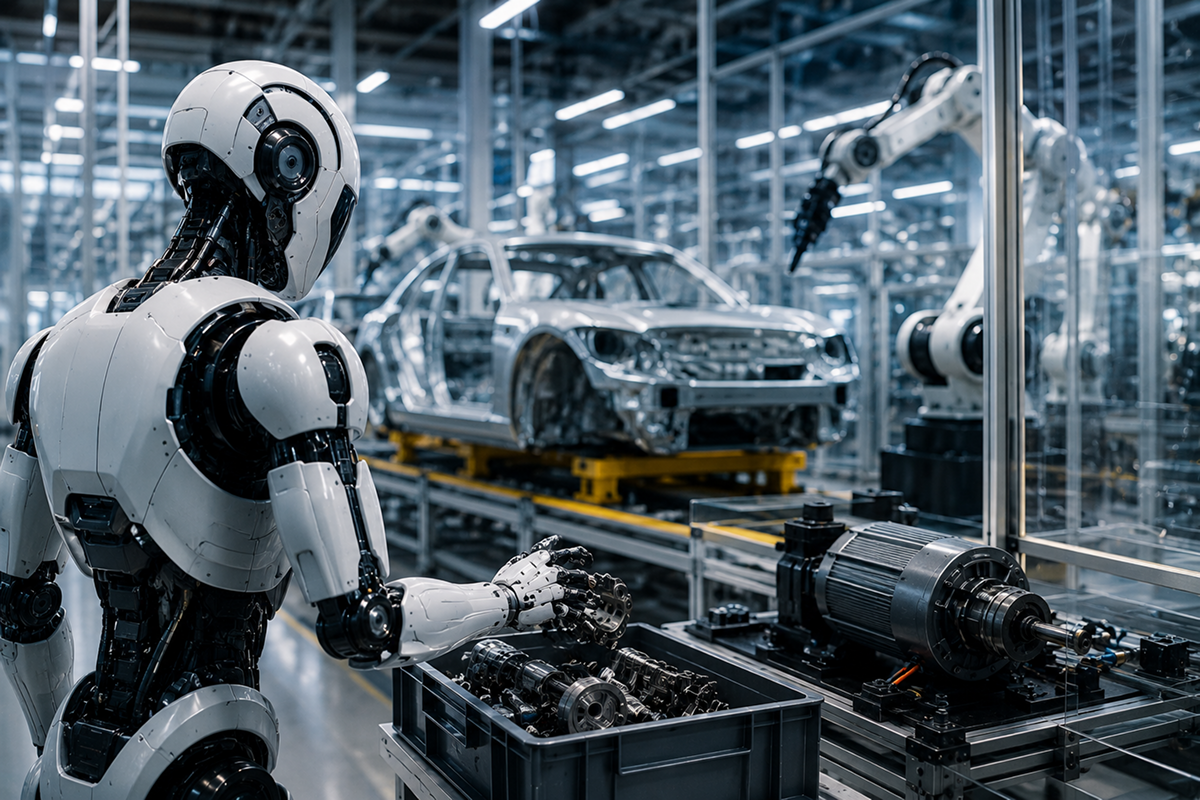
The rapid evolution in physical artificial intelligence is shifting the financial markets’ focus from pure software applications toward advanced hardware integration. A significant update from investment bank Goldman Sachs provides institutional validation for this trend, as the research firm dramatically raised its global forecast for the humanoid robot market. According to the revised data, unit sales are projected to reach 6.48 million by 2035—a sharp surge compared to the previous estimate of merely 1.38 million units. In financial terms, this represents an estimated market size of $138 billion (approximately ¥22 trillion), up from an earlier projection of just ¥6 trillion. This shift reflects a profound conceptual change among investors and institutions: advanced robotics is no longer an abstract futuristic vision, but an accelerated industrialization process driven by large-scale prototypes and an active transition to commercial manufacturing.
The Automotive Industry as a Growth Engine: Will Industrial Experience Tip the Scales?
A central strategic aspect of the Goldman Sachs analysis concerns the identity of the players capable of executing this revolution. While technology companies lead in algorithmic development, the global automotive industry holds a unique structural advantage that places it in an ideal starting position. Decades of accumulated experience in assembling complex industrial products, managing global supply chains, and scaling for mass production serve as a significant barrier to entry for new competitors. The bank’s analysts evaluated automakers based on three primary parameters: a declared intention to enter the humanoid robotics field, the degree of stagnation in their core vehicle manufacturing operations, and the company’s financial and operational resilience. This analysis indicates that companies like Tesla and Hyundai currently lay the groundwork, while among Japanese manufacturers, Toyota, Honda, and Mitsubishi Motors stand out with substantial expansion potential.
Toyota’s Model and Key Participants: Strategic Analysis and Profit Potential
An in-depth examination of the Toyota Group reveals that it possesses four critical assets establishing its presence in the field: a growing internal need for industrial labor, the urgency stemming from electric vehicle supply chain challenges, hardware and software capabilities tailored for serial production, and a management commitment backed by robust financial strength. According to Goldman Sachs’ estimates, Toyota could manufacture between 190,000 and 540,000 humanoid robot units in 2035. These figures reflect a projected global market share of 3% to 8%, a move expected to contribute an additional 2% to 6% to the company’s gross profit estimates for the fiscal year ending in March 2027. The psychological aspect of investors plays a central role here: the market tends to price automakers using traditional, low heavy-industry profit multiples, yet a gradual transition to robotics could lead to multiple expansion and a repricing of these legacy companies as technology equities.
Supply Chain Stocks and Ripple Effects: Hidden Opportunities in the Capital Market
The acceleration in robotics does not stop with end-product manufacturers; it generates ripple effects throughout the entire value chain and supplier network. Goldman Sachs has identified a series of companies positioned at key industry nodes that are poised to benefit from rising demand for complex components, motors, and operating systems. The list of prominent stocks includes component and technology manufacturers JTEKT, Aisin, MinebeaMitsumi, Renesas, Harmonic Drive, as well as NEC and Fujitsu (through Noetra). The bank’s initiation of coverage on JTEKT with a “Buy” rating underscores the working assumption that suppliers specializing in drive components and mechanical precision will enjoy a new, higher-margin revenue stream. For portfolio managers, this presents an opportunity to diversify exposure to the AI revolution beyond the familiar names in the semiconductor sector, capitalizing on more attractive valuations within engineering disciplines.
Looking Ahead
The dramatic upward revision in Goldman Sachs’ forecasts marks a turning point in how the capital market evaluates the integration of artificial intelligence with physical manufacturing. While investors have largely focused on cloud infrastructure and graphics processing units in recent years, the next phase of the industrial revolution is emerging at the intersection of advanced software and complex hardware. In the coming years, the ultimate test for automakers and auxiliary suppliers will be their ability to translate initial prototypes into profitable, commercial-scale production lines. As the technology matures and unit costs decline, the capacity to deploy humanoid robots on the factory floor may transition from a competitive advantage to an existential prerequisite, fundamentally redefining the valuation frameworks of the global automotive and robotics industries.
Comparison, examination, and analysis between investment houses
Leave your details, and an expert from our team will get back to you as soon as possible
* This article, in whole or in part, does not contain any promise of investment returns, nor does it constitute professional advice to make investments in any particular field.
To read more about the full disclaimer, click here
- omer bar
- •
- 9 Min Read
- •
- ago 8 hours
SKN | The European Tech Race: Will These Software Stocks Beat the AI Revolution in 2026?
In a year where artificial intelligence continues to rewrite the rules of the game on Wall Street and across
- ago 8 hours
- •
- 9 Min Read

In a year where artificial intelligence continues to rewrite the rules of the game on Wall Street and across

- Ronny Mor
- •
- 6 Min Read
- •
- ago 12 hours
SKN | OpenAI’s Massive Mac Purchase Signals a New AI Infrastructure Trend as Anthropic Turns to AWS
OpenAI and Anthropic are reportedly taking different approaches to using Apple hardware for artificial-intelligence workloads, highlighting how AI infrastructure is
- ago 12 hours
- •
- 6 Min Read

OpenAI and Anthropic are reportedly taking different approaches to using Apple hardware for artificial-intelligence workloads, highlighting how AI infrastructure is

- sagi habasov
- •
- 7 Min Read
- •
- ago 12 hours
SKN | SK hynix Eyes Japan Memory Fab JV as AI Demand Drives Global Capacity Expansion
SK hynix is studying the feasibility of a joint venture to manufacture memory chips in Japan as the global artificial-intelligence
- ago 12 hours
- •
- 7 Min Read

SK hynix is studying the feasibility of a joint venture to manufacture memory chips in Japan as the global artificial-intelligence
- omer bar
- •
- 7 Min Read
- •
- ago 12 hours
SKN | Tesla Ends Solar Roof After Years of Scaling Challenges — What Does It Mean for TSLA Stock?
Tesla has ended sales of its premium Solar Roof tiles after years of challenges in scaling production and installations, marking
- ago 12 hours
- •
- 7 Min Read
Tesla has ended sales of its premium Solar Roof tiles after years of challenges in scaling production and installations, marking
