





- Ronny Mor
- •
- 6 Min Read
- •
- 6 hours ago
Key Points
- TA-SME60 Index declined approximately 3.16% over the Monday-to-Friday trading week, closing at 1,389.86.
- Selling pressure remained concentrated in Israeli small- and mid-cap companies, reflecting cautious investor sentiment and reduced appetite for higher-risk domestic equities.
- Despite the weekly decline, the index remains 26.29% higher over the past year, highlighting longer-term resilience even as short-term volatility persists.

The TA-SME60 Index, which tracks Israel’s small- and medium-sized publicly traded companies, finished the week with a 3.16% decline, closing at 1,389.86. The move reflected continued caution among investors as domestic market participants balanced geopolitical developments, monetary policy expectations, and a mixed global risk environment. While Israel’s large-cap companies have generally benefited from stronger institutional flows, smaller-cap shares continued to face relatively heavier selling pressure throughout the week.
Small-Cap Stocks Underperform Broader Israeli Market
Trading during the week was characterized by a gradual downward trend rather than a single sharp selloff. After beginning the week above the 1,440 level, the TA-SME60 steadily lost momentum as sellers remained active across multiple sectors. Although the index attempted several intraday recoveries late in the week, buying interest proved insufficient to reverse the broader decline.
Small-cap companies generally exhibit higher sensitivity to domestic economic conditions than Israel’s export-oriented blue-chip firms. Their greater dependence on local consumption, financing conditions, and business investment has contributed to weaker relative performance as investors continue to favor larger, more liquid companies during periods of elevated uncertainty.
Domestic Fundamentals Continue to Influence Sentiment
Investor positioning in Israeli small-cap equities remains closely linked to expectations surrounding domestic economic growth, inflation, and interest-rate policy. Although inflation has moderated compared with previous peaks, financing costs remain materially higher than historical averages, creating additional pressure on smaller businesses that typically rely more heavily on external funding.
At the same time, geopolitical developments continue to influence market sentiment. Periods of regional uncertainty have encouraged investors to maintain a selective approach toward risk assets, with institutional capital generally favoring companies possessing stronger balance sheets, stable cash flows, and greater international revenue diversification.
Liquidity conditions also remain an important consideration, as smaller-cap shares can experience more pronounced price swings when trading volumes decline.
Earnings Outlook Will Determine the Next Phase
Looking ahead, corporate earnings will likely become the primary catalyst for the TA-SME60. Investors will be watching whether smaller Israeli companies demonstrate improving revenue growth, margin stability, and resilience despite higher financing costs and a still-challenging operating environment.
The index’s 26.29% gain over the past 12 months indicates that longer-term investor confidence has not disappeared. However, recent weekly weakness suggests market participants are becoming increasingly selective, placing greater emphasis on profitability, balance-sheet quality, and earnings visibility rather than broad market momentum.
Outlook: The near-term outlook for the TA-SME60 remains cautiously balanced. A stabilization in domestic economic indicators, easing financial conditions, and improving corporate earnings could support renewed buying interest in Israeli small-cap equities. Conversely, renewed geopolitical tensions, persistent inflationary pressures, or weaker-than-expected earnings could prolong the current period of underperformance. For professional investors, the index continues to represent an important measure of Israel’s domestic economic health, although elevated volatility suggests careful monitoring of macroeconomic and company-specific developments will remain essential in the weeks ahead.
Comparison, examination, and analysis between investment houses
Leave your details, and an expert from our team will get back to you as soon as possible
* This article, in whole or in part, does not contain any promise of investment returns, nor does it constitute professional advice to make investments in any particular field.
To read more about the full disclaimer, click here
- Lior mor
- •
- 7 Min Read
- •
- ago 4 hours
SKN | TA 35 Declines 1.66% for the Week as Macro Risks Outweigh Marginal Late-Session Gains
Israeli equities ended the trading week with a net decline, as the TA 35 Index fell 1.66% to settle at
- ago 4 hours
- •
- 7 Min Read

Israeli equities ended the trading week with a net decline, as the TA 35 Index fell 1.66% to settle at

- Arik Arkadi Sluzki
- •
- 7 Min Read
- •
- ago 5 hours
SKN | TA 125 Declines 2.26% for the Week as Macro Risks and Geopolitical Pressures Weigh on Israeli Equities
Israeli equities ended the trading week with a net decline, as the TA 125 Index fell 2.26% to settle
- ago 5 hours
- •
- 7 Min Read

Israeli equities ended the trading week with a net decline, as the TA 125 Index fell 2.26% to settle

- sagi habasov
- •
- 6 Min Read
- •
- ago 5 hours
SKN | TA-RealEstate Index Drops 4.04% for the Week as Elevated Rates and Macro Risks Pressure Israeli Developers
Israeli real estate equities ended the trading week with a pronounced net decline, as the TA-RealEstate Index fell 4.04%
- ago 5 hours
- •
- 6 Min Read
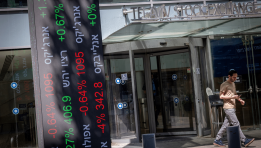
Israeli real estate equities ended the trading week with a pronounced net decline, as the TA-RealEstate Index fell 4.04%

- orshu
- •
- 8 Min Read
- •
- ago 6 hours
SKN | TA Banks 5 Index Advances 2.73% for the Week as Domestic Financials Demonstrate Resilience
Israeli financial markets ended the trading week with a pronounced net advance, as the TA Banks 5 Index climbed approximately
- ago 6 hours
- •
- 8 Min Read

Israeli financial markets ended the trading week with a pronounced net advance, as the TA Banks 5 Index climbed approximately


