





- sagi habasov
- •
- 6 Min Read
- •
- 2 months ago


Key Points
- Siemens Energy plans to sell most of its Transformation of Industry division, which generated €5.7 billion in revenue last year.
- The company could bring in external investors while retaining a minority stake in the business through a potential capital markets transaction.
- The restructuring is designed to concentrate resources on higher-return areas such as gas turbines and grid equipment, supported by rising electricity demand from data centers and artificial intelligence infrastructure.

Siemens Energy is moving to reshape its portfolio by selling most of its Transformation of Industry (ToI) division, a strategic step intended to concentrate the German energy-equipment group on businesses benefiting from the global expansion of electricity generation and grid infrastructure. The decision reflects a broader shift in the power industry as utilities and infrastructure operators accelerate spending to meet rising electricity demand, including from AI-driven data centers.
Siemens Energy Targets a More Focused Business Model
The Transformation of Industry division generated approximately €5.7 billion in revenue last year, equivalent to 15% of Siemens Energy’s group sales, with a profit margin of about 11%. The division supplies industrial customers across sectors including oil and gas, chemicals, paper, cement and maritime industries, while also producing equipment such as steam turbines and electrolysers.
Chief Executive Christian Bruch has argued that ToI operates according to different demand cycles from Siemens Energy’s other businesses and competes internally for investment resources. The planned divestment therefore represents more than a portfolio adjustment; it is an attempt to allocate capital toward businesses where Siemens Energy sees stronger structural demand and higher potential returns.
Power Generation and Grid Investment Become Strategic Priorities
Siemens Energy’s remaining core operations are positioned around equipment needed to generate and distribute electricity, particularly gas turbines and power grids. These markets are benefiting from increased investment in electricity capacity as economies electrify and technology companies expand energy-intensive computing infrastructure.
The comparison with U.S. rival GE Vernova illustrates the strategic backdrop. The chart accompanying the company data shows GE Vernova carrying a substantially higher valuation, with a price-to-earnings ratio of 44.5 and an enterprise-value-to-EBITDA ratio of 30.7, compared with 25.2 and 14.0 respectively for Siemens Energy. GE Vernova also reported a higher 2025 profit margin of 8.4%, while Siemens Energy reported 6.0%, although the companies use different profit measures. Siemens Energy’s restructuring can therefore be viewed partly through the lens of narrowing a long-standing valuation and profitability gap with its U.S. competitor.
Potential Capital Markets Transaction Could Reshape ToI
Siemens Energy said it could introduce external investors into ToI and is considering a potential capital markets transaction, while retaining a minority ownership position. Such a structure would allow the company to unlock capital from the division without completely severing its exposure to the business or its future development.
The division employs approximately 17,000 people, representing about 17% of Siemens Energy’s workforce, making the transaction significant operationally as well as financially. The company will need to balance simplification with continuity for customers and employees as ownership arrangements are developed.
Attention will now turn to the structure, timing and valuation of any transaction involving ToI. Investors will also monitor whether Siemens Energy can translate its greater concentration in power generation and grid infrastructure into stronger margins and valuation metrics. With electricity demand rising and grid investment becoming increasingly important to the global AI buildout, the restructuring could materially influence Siemens Energy’s financial profile and competitive position over the coming years.
Comparison, examination, and analysis between investment houses
Leave your details, and an expert from our team will get back to you as soon as possible
* This article, in whole or in part, does not contain any promise of investment returns, nor does it constitute professional advice to make investments in any particular field.
To read more about the full disclaimer, click here
- Lior mor
- •
- 7 Min Read
- •
- ago 10 minutes
SKN | KOSPI Composite Index (^KS11) Softens 2.62% Daily to 6,625.93 as 4.95% Weekly Pullback Holds Above 3,522 Support
The KOSPI Composite Index (^KS11) finished the trading session on October 8, 2026, lower, dropping 2.62% (177.97 points) to
- ago 10 minutes
- •
- 7 Min Read

The KOSPI Composite Index (^KS11) finished the trading session on October 8, 2026, lower, dropping 2.62% (177.97 points) to

- Arik Arkadi Sluzki
- •
- 7 Min Read
- •
- ago 55 minutes
SKN | Nikkei 225 (^N225) Softens 0.02% Daily to 69,030.92 as 1.31% Weekly Pullback Holds Above 46,544 Support
The Nikkei 225 Index (^N225) finished the trading session on October 9, 2026, virtually flat, edging lower by 0.02%
- ago 55 minutes
- •
- 7 Min Read

The Nikkei 225 Index (^N225) finished the trading session on October 9, 2026, virtually flat, edging lower by 0.02%

- omer bar
- •
- 6 Min Read
- •
- ago 9 hours
SKN | Telecom Stocks Slide as SpaceX Spectrum Deal Raises New Competitive Threat
U.S. and European telecommunications stocks came under pressure on Friday after SpaceX’s acquisition of low-band spectrum intensified concerns that
- ago 9 hours
- •
- 6 Min Read
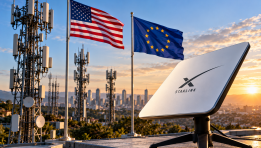
U.S. and European telecommunications stocks came under pressure on Friday after SpaceX’s acquisition of low-band spectrum intensified concerns that

- sagi habasov
- •
- 6 Min Read
- •
- ago 9 hours
SKN | Venezuela Authorizes Starlink to Operate as SpaceX Expands Satellite Internet Reach
Venezuela has authorized Starlink, the satellite internet service operated by Elon Musk’s SpaceX, to begin operating in the country,
- ago 9 hours
- •
- 6 Min Read

Venezuela has authorized Starlink, the satellite internet service operated by Elon Musk’s SpaceX, to begin operating in the country,

