





- omer bar
- •
- 7 Min Read
- •
- 9 hours ago
Key Points
- • Nvidia continues to dominate the AI GPU market while expanding aggressively into CPUs and robotics.
- • AMD remains a major force in CPUs and is benefiting from growing demand for AI infrastructure.
- • Robotics and agentic AI could become the next major battleground between the two semiconductor leaders.
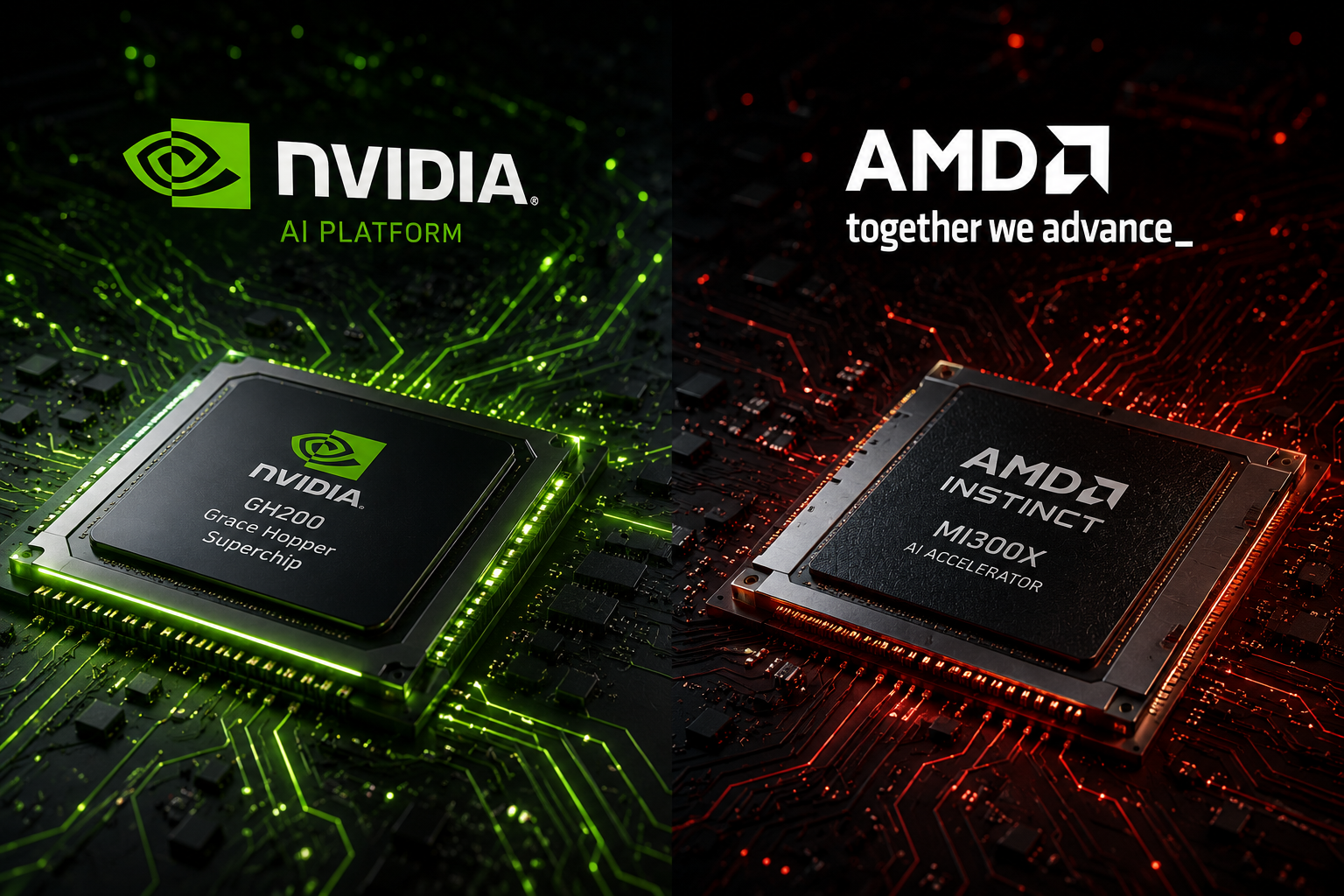
The artificial intelligence revolution has already transformed Nvidia and Advanced Micro Devices into two of the most closely watched companies on Wall Street. Both firms have delivered exceptional revenue growth as enterprises, governments, and technology providers race to build AI infrastructure. However, the next phase of AI expansion may look very different from the initial GPU-driven boom. As industries move toward agentic AI systems, autonomous computing, and robotics, investors are increasingly evaluating which semiconductor company is better positioned to capture the next generation of opportunities.
GPU Leadership Remains Nvidia’s Greatest Advantage
Nvidia entered the AI race years before most competitors recognized its potential. Leveraging its expertise in graphics processing units originally designed for gaming, the company successfully adapted its technology to power large-scale AI training and inference workloads. This early-mover advantage allowed Nvidia to establish an ecosystem that extends beyond hardware into software, networking, and AI development platforms.
The financial results highlight that leadership. Nvidia recently reported revenue growth of 85%, reflecting continued demand for its AI accelerators from hyperscale cloud providers and enterprise customers. While AMD has achieved impressive GPU progress and reported revenue growth of 38%, the company still trails Nvidia in market share, ecosystem adoption, and software integration. Nvidia’s strategy of introducing new GPU architectures on an annual cycle continues to create a competitive moat that remains difficult for rivals to overcome.
The Emerging CPU Opportunity in Agentic AI
While GPUs have dominated headlines, the rise of agentic AI is creating renewed interest in central processing units. Agentic systems are designed to analyze information, make decisions, and execute complex tasks autonomously. These workflows increasingly rely on CPUs to coordinate and manage computational processes alongside AI accelerators.
AMD enters this phase from a position of strength. The company has spent years establishing itself as a leading CPU provider across personal computers, enterprise servers, and cloud environments. Its EPYC and Ryzen product families have gained significant market share and continue to challenge traditional competitors.
However, Nvidia is aggressively entering this market as well. The company has developed standalone data-center CPUs and integrated CPU-GPU platforms aimed at AI workloads. By combining both processor types within a unified architecture, Nvidia hopes to extend its influence beyond AI acceleration and into broader computing infrastructure. This strategy could allow Nvidia to capture additional value from AI deployments while strengthening customer dependence on its ecosystem.
Robotics Could Define the Next AI Growth Cycle
Perhaps the most compelling long-term opportunity lies in robotics. Nvidia CEO Jensen Huang has repeatedly highlighted humanoid robotics as a potential multi-trillion-dollar market opportunity. Unlike traditional AI applications, robotics requires a complete technology stack that includes simulation, training, real-time processing, and deployment capabilities.
AMD participates in this market through adaptive computing platforms and embedded solutions used in industrial automation and robotics applications. Its technologies already support advanced manufacturing systems, autonomous machinery, and specialized robotic devices.
Nvidia, however, has established a broader robotics ecosystem. Through platforms such as Jetson Thor and its robotics software stack, the company offers integrated solutions spanning development, simulation, training, and deployment. With more than two million developers reportedly utilizing its robotics tools, Nvidia has built significant momentum that could translate into long-term leadership as robotic adoption accelerates.
Looking ahead, both companies are likely to benefit from expanding AI investment. Yet Nvidia appears better positioned to dominate across GPUs, AI-focused CPUs, and robotics due to its ecosystem advantage and comprehensive platform strategy. AMD remains a formidable competitor with strong CPU leadership and growing AI exposure, but the next chapter of artificial intelligence may increasingly reward companies capable of controlling the entire technology stack rather than individual components.
Comparison, examination, and analysis between investment houses
Leave your details, and an expert from our team will get back to you as soon as possible
* This article, in whole or in part, does not contain any promise of investment returns, nor does it constitute professional advice to make investments in any particular field.
To read more about the full disclaimer, click here
- orshu
- •
- 8 Min Read
- •
- ago 50 minutes
SKN | Intel’s Breakout Rally Signals Renewed Confidence in AI and Foundry Ambitions
Intel Corporation emerged as one of the most closely watched technology stocks on June 18 after its shares climbed 10.64%
- ago 50 minutes
- •
- 8 Min Read
Intel Corporation emerged as one of the most closely watched technology stocks on June 18 after its shares climbed 10.64%

- sagi habasov
- •
- 7 Min Read
- •
- ago 3 hours
SKN | Can NVIDIA’s Expansion Into XR and Physical AI Create the Next Major Growth Engine Beyond Data Centers?
NVIDIA continues to strengthen its position at the center of the global artificial intelligence revolution, but the company’s latest initiative
- ago 3 hours
- •
- 7 Min Read
NVIDIA continues to strengthen its position at the center of the global artificial intelligence revolution, but the company’s latest initiative

- Lior mor
- •
- 8 Min Read
- •
- ago 7 hours
SKN | Is SpaceX’s Post-IPO Rally Sustainable, or Are Investors Ignoring Key Risks?
SpaceX has rapidly become one of the most closely watched companies on Wall Street following its blockbuster initial public offering.
- ago 7 hours
- •
- 8 Min Read

SpaceX has rapidly become one of the most closely watched companies on Wall Street following its blockbuster initial public offering.

- Ronny Mor
- •
- 6 Min Read
- •
- ago 1 day
SKN | SpaceX Stock Falls After Three-Day Rally Following Historic IPO
SpaceX Takes a Breather After Explosive Debut SpaceX shares declined more than 6% on Thursday, marking the first significant pullback
- ago 1 day
- •
- 6 Min Read
SpaceX Takes a Breather After Explosive Debut SpaceX shares declined more than 6% on Thursday, marking the first significant pullback


