


- omer bar
- •
- 8 Min Read
- •
- 17 seconds ago
Key Points
- Nvidia’s Jensen Huang signals that AGI may already be here, reshaping productivity expectations.
- Massive demand for AI chips could drive a new wave of corporate profitability.
- Investors are shifting focus toward infrastructure and “picks-and-shovels” AI plays.
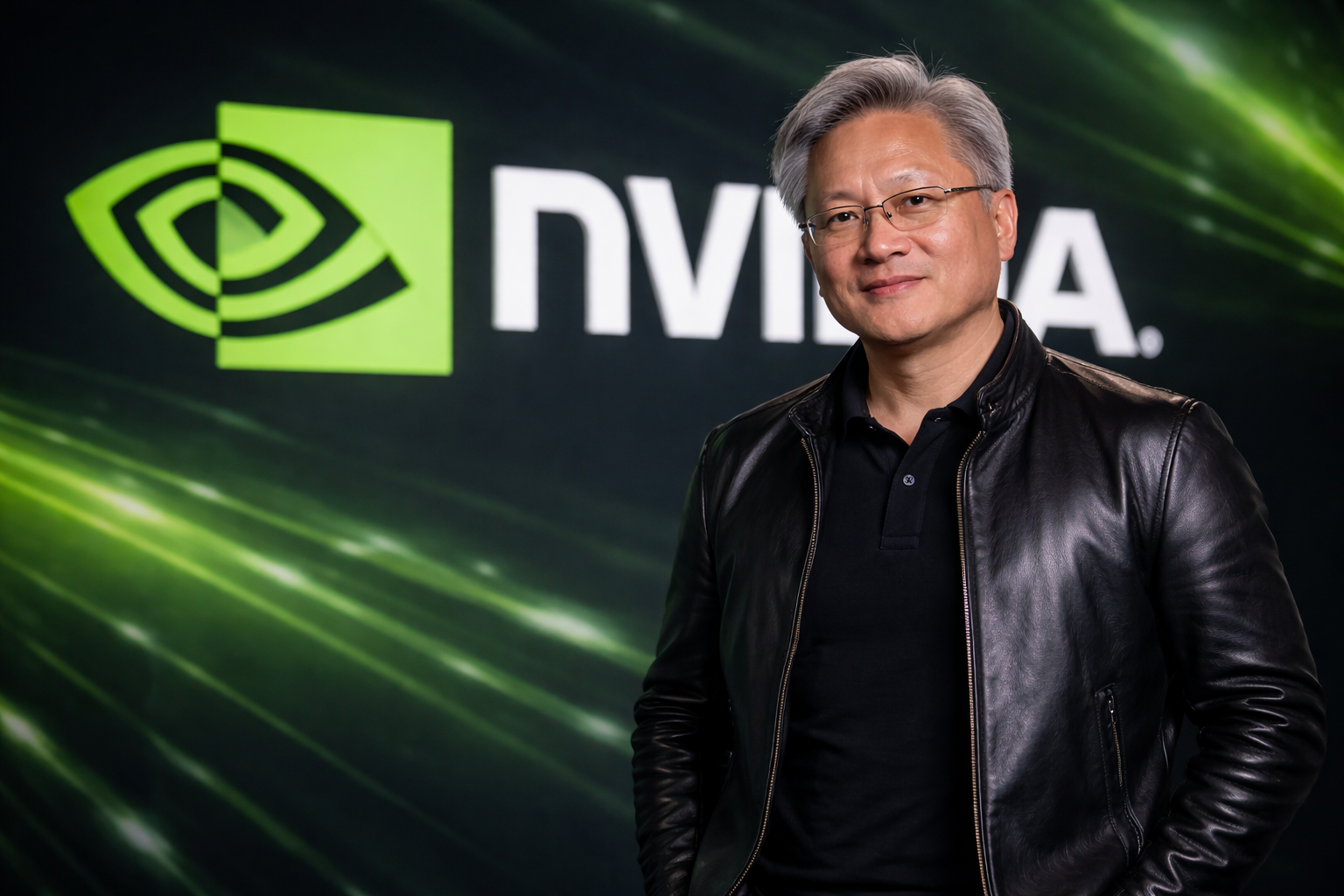
The claim that artificial general intelligence (AGI) may already exist is no longer confined to academic debate—it is now being voiced by industry leaders at the center of the AI revolution. When Nvidia CEO Jensen Huang suggests that AGI has effectively arrived, markets are forced to reassess not only the pace of technological change, but also which companies stand to benefit most from a potential productivity supercycle.
AGI Narrative Signals a Structural Shift in Productivity
The concept of AGI implies machines capable of performing a wide range of cognitive tasks at or beyond human levels. While true AGI remains debated, what is increasingly evident is the rise of “functional AI”—systems capable of automating both white-collar and physical labor at scale.
This shift is already visible in emerging trends such as AI agents capable of coding, managing workflows, and even running businesses with minimal human oversight. In some markets, particularly in Asia, early forms of “one-person companies” powered by AI are beginning to take shape.
If sustained, this transformation could redefine productivity metrics across industries. Companies able to integrate AI-driven automation into operations may see significant margin expansion, while laggards risk structural disadvantage.
Nvidia Positioned at the Center of the AI Economy
At the core of this transformation is Nvidia, which continues to dominate the infrastructure layer of artificial intelligence. The company expects to generate up to $1 trillion in combined sales from its Blackwell and Vera Rubin chip platforms through next year—an extraordinary projection that underscores the scale of anticipated demand.
Nvidia’s role extends beyond hardware. It effectively operates as the backbone of the AI ecosystem, supplying the computational power required for both training and inference. As AI agents proliferate, inference demand—ongoing computation used in real-world applications—is expected to surge, creating a durable tailwind for the company.
If AGI or near-AGI capabilities are indeed emerging, current forecasts may prove conservative. Demand for compute could accelerate far beyond existing projections, reinforcing Nvidia’s position as a “picks-and-shovels” leader in the AI gold rush.
Enterprise AI Players Accelerate the Shift
Beyond chipmakers, software and AI-native firms are rapidly advancing capabilities that support the AGI thesis. Companies developing agentic AI systems—autonomous programs capable of executing complex tasks—are pushing the boundaries of what automation can achieve.
Recent developments in enterprise AI tools highlight a growing ability to replace or augment human labor in areas such as coding, cybersecurity, and operational decision-making. While these innovations unlock efficiency gains, they also introduce new risks, including misuse and cybersecurity vulnerabilities.
The broader implication is clear: AI is transitioning from a supportive tool to an active participant in economic activity. This evolution is likely to reshape business models across sectors.
Market Implications: Rethinking Winners and Losers
For investors, the emergence of AGI—or even credible progress toward it—requires a shift in strategy. Traditional approaches focused solely on end-user applications may overlook the deeper value embedded in infrastructure providers and enabling technologies.
Semiconductor companies, cloud infrastructure providers, and firms building foundational AI models are positioned to capture disproportionate value. At the same time, industries reliant on human-intensive processes may face disruption, particularly if automation scales rapidly.
This dynamic introduces both opportunity and risk. While AI-driven productivity gains could boost corporate earnings, the pace of disruption may also lead to volatility in labor markets and equity valuations.
Outlook: Early Signals of a New Economic Cycle
Whether AGI has truly arrived or remains just over the horizon, the direction of travel is becoming increasingly clear. Markets are beginning to price in a future where AI plays a central role in economic output, decision-making, and value creation.
The next phase will depend on real-world adoption, regulatory responses, and the ability of companies to translate technological capability into sustainable earnings growth. As data accumulates, the true impact of AI on productivity and profitability will become more measurable.
For now, the message from industry leaders is unmistakable: the AI era is accelerating—and those positioned at its core may define the next generation of market winners.
Comparison, examination, and analysis between investment houses
Leave your details, and an expert from our team will get back to you as soon as possible
* This article, in whole or in part, does not contain any promise of investment returns, nor does it constitute professional advice to make investments in any particular field.
To read more about the full disclaimer, click here
- Ronny Mor
- •
- 6 Min Read
- •
- ago 20 hours
SKN | IMF Warns Tokenized Finance Could Amplify Market Crises: Innovation Meets Systemic Risk
The International Monetary Fund (IMF) has raised concerns that the rapid growth of tokenized finance could introduce new vulnerabilities
- ago 20 hours
- •
- 6 Min Read

The International Monetary Fund (IMF) has raised concerns that the rapid growth of tokenized finance could introduce new vulnerabilities

- sagi habasov
- •
- 6 Min Read
- •
- ago 20 hours
SKN | OpenAI’s Media Move: Strategic Content Acquisition Signals Expansion Beyond AI Infrastructure
OpenAI’s reported move to acquire a podcast platform signals a strategic expansion beyond artificial intelligence infrastructure into media influence
- ago 20 hours
- •
- 6 Min Read

OpenAI’s reported move to acquire a podcast platform signals a strategic expansion beyond artificial intelligence infrastructure into media influence

- Arik Arkadi Sluzki
- •
- 6 Min Read
- •
- ago 2 days
SKN | Figma’s Sharp Decline: Growth Reset or Market Repricing in Design Software?
Figma has experienced a significant pullback over the past month, with its stock falling by 28% as investors reassess
- ago 2 days
- •
- 6 Min Read

Figma has experienced a significant pullback over the past month, with its stock falling by 28% as investors reassess
- Ronny Mor
- •
- 6 Min Read
- •
- ago 2 days
SKN | Volvo’s New VNR Launch Targets Aging US Truck Fleet: Replacement Cycle Gaining Momentum?
Volvo is accelerating its push into the US trucking market with the launch of its updated VNR model, as
- ago 2 days
- •
- 6 Min Read

Volvo is accelerating its push into the US trucking market with the launch of its updated VNR model, as

