





- orshu
- •
- 8 Min Read
- •
- 7 seconds ago


Key Points
- Emerging-market central banks hold around 11% of their reserves in gold, compared with roughly 34% for advanced economies, leaving a substantial allocation gap.
- Gold’s current bull market, which began in 2018, has generated approximately 19% annualized returns, following major rallies in 1971–1980 and 1999–2011.
- Central banks remain structurally supportive of gold, with 89% of reserve managers expecting global official gold holdings to increase over the next 12 months.

Gold is increasingly moving beyond its traditional role as a defensive commodity and becoming a strategic component of global reserve management. As geopolitical fragmentation, fiscal pressures and concerns over the reliability of foreign-currency reserves reshape capital allocation, emerging-market central banks still hold substantially less gold as a share of reserves than their developed-market counterparts.
Emerging Markets Still Hold Far Less Gold Than Advanced Economies
The accompanying Bloomberg and UBS data show a significant divergence in reserve composition. At the end of 2025, gold represented approximately 34% of reserves at advanced-economy central banks, compared with about 11% for emerging and developing economies and approximately 22% globally.
The gap has narrowed over the past decade, but it remains substantial. The World Gold Council’s latest market analysis estimates that emerging-market central banks held around 15% of their total reserves in gold in 2025, compared with approximately 30% among developed-market central banks. That compares with roughly 4% for emerging markets in 2010, illustrating the scale of the structural shift already underway.
The difference matters because gold allocation is not simply a function of price. Reserve managers also consider liquidity, diversification, geopolitical risk and the credit exposure associated with foreign government securities. The IMF has found that emerging markets have been the principal active diversifiers into gold over the past two decades, with sanctions and geopolitical uncertainty among the factors associated with increased gold allocations.
A Third Gold Bull Market Is Developing Under Different Conditions
Gold’s current advance represents its third major secular bull market since the end of the Bretton Woods system. The first major rally from 1971 to 1980 occurred amid monetary instability, negative real rates, geopolitical tensions and rising fiscal deficits. The second, from 1999 to 2011, developed during a period of strong Chinese demand and exceptionally accommodative U.S. monetary policy.
The current cycle began in 2018 and has generated approximately 19% annualized returns, according to recent Financial Times analysis. What distinguishes the present cycle is the increasingly strategic role of official-sector demand following the freezing of Russia’s foreign-exchange reserves after the invasion of Ukraine in 2022. That episode reinforced concerns among some reserve managers that foreign-currency assets held abroad can become inaccessible under geopolitical conditions.
Gold has also demonstrated unusual resilience against higher real interest rates. The World Gold Council noted that gold gained in 2022 even as U.S. 10-year real yields rose by an unprecedented 250 basis points, challenging the traditional assumption that rising real yields necessarily produce sustained pressure on the metal.
Central Banks Are Providing a Structural Source of Demand
The latest official-sector data reinforce the strategic argument. Central banks and other official institutions purchased 289 tonnes of gold in Q2 2026, a sharp rebound from the revised 57 tonnes in the first quarter. Poland was the largest buyer, while China added 33 tonnes during the quarter. First-half net purchases reached 345 tonnes.
The World Gold Council’s 2026 survey provides an even stronger indication of future demand. 89% of reserve managers expect global central-bank gold holdings to increase over the following 12 months, while a record 45% expect their own institutions to increase gold holdings. In addition, 84% believe gold will represent a moderately or significantly higher share of reserves five years from now.
This demand is occurring even though gold already represents a meaningful share of the global financial system. The World Gold Council estimates that gold accounts for approximately 3% of global financial assets excluding central-bank reserves, while central banks and official institutions collectively hold more than 38,000 tonnes.
For global investors, including institutions and high-net-worth investors in Israel, the key issue is therefore not simply whether gold can extend its recent rally. It is whether the structural reallocation of official reserves continues. If emerging-market central banks gradually narrow the allocation gap with developed economies, official-sector demand could remain an important long-term component of the gold market. At the same time, elevated prices, changing real yields and the possibility of slower reserve accumulation remain important risks to monitor. The direction of central-bank allocation may ultimately prove as significant as short-term changes in the gold price itself.
Comparison, examination, and analysis between investment houses
Leave your details, and an expert from our team will get back to you as soon as possible
* This article, in whole or in part, does not contain any promise of investment returns, nor does it constitute professional advice to make investments in any particular field.
To read more about the full disclaimer, click here
- Ronny Mor
- •
- 6 Min Read
- •
- ago 26 minutes
SKN | Does the Volatility in Gold and Commodities Markets Signal the End of an Era of Stability?
Commodities Under the Microscope: Examining Recent Fluctuations The global commodities market continues to register sharp and contradictory movements, placing precious
- ago 26 minutes
- •
- 6 Min Read

Commodities Under the Microscope: Examining Recent Fluctuations The global commodities market continues to register sharp and contradictory movements, placing precious

- orshu
- •
- 9 Min Read
- •
- ago 50 minutes
SKN | U.S. Treasury Yields Near 4.8%: Could Rising Bond Costs Trigger a New Equity Market Correction?
The U.S. Treasury market has become one of the most important signals for global investors as long-term borrowing costs
- ago 50 minutes
- •
- 9 Min Read

The U.S. Treasury market has become one of the most important signals for global investors as long-term borrowing costs

- Lior mor
- •
- 9 Min Read
- •
- ago 16 hours
SKN | Is Big Tech’s AI Debt Boom Pushing U.S. Treasury Yields Higher?
The artificial-intelligence investment cycle is increasingly becoming a bond-market story as well as an equity-market story. The latest analysis
- ago 16 hours
- •
- 9 Min Read

The artificial-intelligence investment cycle is increasingly becoming a bond-market story as well as an equity-market story. The latest analysis

- Arik Arkadi Sluzki
- •
- 9 Min Read
- •
- ago 16 hours
SKN | Bitcoin and Gold Move Closer Together: Is the Debasement Trade Reshaping Crypto Markets?
Bitcoin is increasingly trading alongside gold rather than behaving primarily like a high-beta technology asset. The 90-day correlation between
- ago 16 hours
- •
- 9 Min Read
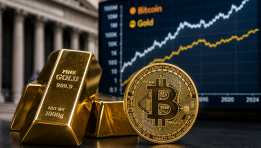
Bitcoin is increasingly trading alongside gold rather than behaving primarily like a high-beta technology asset. The 90-day correlation between

