


- Arik Arkadi Sluzki
- •
- 6 Min Read
- •
- 13 seconds ago
Key Points
- The DAX Performance Index (^GDAXI) recorded a five-day decline of 0.35%, settling at 22,300.75 amidst heightened intra-week volatility.
- A steep 1.38% daily contraction erased a significant mid-week rally that had briefly propelled the index above the 23,000 threshold.
- This retracement in Germany's premier equity benchmark requires careful analysis by globally diversified and Israeli investment portfolios exposed to European industrial and export sectors.
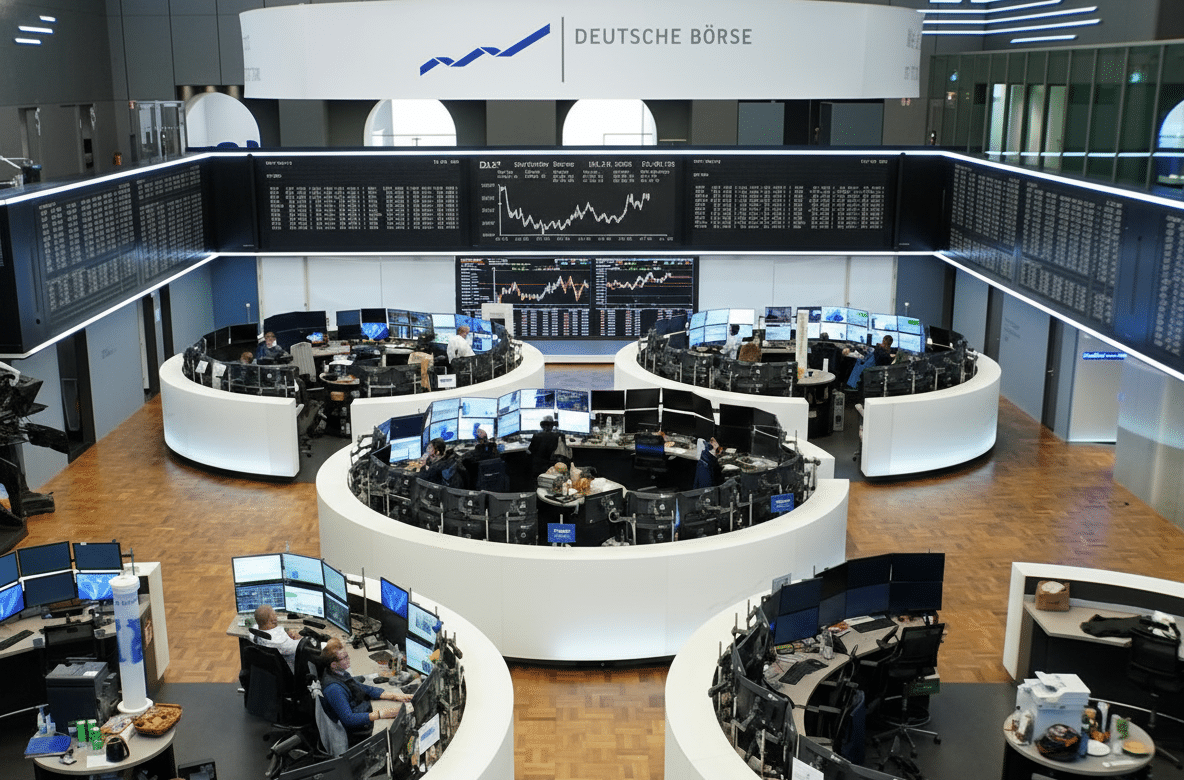
The DAX Performance Index concluded a turbulent trading week with a fractional 0.35% five-day decline, ultimately settling at 22,300.75. This marginal net loss, however, masks a dramatic intra-week reversal that highlights shifting sentiment among institutional investors regarding the trajectory of the German economy and broader European capital markets.
Analyzing the Intra-Week Technical Reversal
A close examination of the five-day trading chart reveals a pronounced hump-shaped trajectory. Early in the week, the DAX exhibited strong upward momentum, surging from its baseline to break above the psychological 23,000 level around March 25th. This aggressive buying, however, quickly encountered heavy technical resistance. The latter half of the week was characterized by sustained distribution, culminating in a sharp 312.22-point daily drop that dragged the index back down to its weekly starting point. Closing near its daily low of 22,215.86, the price action visually demonstrates that while near-term speculative capital was quick to enter, institutional conviction remains fragile at elevated valuations.
Macroeconomic Undercurrents and Industrial Exposure
As a total return index heavily weighted toward global export giants in automotive, chemicals, and industrial manufacturing, the DAX is acutely sensitive to international trade dynamics and localized energy costs. The mid-week surge and subsequent fade likely reflect complex, competing macroeconomic signals. Investors are weighing the potential for an ECB rate cut—which would stimulate robust economic growth—against lingering concerns over sticky European inflation and sluggish industrial orders. This volatility underscores the challenges facing the Eurozone’s largest economy as it attempts to navigate a complex post-inflationary recovery.
Cross-Border Implications for Diversified Portfolios
For sophisticated market participants operating within the Israeli financial ecosystem, the recent performance of the DAX highlights the critical importance of strategic portfolio diversification. While the Tel Aviv Stock Exchange (TASE) is primarily influenced by domestic tech innovation and regional geopolitics, allocating capital to the German benchmark provides essential exposure to cyclical industrial trends. Navigating this cross-border exposure requires rigorous financial planning and a careful assessment of foreign exchange dynamics between the Euro, US Dollar, and the New Israeli Shekel, as these currency fluctuations directly impact the risk-adjusted returns for domestic investors holding European assets.
Looking forward to the upcoming trading sessions, the primary outlook for the German equity benchmark centers on its ability to establish a durable technical floor above the critical 22,200 level. Market resilience will be rigorously tested as investors digest impending German economic data, particularly industrial production figures and consumer sentiment indices. Strategic allocations must remain highly agile; market participants should prioritize strict capital preservation while actively scanning for fundamentally mispriced, dividend-yielding industrial opportunities that frequently emerge during periods of elevated regional turbulence. By maintaining disciplined risk management, sophisticated investors can position their portfolios to capture sustainable, long-term growth.
Comparison, examination, and analysis between investment houses
Leave your details, and an expert from our team will get back to you as soon as possible
* This article, in whole or in part, does not contain any promise of investment returns, nor does it constitute professional advice to make investments in any particular field.
To read more about the full disclaimer, click here
- sagi habasov
- •
- 6 Min Read
- •
- ago 1 hour
SKN | Does the MSCI Europe’s Late-Week Reversal Signal Shifting Sentiment in Continental Equities?
The MSCI Europe Index navigated a week defined by sharp, divergent price action, ultimately recording a 0.85% decline over
- ago 1 hour
- •
- 6 Min Read

The MSCI Europe Index navigated a week defined by sharp, divergent price action, ultimately recording a 0.85% decline over

- orshu
- •
- 6 Min Read
- •
- ago 2 hours
SKN | Does the EURO STOXX 50’s Flat Weekly Close Mask Underlying Volatility in European Equities?
The EURO STOXX 50 Index navigated a week of pronounced technical swings, ultimately closing near its starting baseline at
- ago 2 hours
- •
- 6 Min Read

The EURO STOXX 50 Index navigated a week of pronounced technical swings, ultimately closing near its starting baseline at

- Ronny Mor
- •
- 6 Min Read
- •
- ago 3 hours
SKN | Does the CAC 40’s Volatile Five-Day Trajectory Signal Resilient European Equities?
The CAC 40 Index navigated a week defined by sharp intra-week fluctuations, ultimately securing a fractional five-day advance as
- ago 3 hours
- •
- 6 Min Read
The CAC 40 Index navigated a week defined by sharp intra-week fluctuations, ultimately securing a fractional five-day advance as

- omer bar
- •
- 6 Min Read
- •
- ago 4 hours
SKN | Does the FTSE 100’s Intraday Rebound Signal Resilience Amidst Market Consolidation?
The FTSE 100 Index navigated a highly turbulent trading session this week, reflecting shifting sentiment regarding the underlying health
- ago 4 hours
- •
- 6 Min Read
The FTSE 100 Index navigated a highly turbulent trading session this week, reflecting shifting sentiment regarding the underlying health

