




- Ronny Mor
- •
- 9 Min Read
- •
- 43 seconds ago


Key Points
- The People's Bank of China reportedly added 740,000 troy ounces of gold, equivalent to approximately 23 tonnes, in September 2026, extending its purchasing streak to 23 consecutive months.
- China's reported gold holdings reached a record 2,410 tonnes, representing approximately 9% of its foreign exchange reserves, according to the attached source.
- A 2026 World Gold Council survey found that 45% of surveyed central banks intend to increase their gold holdings over the following 12 months, reinforcing the metal's strategic role in reserve diversification.
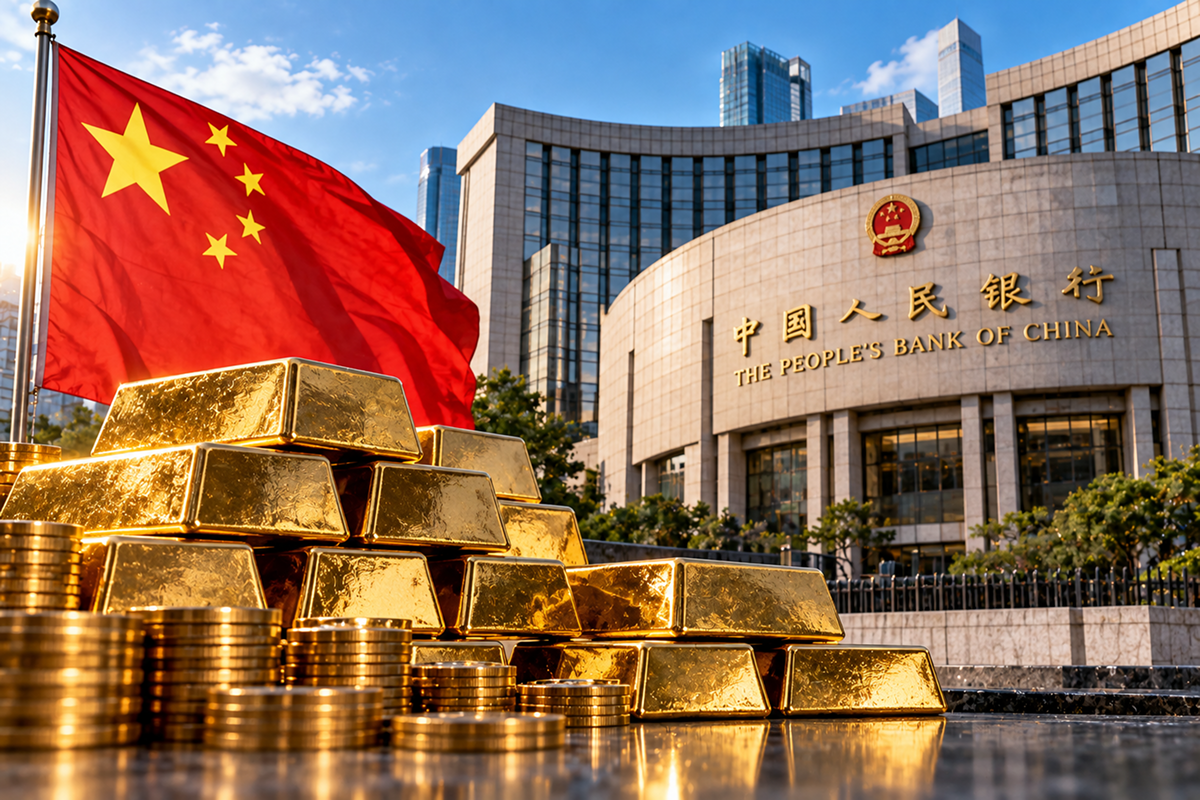
China is continuing to expand its official gold reserves as central banks reassess how they allocate assets amid geopolitical uncertainty, concerns over sovereign debt and changing global currency dynamics. The People’s Bank of China’s reported September purchase of approximately 23 tonnes extends its gold-buying streak to 23 consecutive months, highlighting the continuing importance of gold as a strategic reserve asset rather than simply a commodity exposed to market-price movements.
China’s Gold Accumulation Reaches a New Milestone
According to the attached market report, the People’s Bank of China (PBOC) added approximately 740,000 troy ounces of gold in September 2026, equivalent to around 23 metric tonnes. The purchase was reportedly China’s largest monthly addition in three years and extended its accumulation streak to 23 consecutive months. Its reported gold holdings consequently reached approximately 2,410 tonnes, accounting for around 9% of its foreign exchange reserves.
The sustained buying follows a broader increase in China’s reported gold holdings during 2026. The World Gold Council reported that China added 40 tonnes in the first half of the year, bringing its holdings to 2,346 tonnes by the end of June. Its subsequent reported purchases indicate that gold remains an ongoing component of China’s reserve-management strategy, although monthly figures can be revised as additional official data become available.
The scale and persistence of the purchases are significant because central-bank reserve decisions typically reflect long-term strategic considerations. Unlike short-term trading, official gold accumulation can be intended to diversify reserve assets, preserve purchasing power and reduce dependence on any single currency or financial instrument.
Reserve Diversification Supports Central Bank Demand
China’s buying is part of a wider trend among central banks seeking to diversify their reserve portfolios. The World Gold Council’s 2026 Central Bank Gold Reserves Survey, published in June, found that 45% of surveyed reserve managers intended to increase their own gold holdings over the following 12 months. A further 54% planned to maintain their existing allocations, while only 1% expected to reduce them. The survey included responses from 74 central banks.
The survey identified gold’s performance during crises, its role in portfolio diversification and its long-term store-of-value characteristics among the principal reasons for holding the metal. These considerations have gained relevance as governments face geopolitical risks, uncertainty over the future composition of international reserves and concerns about the long-term sustainability of public finances.
China is not the only major buyer. World Gold Council data through June 2026 identified Poland as the leading central-bank gold purchaser for the first half of the year, with 82 tonnes added, followed by Uzbekistan with 41 tonnes and China with 40 tonnes. The figures show that official demand is distributed across several countries, even as China maintains a particularly visible accumulation programme.
Implications for Gold Prices and Global Financial Markets
Persistent central-bank demand can influence the gold market by providing a source of buying that is less directly tied to short-term retail-investor sentiment. Official-sector purchases may help support demand during periods of uncertainty, although they do not determine prices on their own. Gold remains sensitive to real interest rates, the U.S. dollar, investor positioning, exchange-traded fund flows and changes in expectations for monetary policy.
The relationship between gold and interest rates is particularly important. Because gold does not generate interest income, higher yields on government bonds can increase the opportunity cost of holding the metal. Conversely, declining real yields, a weaker dollar or heightened geopolitical uncertainty can strengthen its appeal. Central-bank purchases therefore represent one part of a broader market equation rather than a guarantee of continued price appreciation.
China’s reported holdings of approximately 2,410 tonnes also illustrate how reserve composition can evolve over time. Gold’s share of China’s foreign exchange reserves, estimated at around 9% in the attached report, indicates that the metal is an established component of its reserve portfolio. However, changes in gold prices and the value of other reserve assets can alter that percentage even without additional purchases.
Looking ahead, markets will be watching China’s monthly reserve disclosures, purchases by Poland and other central banks, and the next World Gold Council demand reports for evidence that official-sector accumulation is continuing. Interest-rate expectations, dollar movements and geopolitical developments will remain equally important in determining gold’s market performance. For global investors, including those in Israel, the central issue is whether sustained official demand remains strong enough to offset periods of weaker investment demand and pressure from higher bond yields. China’s latest reported purchase reinforces the strategic importance of gold in global reserve management, while leaving the metal’s near-term price direction dependent on a wider set of financial conditions.
Comparison, examination, and analysis between investment houses
Leave your details, and an expert from our team will get back to you as soon as possible
* This article, in whole or in part, does not contain any promise of investment returns, nor does it constitute professional advice to make investments in any particular field.
To read more about the full disclaimer, click here
- sagi habasov
- •
- 8 Min Read
- •
- ago 49 seconds
SKN | France’s 10-Year Bond Yield Surpasses Italy’s: What the Historic Reversal Signals for European Debt Markets
France is facing an unusual shift in European sovereign debt markets: investors are demanding a higher yield to hold
- ago 49 seconds
- •
- 8 Min Read

France is facing an unusual shift in European sovereign debt markets: investors are demanding a higher yield to hold

- omer bar
- •
- 6 Min Read
- •
- ago 1 day
SKN | U.S. Consumer Sentiment Falls to 46.3 as Inflation Concerns Weigh on Household Confidence
Consumer Confidence Weakens Further The University of Michigan’s October consumer sentiment index fell to 46.3, below the expected 47.6 and
- ago 1 day
- •
- 6 Min Read

Consumer Confidence Weakens Further The University of Michigan’s October consumer sentiment index fell to 46.3, below the expected 47.6 and

- orshu
- •
- 7 Min Read
- •
- ago 1 day
SKN | Germany Seeks ECB Executive Board Seat as Succession Debate Takes Shape
Germany is preparing to put forward a candidate for a vacant seat on the European Central Bank’s executive board,
- ago 1 day
- •
- 7 Min Read

Germany is preparing to put forward a candidate for a vacant seat on the European Central Bank’s executive board,

- Lior mor
- •
- 6 Min Read
- •
- ago 1 day
SKN | Wall Street Ends Week Higher as Earnings and Inflation Data Take Center Stage
Wall Street closed higher on Friday as investors shifted their attention toward the next stage of the market calendar,
- ago 1 day
- •
- 6 Min Read

Wall Street closed higher on Friday as investors shifted their attention toward the next stage of the market calendar,
