




- Lior mor
- •
- 7 Min Read
- •
- 16 seconds ago


Key Points
- Canadian consumers are increasingly avoiding U.S. products, prompting grocers to change sourcing strategies and strengthen country-of-origin labeling.
- Alternative suppliers from Morocco, South Africa, Spain, Brazil and Honduras are gaining a larger role as retailers reduce reliance on U.S. produce.
- Canada is investing about C$3 billion over a decade in greenhouses and vertical farming to strengthen domestic food production.
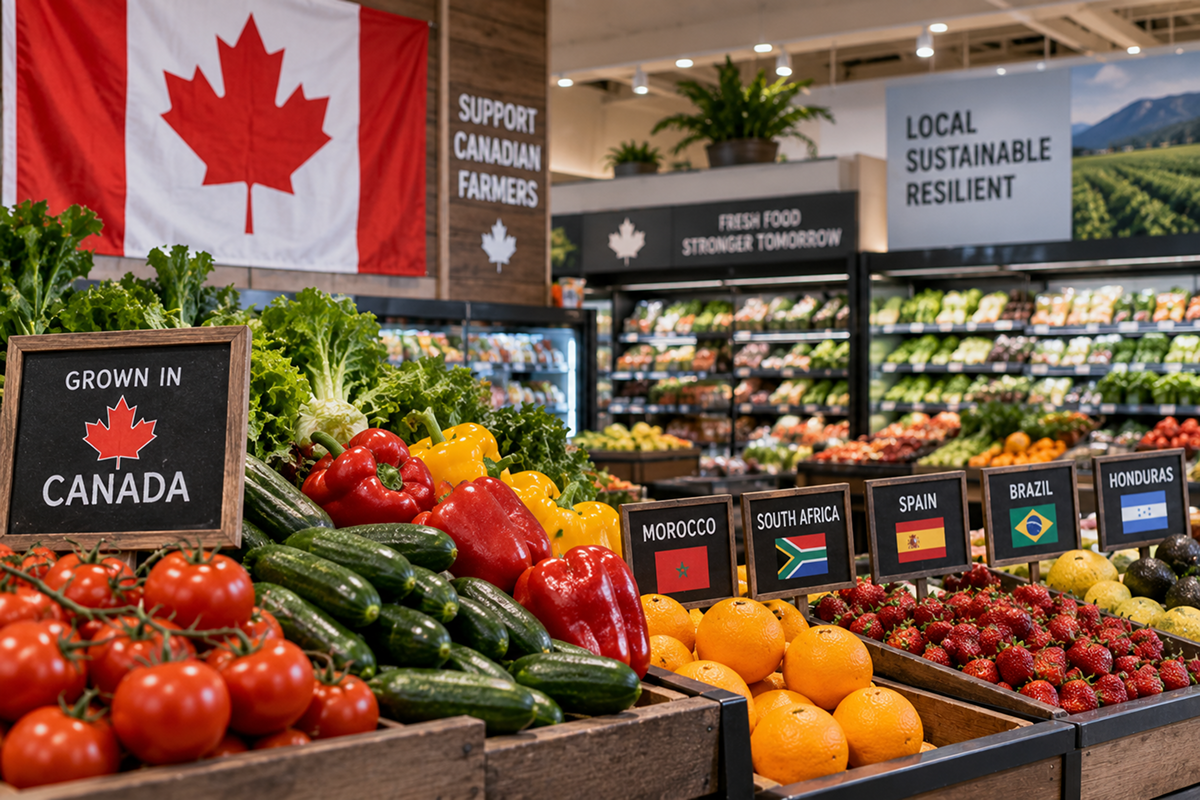
A growing Canadian consumer boycott of U.S. products is beginning to reshape supermarket supply chains, adding a new commercial dimension to the broader Canada-U.S. trade conflict. Grocers are responding by increasing domestic sourcing, finding alternative international suppliers and making product origins more visible to consumers, potentially creating longer-term changes in North American food trade.
Consumer Nationalism Changes Grocery-Sourcing Decisions
The pressure on Canadian retailers has intensified as consumers become more attentive to where their money is spent. Reuters reported that independent grocer Vince’s Market in Ontario has received complaints over U.S. produce, prompting the company to publicly explain its sourcing practices. The retailer now has about 90% Canadian produce across its four stores and has shifted some purchases, including strawberries, from U.S. suppliers to Quebec.
The change creates a more complicated purchasing equation for grocers. Retailers have traditionally balanced quality and price when selecting suppliers, but country of origin has increasingly become an additional commercial consideration. That can raise procurement costs and reduce flexibility, particularly for products that Canada cannot efficiently produce year-round.
U.S. Dominance in Produce Imports Begins to Erode
The United States remains Canada’s largest source of fresh produce, accounting for more than half of the country’s imports. However, government data cited by Reuters show that the U.S. share of Canada’s vegetable imports fell to 62.6% in July, compared with 69% in the same month of 2023.
The shift is encouraging grocers to establish relationships with suppliers farther afield. Retailers are increasingly sourcing produce from countries including Spain, Brazil, Honduras, Morocco and South Africa. These relationships could provide greater supply diversification, although they also introduce additional transportation, logistics and regulatory considerations.
Canada Seeks Greater Domestic Food Resilience
Canada’s climate makes food self-sufficiency particularly difficult. Harsh winters limit domestic production of many fresh products, leaving retailers dependent on greenhouses, stored vegetables and imports. The government is responding with approximately C$3 billion in investment over 10 years to expand greenhouse production and other controlled-environment agriculture.
The policy has an economic objective beyond reducing dependence on the United States. Increasing domestic supply could also help address Canada’s food inflation, which Reuters notes has been among the highest in the Group of Seven developed economies. Greater local production could eventually provide retailers with another source of supply during periods of international disruption.
Supply Diversification Could Outlast the Trade Dispute
The strategic implications extend beyond the immediate boycott. Loblaw has restored prominent Canadian-origin signs in its produce and fresh-food sections, while Metro has said it will continue prioritizing Canadian products. Such measures suggest that retailers are responding not only to temporary consumer sentiment but also to a potentially lasting change in purchasing behavior.
However, economics could eventually regain influence if trade relations improve. Alternative suppliers may be more expensive than U.S. sources, while transportation distances can add costs and complexity. Going forward, investors and businesses will watch consumer preferences, food inflation, import shares and Canada-U.S. trade negotiations. If diversified supply networks remain in place even after tensions ease, the current dispute could leave a lasting structural impact on Canada’s grocery industry and its broader relationship with North American suppliers.
Comparison, examination, and analysis between investment houses
Leave your details, and an expert from our team will get back to you as soon as possible
* This article, in whole or in part, does not contain any promise of investment returns, nor does it constitute professional advice to make investments in any particular field.
To read more about the full disclaimer, click here
- omer bar
- •
- 7 Min Read
- •
- ago 2 minutes
SKN | U.S. Inflation Accelerates as August Consumer Prices Strengthen the Case for a Federal Reserve Rate Hike
U.S. consumer inflation accelerated in August, reinforcing expectations that the Federal Reserve will raise interest rates at its September policy
- ago 2 minutes
- •
- 7 Min Read

U.S. consumer inflation accelerated in August, reinforcing expectations that the Federal Reserve will raise interest rates at its September policy

- Arik Arkadi Sluzki
- •
- 6 Min Read
- •
- ago 7 minutes
SKN | MSCI Europe Index (^125904-USD-STRD) Edges Up 0.37% to 2,824.33: Are European Developed Market Equities Consolidating Above Core Support?
The MSCI Europe Index (^125904-USD-STRD) demonstrated defensive structural stability to close out the trading week, advancing 0.37% on Friday
- ago 7 minutes
- •
- 6 Min Read

The MSCI Europe Index (^125904-USD-STRD) demonstrated defensive structural stability to close out the trading week, advancing 0.37% on Friday

- sagi habasov
- •
- 7 Min Read
- •
- ago 37 minutes
SKN | FTSE 100 Rebounds 0.39% to 10,650.44: Are UK Equities Stabilizing Above Core Support Following Solid GDP Data?
The FTSE 100 Index (^FTSE) exhibited defensive structural resilience to close out the trading week on the London Stock
- ago 37 minutes
- •
- 7 Min Read

The FTSE 100 Index (^FTSE) exhibited defensive structural resilience to close out the trading week on the London Stock

- orshu
- •
- 7 Min Read
- •
- ago 59 minutes
SKN | CAC 40 Rebounds 0.78% to 8,179.77: Are French Blue-Chips Stabilizing Above Core Technical Support Despite Weekly Contraction?
The CAC 40 Index (^FCHI) exhibited structural resilience to close out the trading week on Euronext Paris, advancing 0.78%
- ago 59 minutes
- •
- 7 Min Read

The CAC 40 Index (^FCHI) exhibited structural resilience to close out the trading week on Euronext Paris, advancing 0.78%
