


- Ronny Mor
- •
- 7 Min Read
- •
- 2 months ago
Key Points
- Trump is privately weighing whether to withdraw from the USMCA ahead of its July 1 review.
- A potential exit would disrupt nearly $2 trillion in annual trade between the U.S., Canada, and Mexico.
- Even the threat of withdrawal could inject volatility into equities, currencies, and supply chains.
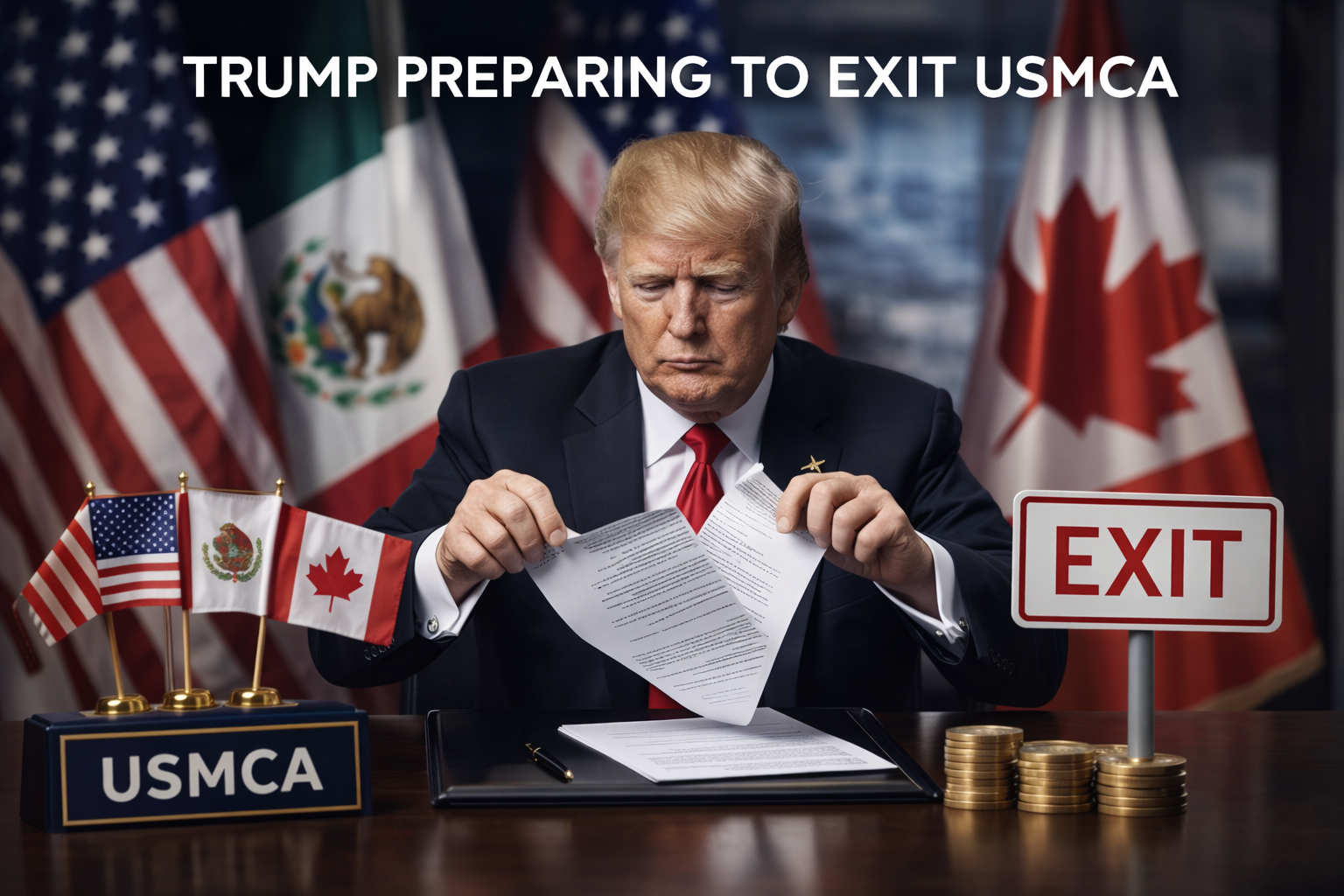
President Donald Trump is reportedly questioning whether the United States should remain in the US-Mexico-Canada Agreement (USMCA), the very trade pact he signed during his first term. While no formal decision has been announced, internal discussions about a possible withdrawal are unfolding just months before the agreement’s mandatory review on July 1. For investors and policymakers alike, the mere possibility of a U.S. exit is enough to reignite uncertainty across North America’s tightly integrated economies.
The USMCA governs nearly $2 trillion in goods and services trade annually, making it one of the largest trading blocs in the world. Any disruption could ripple through manufacturing, agriculture, automotive supply chains, and cross-border energy markets — all critical sectors for both U.S. and global growth.
Renegotiation Turns Contentious
Originally expected to be procedural, the upcoming review has evolved into a high-stakes negotiation. U.S. Trade Representative Jamieson Greer has signaled that the administration does not intend to rubber-stamp the 2019 terms, instead pushing for stronger rules of origin, expanded worker protections, and enhanced cooperation on critical minerals.
Trump has reportedly asked aides why he should not withdraw entirely, though he has stopped short of issuing a formal threat. The administration appears to be keeping its options open, potentially using the possibility of exit as leverage to extract further concessions from Canada and Mexico.
Mexican President Claudia Sheinbaum has downplayed the risk of a U.S. departure, while Canadian Prime Minister Mark Carney described recent talks as “positive.” However, officials in Ottawa acknowledge that negotiations have grown more challenging, particularly amid broader geopolitical tensions and trade disputes.
Economic Stakes and Market Risks
If the agreement is not renewed, the pact could enter annual reviews until its expiration in 2036. Alternatively, any member country can announce its intent to withdraw with six months’ notice. Such a move would likely expose Canadian and Mexican exports to higher U.S. tariffs, with potential retaliatory measures following swiftly.
Markets are particularly sensitive to tariff escalation risks. Automotive manufacturers, whose supply chains span all three countries, could face immediate cost pressures. U.S. exporters may also suffer if retaliatory duties curb access to Canada and Mexico — currently America’s two largest trading partners.
Heading into midterm elections, rising tariffs could also exacerbate inflation and affordability concerns, a politically delicate issue. Business groups and lawmakers from both parties are expected to resist any abrupt withdrawal that threatens domestic industries.
Strategic Leverage or Structural Shift?
Trump has previously threatened to exit trade frameworks before negotiating revised terms, as seen during the transition from NAFTA to USMCA. His recent comments labeling the agreement “irrelevant” contrast sharply with earlier praise describing it as “great for all countries.”
For global investors, the key question is whether this is tactical brinkmanship or a genuine shift in U.S. trade doctrine. Supply chain integration across North America has deepened over three decades. Reversing that integration could trigger capital reallocation, currency volatility, and long-term structural adjustments.
What to Watch Going Forward
Markets will focus on whether Trump escalates rhetoric publicly or initiates formal withdrawal procedures. Equally important will be responses from Canada and Mexico, as well as signals from U.S. industry groups.
With trade, inflation, and geopolitical tensions intersecting, the USMCA review has become more than a routine update — it is a test of North America’s economic cohesion in a shifting global order.
Comparison, examination, and analysis between investment houses
Leave your details, and an expert from our team will get back to you as soon as possible
* This article, in whole or in part, does not contain any promise of investment returns, nor does it constitute professional advice to make investments in any particular field.
To read more about the full disclaimer, click here
- orshu
- •
- 6 Min Read
- •
- ago 4 hours
SKN | Trump’s $2.2 Trillion Budget Plan: Defense Expansion Signals Strategic Shift in US Fiscal Policy
Former President Donald Trump’s proposed $2.2 trillion federal budget is drawing attention across global financial markets, as it combines
- ago 4 hours
- •
- 6 Min Read
Former President Donald Trump’s proposed $2.2 trillion federal budget is drawing attention across global financial markets, as it combines

- Ronny Mor
- •
- 6 Min Read
- •
- ago 1 day
SKN | Strait of Hormuz in Focus: Trump Calls for Global Responsibility as Energy Risks Reprice Markets
Statements urging other nations to take a leading role in securing the Strait of Hormuz have brought renewed attention
- ago 1 day
- •
- 6 Min Read

Statements urging other nations to take a leading role in securing the Strait of Hormuz have brought renewed attention

- Lior mor
- •
- 5 Min Read
- •
- ago 3 days
SKN | Trump Signals Potential U.S. Withdrawal from Iran Within Weeks: Market Implications
U.S. former President Donald Trump suggested that American forces could withdraw from Iran within a two- to three-week timeframe, signaling
- ago 3 days
- •
- 5 Min Read
U.S. former President Donald Trump suggested that American forces could withdraw from Iran within a two- to three-week timeframe, signaling

- sagi habasov
- •
- 9 Min Read
- •
- ago 4 days
SKN | Are Surging Energy Costs Fueling Germany’s Political Shift Back Toward Russian Supplies?
Germany’s energy crisis is rapidly evolving into a political flashpoint, as soaring fuel prices reignite debate over the country’s post-2022
- ago 4 days
- •
- 9 Min Read

Germany’s energy crisis is rapidly evolving into a political flashpoint, as soaring fuel prices reignite debate over the country’s post-2022

