


- Lior mor
- •
- 6 Min Read
- •
- 4 months ago
Key Points
- The KOSPI Composite Index reached a historic milestone, closing at 4,840.74 and securing its 11th consecutive session of gains.
- Robust demand for high-bandwidth memory (HBM) and AI infrastructure continues to serve as the primary engine for South Korean large-cap equities.
- While institutional buying remains strong, the market faces potential volatility from a weakening Korean won and overextended retail short positions.
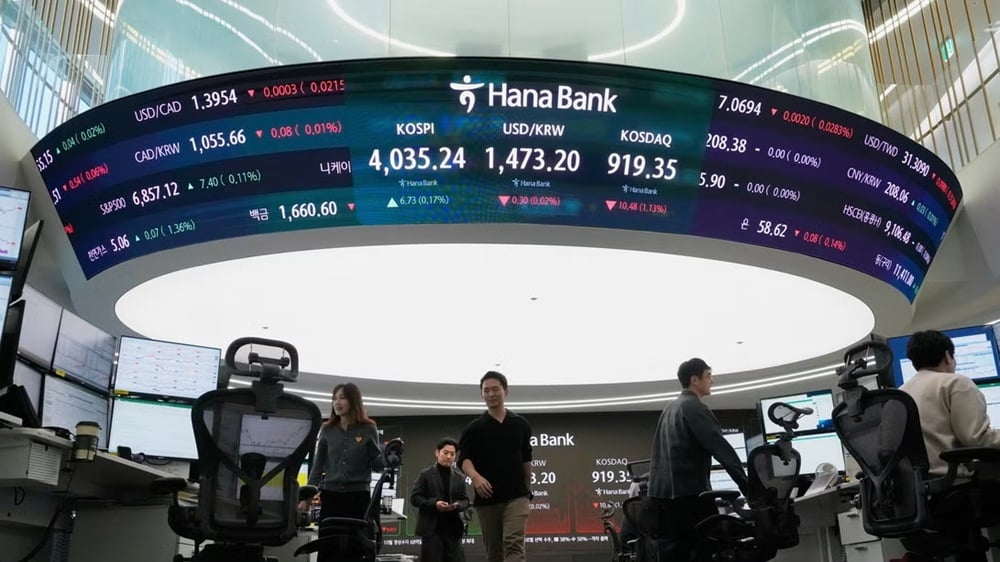
The South Korean equity market demonstrated remarkable resilience this week, with the KOSPI Composite Index breaking through the critical 4,800-point resistance level to reach a new record high. This persistent rally, which has seen the index climb nearly 12% since the start of 2026, unfolds against a complex backdrop of strengthening industrial exports and a domestic currency under pressure.
Semiconductor Dominance and Export Momentum
The primary catalyst for the current surge remains the semiconductor sector, led by heavyweights Samsung Electronics and SK Hynix. Recent data from the Korea Customs Service indicates that while overall exports saw a slight dip in the first ten days of January due to fewer working days, chip exports spiked by 45.6% year-on-year. This underscores a structural “super-cycle” driven by global Artificial Intelligence (AI) investment. Investors are increasingly pricing in aggressive earnings-per-share (EPS) growth for 2026, with major brokerages like Macquarie suggesting that the market’s price-to-earnings (PE) ratio remains attractive even at these elevated levels.
Market Polarization and Retail Sentiment
Despite the record-breaking performance, a “K-shaped” polarization is becoming evident within the Seoul bourse. While export-oriented tech and defense sectors are flourishing, domestically focused firms and the small-cap KOSDAQ have lagged. A significant point of friction has emerged in retail sentiment; many individual investors have increased their exposure to inverse ETFs, betting on a market correction that has yet to materialize. This has led to a “short squeeze” effect, where rising prices force the unwinding of bearish bets, further propelling the KOSPI upward.
Macroeconomic Headwinds: The Won and Monetary Policy
The Korean won continues to fluctuate near the 1,470 per dollar mark, a level that historically triggers caution regarding foreign capital outflows. While a weaker won typically benefits exporters’ bottom lines, it also increases the cost of energy imports and complicates the Bank of Korea’s (BOK) inflation management. Governor Rhee Chang-yong recently signaled a shift away from imminent interest rate cuts, suggesting that the central bank will maintain a restrictive stance until currency stability is restored. This “higher-for-longer” rate environment serves as a necessary counterbalance to the overheated equity markets.
The outlook for the remainder of the first quarter remains bullish yet cautious. Investors should closely monitor the January flash PMI data and upcoming Q4 2025 earnings calls for confirmation that the AI-driven demand is translating into realized cash flow. While some analysts have raised year-end targets toward the 5,200–5,600 range, the immediate risk lies in a technical “pullback” as the index enters overbought territory. Strategic focus should remain on valuation rerating opportunities in laggard sectors like shipbuilding and automobiles, which may offer a hedge if the tech rally pauses.
Comparison, examination, and analysis between investment houses
Leave your details, and an expert from our team will get back to you as soon as possible
* This article, in whole or in part, does not contain any promise of investment returns, nor does it constitute professional advice to make investments in any particular field.
To read more about the full disclaimer, click here
- Ronny Mor
- •
- 6 Min Read
- •
- ago 10 minutes
SKN | Supermicro Allegations Raise Red Flags—Could Nvidia Server Flows to China Trigger Sector-Wide Scrutiny?
Allegations that a Super Micro Computer (Supermicro) co-founder was involved in smuggling Nvidia-powered AI servers into China have introduced
- ago 10 minutes
- •
- 6 Min Read
Allegations that a Super Micro Computer (Supermicro) co-founder was involved in smuggling Nvidia-powered AI servers into China have introduced

- Arik Arkadi Sluzki
- •
- 5 Min Read
- •
- ago 13 minutes
SKN | Silver in the Next Decade — Structural Upside or Volatility Trap?
Silver is entering the next decade at the intersection of industrial demand and macroeconomic uncertainty, positioning it uniquely among
- ago 13 minutes
- •
- 5 Min Read

Silver is entering the next decade at the intersection of industrial demand and macroeconomic uncertainty, positioning it uniquely among

- sagi habasov
- •
- 5 Min Read
- •
- ago 49 minutes
SKN | Gold at $6,000 — Realistic Breakout or Market Speculation?
Gold has re-emerged as a focal point for global investors, with some projections raising the possibility of prices reaching
- ago 49 minutes
- •
- 5 Min Read

Gold has re-emerged as a focal point for global investors, with some projections raising the possibility of prices reaching

- orshu
- •
- 5 Min Read
- •
- ago 2 hours
SKN | U.S. Trade Deficit Widens 4.3% in March as Tariff Policy Uncertainty Resurfaces
The U.S. trade deficit widened by 4.3% in March, marking the second straight monthly increase since the reversal of
- ago 2 hours
- •
- 5 Min Read

The U.S. trade deficit widened by 4.3% in March, marking the second straight monthly increase since the reversal of

