


- Ronny Mor
- •
- 7 Min Read
- •
- 4 months ago
Key Points
- A historic divergence has emerged: While Nvidia crashes by 12.59% and the "Magnificent 7" ETF retreats by 1.77%, the S&P 500 maintains positive territory.
- This decoupling signals a massive capital rotation from concentrated tech growth into the broader market, validating the strength of the "other 493" stocks.
- The market’s ability to absorb a double-digit correction in its leading asset without a systemic sell-off indicates reduced fragility and matured investor psychology.
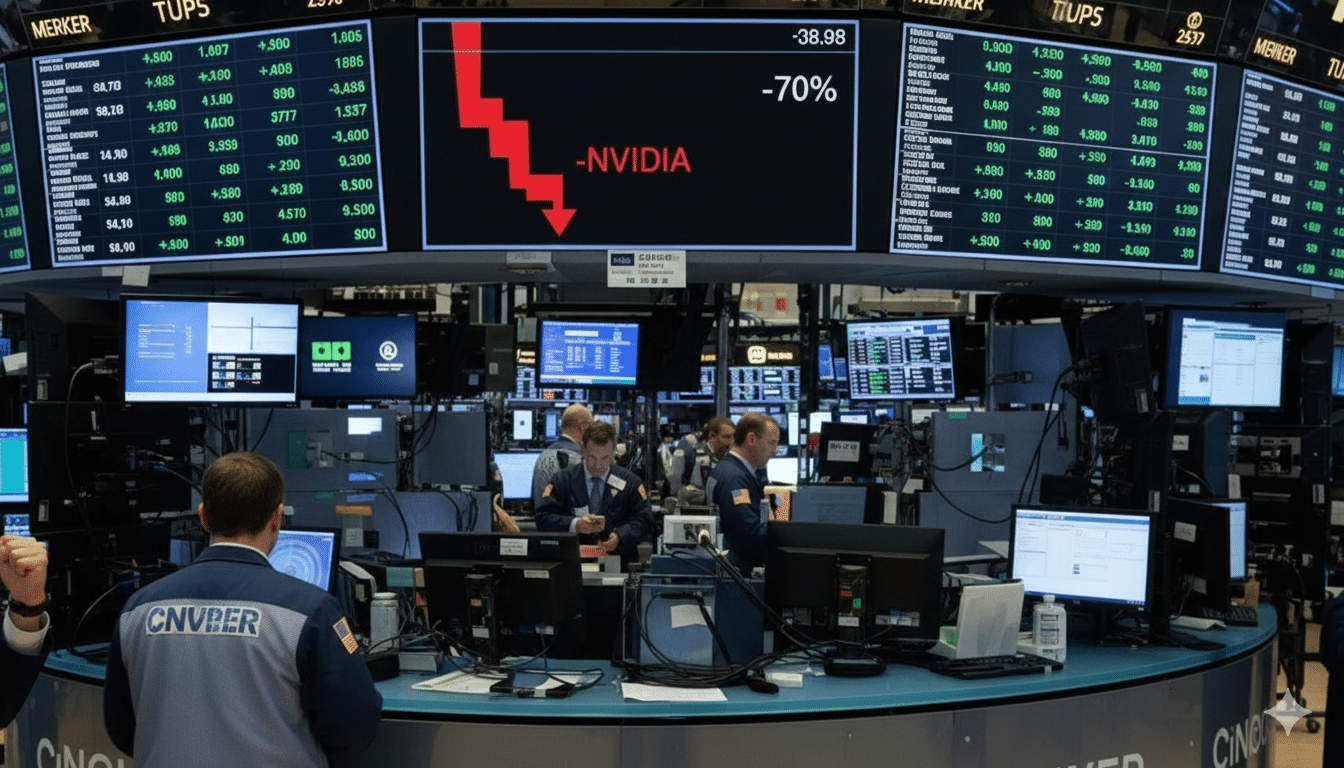
The chart tracking market performance through November 2025 serves as more than a simple price history; it is definitive proof of a regime change in U.S. equity markets. For two years, the prevailing narrative on Wall Street was linear and simplistic: “As goes Nvidia, so goes the market.” This dogma created a high risk premium and a persistent fear that an AI bubble burst would drag the entire economy into a recession. However, reality has shattered this skepticism. The data clearly shows Nvidia nose-diving 12.59% and the MAGS ETF falling 1.77%, yet remarkably, the S&P 500 closes the period in the green, up 0.13%. This is not a statistical anomaly; it is the real economy declaring independence from technological over-dependence.
Anatomy of a Rotation: Smart Money Finds New Homes
The dramatic gap between the red line (Nvidia) and the green line (S&P 500) reveals the mechanics under the hood of Wall Street’s algorithmic engines. When a mega-cap, market-moving asset like Nvidia sheds nearly an eighth of its value in a single month, the mathematical implication is immense downward pressure on the index. The fact that the index remained resilient suggests that every dollar fleeing Nvidia and Big Tech did not exit the market to cash, but rather rotated immediately into other sectors. We are witnessing the “Great Rotation”—capital moving from hyper-speculative momentum plays into value, industrials, financials, and energy. Smart money recognizes that the valuation of the “Magnificent 7” has reached saturation and is now hunting for yield among the remaining 493 stocks, which have traded at an unjustifiable discount until now.
Market Psychology: The End of Reflexive Panic
A fascinating aspect revealed by the data is the psychological resilience of the investor base. In the recent past, a double-digit drop in Nvidia would have served as a trigger for a global “Risk-Off” event, spiking the VIX and causing broad liquidations. The current scenario, where the broad index shrugs off the collapse of its leading constituent, points to a healthy emotional detachment. Investors have ceased to view AI as the sole pillar of the economy. They are beginning to price risk idiosyncratically rather than systemically. The market is effectively stating: “Nvidia’s problem is Nvidia’s problem, not the American economy’s problem.” This maturity signals a healthier market structure, driven by broad-based earnings rather than focused hype.
Opportunity in the Shadow of Fading Giants
For the professional strategist, this chart is a counter-intuitive “Buy” signal for the broader index. When the market can absorb a ~12.6% drop in its primary growth engine and still remain positive, it demonstrates tremendous underlying strength. This is “Anti-Fragility” in action—the system withstands stress and becomes more robust. Concentration risk, the dark cloud hovering over Wall Street throughout 2023 and 2024, is dissipating. Investors who hesitated to enter the market, fearing it was “too dependent on a few stocks,” now have the proof they needed: the S&P 500 is a living organism capable of reinventing itself even as its brightest stars fade.
The core lesson for the coming quarters is clear: do not bet against the market simply because tech is correcting. The dynamics have shifted. We are entering an era where stock picking outside the tech sector will generate significant alpha. Nvidia may have finished its role as the sole locomotive, but the train itself continues to barrel forward, now powered by hundreds of smaller, more efficient engines. This is excellent news for long-term financial stability, ensuring that the tech correction remains an isolated sectoral event rather than a macroeconomic crisis.
Comparison, examination, and analysis between investment houses
Leave your details, and an expert from our team will get back to you as soon as possible
* This article, in whole or in part, does not contain any promise of investment returns, nor does it constitute professional advice to make investments in any particular field.
To read more about the full disclaimer, click here
- sagi habasov
- •
- 4 Min Read
- •
- ago 2 months
SKN | JPMorgan: Bitcoin Now More Attractive Than Gold Long Term
Investment bank JPMorgan suggests a significant shift in Bitcoin's status as a long-term investment asset compared to gold. According to
- ago 2 months
- •
- 4 Min Read

Investment bank JPMorgan suggests a significant shift in Bitcoin's status as a long-term investment asset compared to gold. According to

- Ronny Mor
- •
- 6 Min Read
- •
- ago 3 months
SKN | Intel and Tata Push India Into the Semiconductor Big Leagues with a Strategic Supply-Chain Alliance
India’s emerging semiconductor strategy gained major momentum as Tata Electronics and Intel announced a far-reaching collaboration aimed at building a
- ago 3 months
- •
- 6 Min Read
India’s emerging semiconductor strategy gained major momentum as Tata Electronics and Intel announced a far-reaching collaboration aimed at building a

- omer bar
- •
- 7 Min Read
- •
- ago 4 months
SKN | Horizon Quantum Deploys Singapore’s First Commercial Quantum Computer Ahead of Nasdaq Listing
Singapore Marks Major Milestone in Quantum Race Singapore-based Horizon Quantum has become the first private company to deploy a commercial
- ago 4 months
- •
- 7 Min Read

Singapore Marks Major Milestone in Quantum Race Singapore-based Horizon Quantum has become the first private company to deploy a commercial
- Ronny Mor
- •
- 7 Min Read
- •
- ago 4 months
SKN | The Last Wall Falls: Bank of America Signals 4% as the New Portfolio Standard for Crypto
The implication from Bank of America that wealth management clients may allocate up to 4% of their portfolios to crypto
- ago 4 months
- •
- 7 Min Read

The implication from Bank of America that wealth management clients may allocate up to 4% of their portfolios to crypto

