




- Lior mor
- •
- 8 Min Read
- •
- 2 minutes ago


Key Points
- Nvidia generated approximately $96.2 billion in quarterly revenue in the latest period shown in the attached chart.
- AMD generated approximately $11.5 billion, highlighting the substantial revenue gap between the two semiconductor companies.
- The comparison illustrates how the AI infrastructure boom has transformed Nvidia's financial scale while AMD continues to expand from a significantly smaller revenue base.
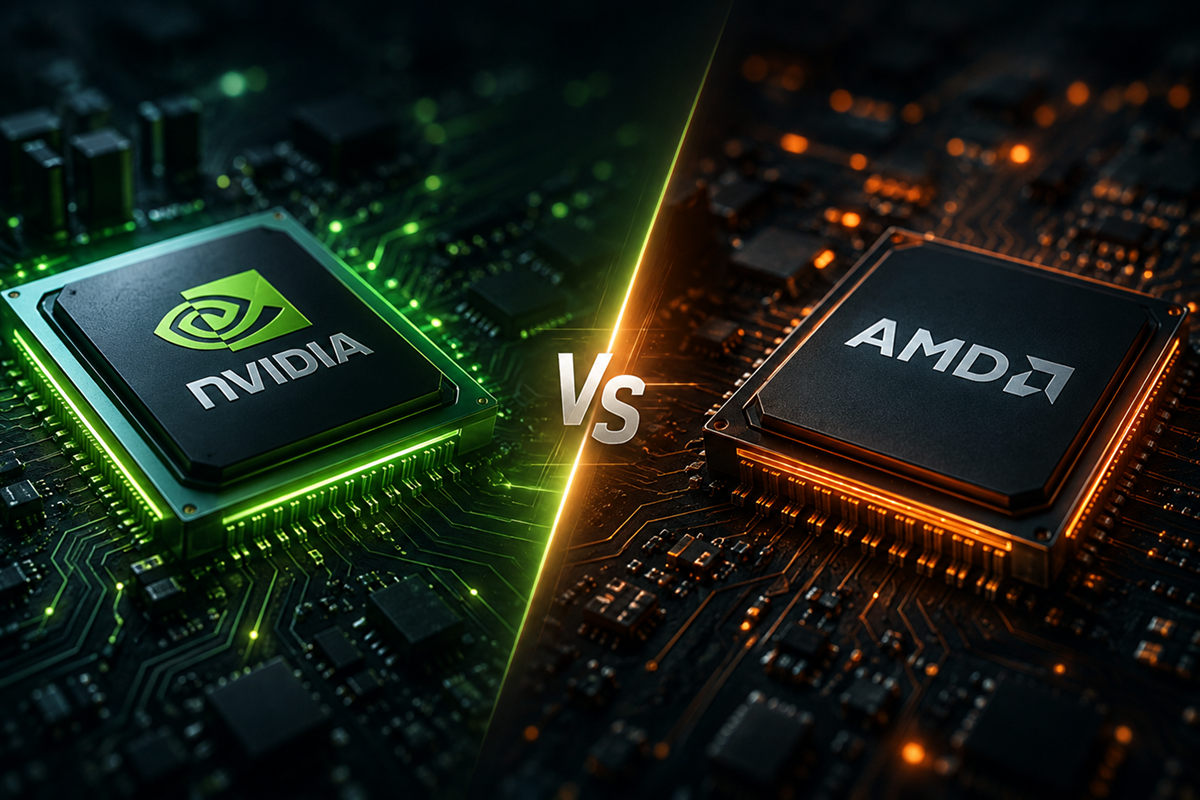
When ChatGPT emerged in late 2022, Nvidia and AMD were generating quarterly revenue at broadly similar levels, according to the attached source, with both companies bringing in roughly $6.1 billion. Less than four years later, the revenue trajectories shown in the chart have diverged dramatically, reflecting Nvidia’s dominant position in the infrastructure buildout surrounding artificial intelligence.
The latest figures shown place Nvidia’s quarterly revenue at approximately $96.2 billion, compared with about $11.5 billion for AMD. The gap demonstrates the extraordinary scale of Nvidia’s expansion as hyperscale cloud providers, technology companies and governments have accelerated spending on AI computing infrastructure.
Nvidia’s Revenue Growth Has Accelerated With the AI Infrastructure Cycle
The attached chart shows Nvidia’s quarterly revenue climbing from roughly $6 billion in the period around ChatGPT’s emergence to more than $96 billion in the latest quarter displayed. The acceleration became particularly pronounced as demand for AI accelerators and data-center computing capacity expanded across the global technology industry.
This growth reflects a broader shift in capital expenditure. Major cloud providers and technology companies have increasingly allocated substantial budgets toward the data centers, processors, networking equipment and power infrastructure required to train and operate advanced AI systems. Nvidia has been one of the largest beneficiaries of that investment cycle because its products and software ecosystem have become deeply embedded in AI computing infrastructure.
For capital markets, Nvidia’s rise has therefore become more than a semiconductor story. The company’s revenue trajectory has become a closely watched indicator of how rapidly global investment in artificial intelligence infrastructure is translating into corporate spending and financial results.
AMD Is Growing, but From a Very Different Revenue Base
AMD’s latest quarterly revenue shown in the chart is approximately $11.5 billion. While that figure represents substantial scale for a semiconductor company, it remains far below Nvidia’s reported level in the same comparison.
The difference is important because the AI market is not simply a contest over technological capability. Revenue leadership is heavily influenced by manufacturing capacity, software ecosystems, customer relationships and the speed at which companies can deploy products at global scale. Nvidia established a powerful early position in accelerated computing, while AMD has been working to expand its presence across AI accelerators, data-center processors and other high-performance computing markets.
AMD’s future performance will therefore be closely tied to its ability to capture a larger share of AI-related spending without relying exclusively on the traditional PC and server processor markets. A broader competitive field could eventually benefit customers seeking additional sources of high-performance computing capacity, although Nvidia’s current revenue advantage remains substantial.
The Revenue Gap Highlights the Economics of AI Leadership
The comparison between $96.2 billion for Nvidia and $11.5 billion for AMD illustrates how concentrated the financial rewards of the current AI investment cycle have become. Nvidia’s scale provides it with significant resources for research, product development and ecosystem expansion, potentially reinforcing its competitive position as the industry moves toward increasingly complex AI systems.
At the same time, the scale of global AI spending creates opportunities for other semiconductor companies. The demand for computing power is expanding across chips, networking, memory, data-center construction and energy infrastructure. For Israeli investors and institutions with exposure to global technology markets, this means the AI cycle extends beyond a single company, even if Nvidia currently represents its most prominent financial beneficiary.
Looking ahead, investors will be watching whether Nvidia can sustain its exceptional revenue growth as the AI infrastructure cycle matures, and whether AMD can convert growing demand for alternative computing platforms into a larger share of industry revenue. The next phase of the competition may depend less on proving that AI demand exists and more on determining how broadly the enormous spending pool is distributed among semiconductor leaders.
Comparison, examination, and analysis between investment houses
Leave your details, and an expert from our team will get back to you as soon as possible
* This article, in whole or in part, does not contain any promise of investment returns, nor does it constitute professional advice to make investments in any particular field.
To read more about the full disclaimer, click here
- Ramil
- •
- 7 Min Read
- •
- ago 2 minutes
SKN | Big Tech Faces a Pivotal Week as Apple Leadership Transition and Tesla Robotaxi Event Take Center Stage
The coming week could bring two closely watched developments for the global technology sector, according to the attached market
- ago 2 minutes
- •
- 7 Min Read
The coming week could bring two closely watched developments for the global technology sector, according to the attached market

- sagi habasov
- •
- 9 Min Read
- •
- ago 51 minutes
SKN | OpenAI Moves to Cut Off Cursor Models as Rivalry With Musk’s SpaceX Escalates
OpenAI plans to cut off access to its artificial intelligence models for Cursor, the fast-growing coding platform now owned
- ago 51 minutes
- •
- 9 Min Read

OpenAI plans to cut off access to its artificial intelligence models for Cursor, the fast-growing coding platform now owned

- omer bar
- •
- 9 Min Read
- •
- ago 2 hours
SKN | China’s CXMT Challenges Pentagon Over ‘Chinese Military Company’ Designation
China’s leading memory-chip producer ChangXin Memory Technologies, or CXMT, has launched a legal challenge against the Pentagon after being
- ago 2 hours
- •
- 9 Min Read
China’s leading memory-chip producer ChangXin Memory Technologies, or CXMT, has launched a legal challenge against the Pentagon after being

- orshu
- •
- 7 Min Read
- •
- ago 1 day
SKN | IREN Expands AI Infrastructure Ambitions as Cloud Revenue Accelerates and ARR Reaches $1 Billion
IREN Ltd. reported fiscal fourth-quarter 2026 results on August 27, 2026, highlighting the company’s accelerating transition from cryptocurrency mining
- ago 1 day
- •
- 7 Min Read

IREN Ltd. reported fiscal fourth-quarter 2026 results on August 27, 2026, highlighting the company’s accelerating transition from cryptocurrency mining
