




- omer bar
- •
- 7 Min Read
- •
- 3 hours ago


Key Points
- SpaceX has indicated that it intends to standardize its future AI infrastructure on Nvidia's Vera Rubin architecture, potentially extending across terrestrial and orbital computing.
- Investor Larry Goldberg believes the relationship could encompass SpaceX's ground facilities, Starmind satellite payloads and expanding AI computing network.
- TeraFab and Nvidia's broader AI financing initiatives could become relevant to SpaceX's infrastructure ambitions, although no overarching agreement between the companies has been confirmed.
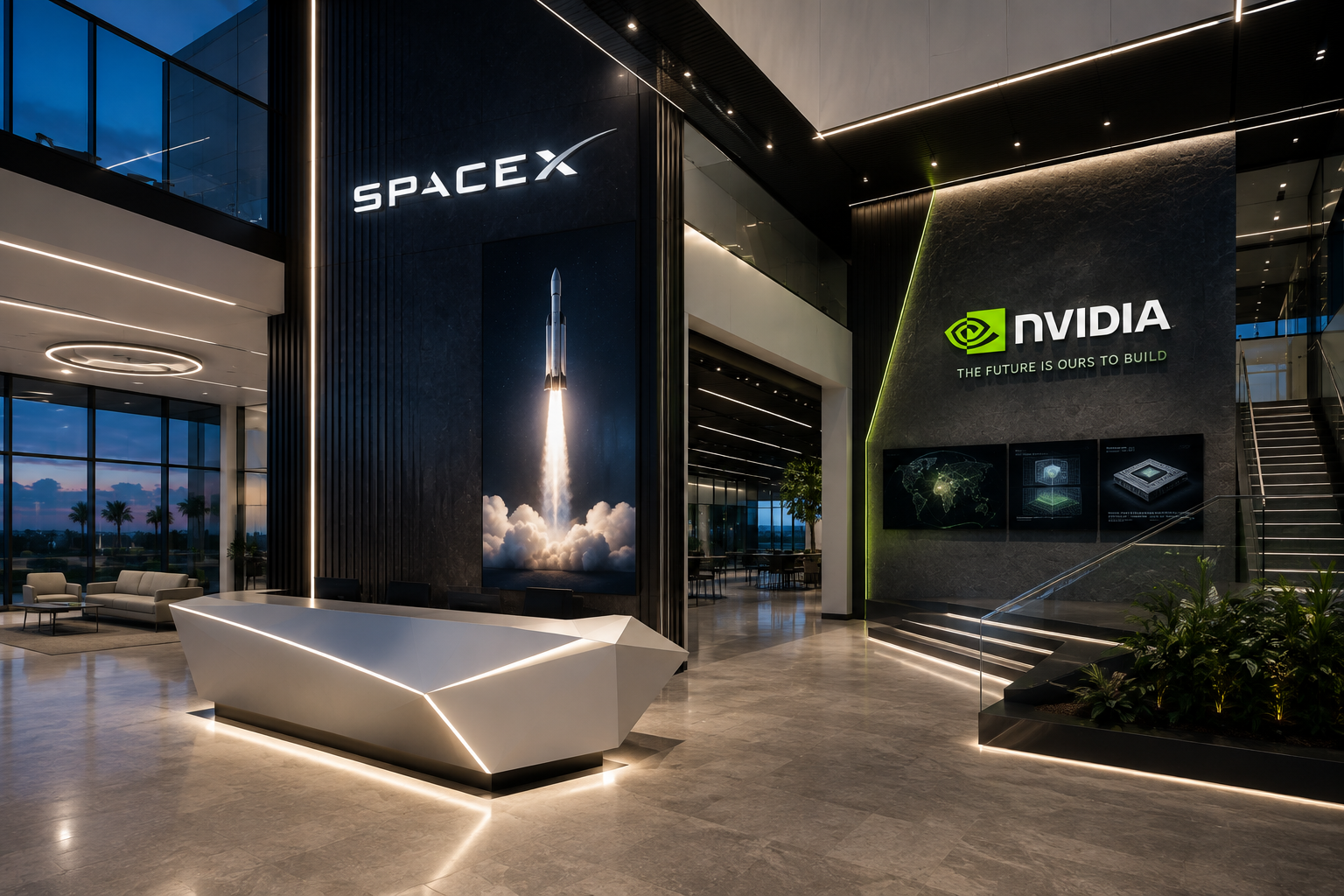
SpaceX and Nvidia may be developing a relationship that extends well beyond the conventional supplier-customer model, according to investor Larry Goldberg. The thesis centers on SpaceX’s decision to standardize its AI infrastructure on Nvidia technology, including planned computing capacity on Earth and potentially in orbit. If the relationship develops as suggested, it could connect Nvidia’s AI hardware strategy with SpaceX’s expanding data-center, satellite and space-computing ambitions, although no overarching partnership covering all of these initiatives has been confirmed.
Nvidia Hardware Could Become the Foundation of SpaceX’s AI Network
Following SpaceX’s August 4 earnings call, Goldberg highlighted comments from Elon Musk indicating that SpaceX intends to build its future AI infrastructure exclusively around Nvidia’s Vera Rubin architecture. Musk described Nvidia’s technology as the preferred AI computing platform and emphasized the companies’ broader cooperation.
The significance extends beyond purchasing GPUs for conventional data centers. SpaceX is pursuing a major expansion of computing capacity, with targets exceeding 2 gigawatts by the end of 2026 and approaching 10 gigawatts the following year. If Nvidia becomes the standardized architecture across this infrastructure, the relationship could create a substantial long-term source of demand for Nvidia’s computing platforms.
Orbital Computing Could Expand the Relationship
Goldberg also pointed to SpaceX’s work on Starmind AI satellite payloads, which could use Nvidia Rubin GPUs and Vera CPUs to deliver data-center-level processing capabilities in orbit. Similar computing systems could potentially support SpaceX’s terrestrial facilities, creating an infrastructure model that spans both conventional data centers and space-based computing.
This distinction is strategically important. Instead of treating satellites primarily as communications assets, SpaceX could increasingly position orbital infrastructure as part of a broader computing network. Nvidia’s hardware would then potentially become embedded across multiple layers of that ecosystem.
However, the available information does not establish a comprehensive SpaceX-Nvidia agreement covering all of these projects. The broader alliance remains an investment thesis based on the companies’ stated technology relationship and SpaceX’s computing ambitions.
TeraFab Adds a Semiconductor Dimension
The potential relationship becomes more complicated when SpaceX and Tesla’s TeraFab investment is considered. The companies have committed an initial $16.8 billion to the Texas semiconductor complex, which is intended to produce chips for edge inference applications in Optimus and Cybercab systems as well as high-power processors for space-based data centers.
Intel is the named TeraFab partner, and Nvidia has no formal role in the project according to the source material. Nevertheless, Goldberg argues that the semiconductor initiative fits into a broader strategy centered on expanding specialized computing capacity.
The coexistence of Intel’s manufacturing role and Nvidia’s AI architecture highlights the different layers of the emerging infrastructure ecosystem. Nvidia could provide the computing architecture while other partners contribute manufacturing and production capabilities.
Could AI Financing Accelerate SpaceX’s Expansion?
Goldberg also sees Nvidia’s $500 billion AI financing initiative as a potential source of future infrastructure capital. SpaceX has not been identified as a participant, so any connection remains speculative. Nevertheless, the company’s ambitious computing expansion and close relationship with Nvidia raise questions about whether future financing programs could support portions of its terrestrial or orbital infrastructure.
Market Outlook
The potential SpaceX-Nvidia relationship represents a broader shift toward integrating AI computing with physical infrastructure, telecommunications and space systems. For Nvidia, deeper adoption by SpaceX could reinforce demand for its next-generation architecture, while SpaceX could gain access to a standardized computing platform as it expands capacity on Earth and in orbit. Investors will likely watch for additional announcements involving Nvidia hardware, Starmind, orbital data centers and financing arrangements. Until a broader agreement is formally disclosed, however, the deeper-alliance thesis remains an emerging possibility rather than an established corporate partnership.
Comparison, examination, and analysis between investment houses
Leave your details, and an expert from our team will get back to you as soon as possible
* This article, in whole or in part, does not contain any promise of investment returns, nor does it constitute professional advice to make investments in any particular field.
To read more about the full disclaimer, click here
- sagi habasov
- •
- 7 Min Read
- •
- ago 4 hours
SKN | Who Controls What Your Team Shares With AI?
As artificial intelligence becomes embedded in everyday workplace workflows, organizations face a growing security challenge: employees may use AI tools
- ago 4 hours
- •
- 7 Min Read

As artificial intelligence becomes embedded in everyday workplace workflows, organizations face a growing security challenge: employees may use AI tools

- omer bar
- •
- 6 Min Read
- •
- ago 7 hours
SKN | OpenAI Revenue Surpasses $40 Billion Run Rate as Codex, Subscriptions and Advertising Fuel Growth
OpenAI’s annualized revenue has reportedly exceeded $40 billion, marking a sharp acceleration in commercial activity as demand for artificial intelligence
- ago 7 hours
- •
- 6 Min Read

OpenAI’s annualized revenue has reportedly exceeded $40 billion, marking a sharp acceleration in commercial activity as demand for artificial intelligence

- Ronny Mor
- •
- 6 Min Read
- •
- ago 9 hours
SKN | What Are the Five Key Questions Analysts Are Asking After Vishay Intertechnology’s Q2 Results?
Vishay Intertechnology’s second-quarter results arrive as the semiconductor and electronic-components markets show signs of improving demand following a prolonged inventory
- ago 9 hours
- •
- 6 Min Read

Vishay Intertechnology’s second-quarter results arrive as the semiconductor and electronic-components markets show signs of improving demand following a prolonged inventory
- Ronny Mor
- •
- 6 Min Read
- •
- ago 10 hours
SKN | Pony.ai and Uber Target Europe With More Than 2,000 Robotaxis in Major Autonomous Driving Push
China’s Pony.ai and Uber are preparing to deploy more than 2,000 robotaxis across Europe, marking a significant expansion of autonomous
- ago 10 hours
- •
- 6 Min Read

China’s Pony.ai and Uber are preparing to deploy more than 2,000 robotaxis across Europe, marking a significant expansion of autonomous


