





- Lior mor
- •
- 8 Min Read
- •
- 12 hours ago
Key Points
- Credit default swap spreads for several major technology companies have risen sharply in 2026, signaling increased investor scrutiny of Big Tech balance sheets.
- Oracle's five-year CDS has recorded the largest increase among the companies highlighted, while Broadcom, Meta, Nvidia, Amazon, and Alphabet have also seen higher credit protection costs.
- The surge in technology-sector borrowing reflects the enormous capital requirements of AI infrastructure and raises questions about the long-term returns on that spending.
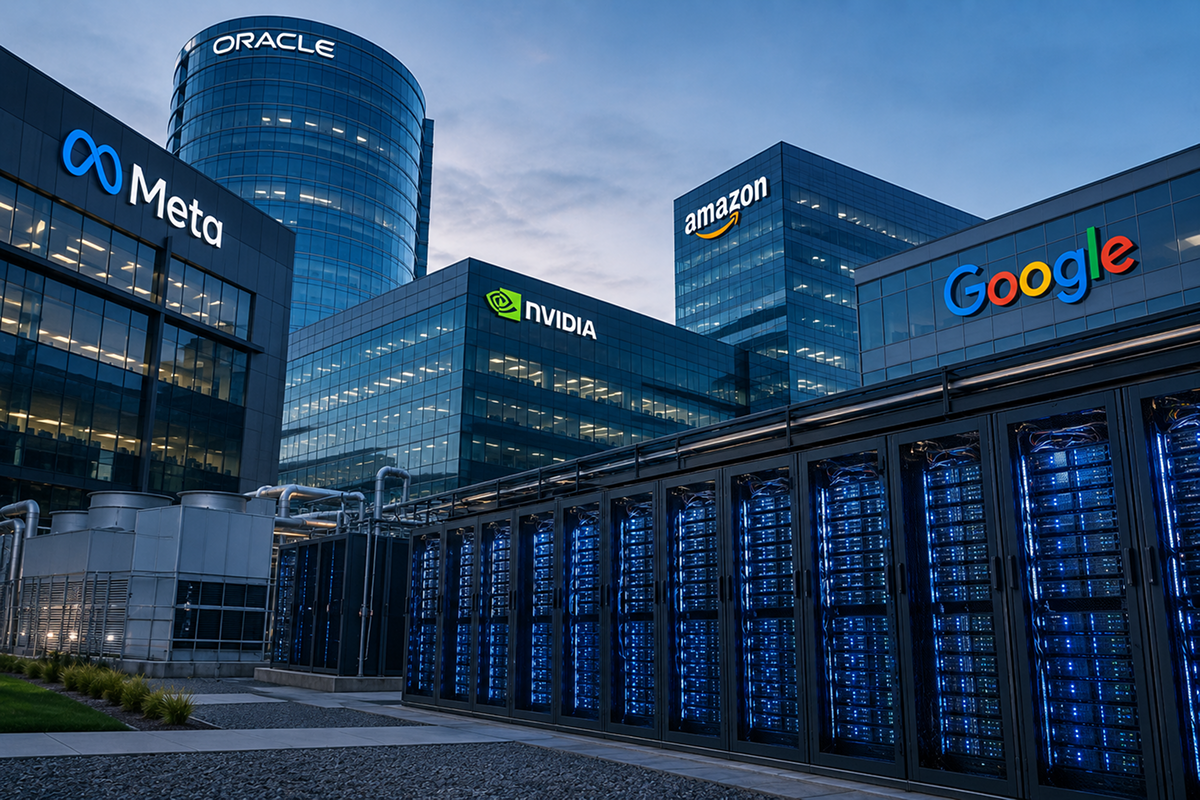
Credit markets are increasingly scrutinizing the cost of financing the artificial intelligence buildout as major technology companies commit hundreds of billions of dollars to data centers, chips, networking equipment, and related infrastructure. The latest move in credit default swaps suggests that bond investors are becoming more sensitive to leverage and cash-flow pressures even as equity markets continue to price substantial long-term growth opportunities from AI.
The development marks an important shift in the AI investment cycle. What began primarily as an equity-market story has increasingly become a corporate credit story, with the world’s largest technology companies turning to debt markets to supplement internal cash flows and fund rapidly expanding capital expenditure programs.
Oracle Leads the Increase in Credit Protection Costs
Among the companies highlighted in the market data, Oracle has experienced the most significant increase in its five-year credit default swap spread. Its CDS has risen by approximately 70 basis points during 2026 to roughly 215 basis points, according to the figures referenced in the source material.
The increase is notable because CDS spreads represent the cost of purchasing protection against a deterioration in a company’s creditworthiness. A wider spread does not mean that a company is expected to default. Instead, it indicates that the market is demanding greater compensation for taking on perceived credit risk.
Oracle’s exposure is particularly relevant because the company has been aggressively expanding its cloud infrastructure to meet contracted demand from major AI customers. Oracle itself announced in February that it expected to raise $45 billion to $50 billion during 2026 through a combination of debt and equity financing to fund the expansion of Oracle Cloud Infrastructure.
Credit Concerns Spread Across the AI Ecosystem
The increase has not been isolated to Oracle. The source data shows that Broadcom’s five-year CDS increased by approximately 48 basis points, while Meta’s rose by 39 basis points to around 95 basis points. Nvidia’s five-year CDS increased by approximately 32 basis points to roughly 82 basis points, while Amazon and Alphabet recorded increases of approximately 30 and 29 basis points, respectively.
The broad-based nature of the moves is significant. These companies have different business models and balance-sheet structures, yet they share substantial exposure to the AI infrastructure investment cycle. That makes the movement in CDS spreads less about the financial condition of a single company and more about how credit markets are reassessing the capital intensity of the broader AI expansion.
Recent market data also shows that technology companies have dramatically increased their use of the corporate bond market. Reuters reported in July that the largest technology companies were increasingly using debt and equity financing to support AI infrastructure, with combined AI-related spending expected to exceed $700 billion in 2026.
AI Spending Creates a New Test for Corporate Cash Flow
The central issue for credit investors is not necessarily whether AI demand will continue, but whether the returns generated by that demand will justify the scale of current capital expenditure. Building data centers, acquiring advanced chips, expanding networking capacity, and securing power supplies require enormous upfront investments before the resulting infrastructure can generate sufficient cash flow.
This creates a different risk profile from earlier technology investment cycles. Even highly profitable companies can experience pressure on free cash flow when capital expenditure grows faster than operating cash generation. For bondholders, the question is therefore increasingly focused on whether future AI-related revenues will arrive quickly enough to support higher financing requirements.
For institutional investors in Israel and globally, the widening CDS spreads provide an additional lens through which to evaluate the AI trade. Equity markets may emphasize revenue growth and future earnings potential, while credit markets place greater weight on leverage, cash generation, refinancing requirements, and downside protection.
Looking ahead, investors will closely monitor corporate bond issuance, CDS spreads, capital expenditure guidance, free cash flow, and the pace at which AI infrastructure generates measurable returns. A continued rise in credit protection costs could indicate that bond investors are becoming increasingly cautious about the financing burden of the AI buildout. Conversely, stabilization in credit spreads alongside strong cash-flow growth could reinforce confidence that the industry’s enormous infrastructure investments are beginning to translate into sustainable economic returns.
Comparison, examination, and analysis between investment houses
Leave your details, and an expert from our team will get back to you as soon as possible
* This article, in whole or in part, does not contain any promise of investment returns, nor does it constitute professional advice to make investments in any particular field.
To read more about the full disclaimer, click here
- orshu
- •
- 8 Min Read
- •
- ago 8 hours
SKN | ServiceNow’s AI Growth Story Faces a New Test: Can Revenue Expansion Restore Its Former Valuation?
ServiceNow (NYSE: NOW) has become a focal point of the debate over whether enterprise software stocks have been unfairly
- ago 8 hours
- •
- 8 Min Read
ServiceNow (NYSE: NOW) has become a focal point of the debate over whether enterprise software stocks have been unfairly

- Ronny Mor
- •
- 7 Min Read
- •
- ago 8 hours
SKN | Rocket Lab Heads Toward Another Record Quarter as Space and Defense Demand Accelerate
Rocket Lab USA (NASDAQ: RKLB) is approaching another potentially record-setting quarter as demand for launch services, satellites and national-security
- ago 8 hours
- •
- 7 Min Read
Rocket Lab USA (NASDAQ: RKLB) is approaching another potentially record-setting quarter as demand for launch services, satellites and national-security

- Lior mor
- •
- 7 Min Read
- •
- ago 8 hours
SKN | Could Ondas Be Emerging as a Key Autonomous Defense Platform With Strong Growth Potential?
Ondas Inc. (NASDAQ: ONDS) is increasingly attracting attention as the global defense industry accelerates its adoption of autonomous systems,
- ago 8 hours
- •
- 7 Min Read
Ondas Inc. (NASDAQ: ONDS) is increasingly attracting attention as the global defense industry accelerates its adoption of autonomous systems,

- omer bar
- •
- 8 Min Read
- •
- ago 9 hours
SKN | AMD Expands Its AI Strategy With Taalas Acquisition to Target the Next Phase of Inference Computing
Advanced Micro Devices (AMD) is expanding its artificial intelligence strategy with an agreement to acquire Taalas, a Toronto-based semiconductor
- ago 9 hours
- •
- 8 Min Read
Advanced Micro Devices (AMD) is expanding its artificial intelligence strategy with an agreement to acquire Taalas, a Toronto-based semiconductor


