Key Points

  • Rocket Lab generated stronger revenue growth and larger scale than Redwire in 2025, making it one of the fastest-growing companies in the commercial space sector.
  • Redwire offers exposure to critical space infrastructure and trades at a lower valuation, but continues to face profitability and customer concentration challenges.
  • Rocket Lab's vertically integrated business model and expansion into satellite services position it for broader long-term growth opportunities.
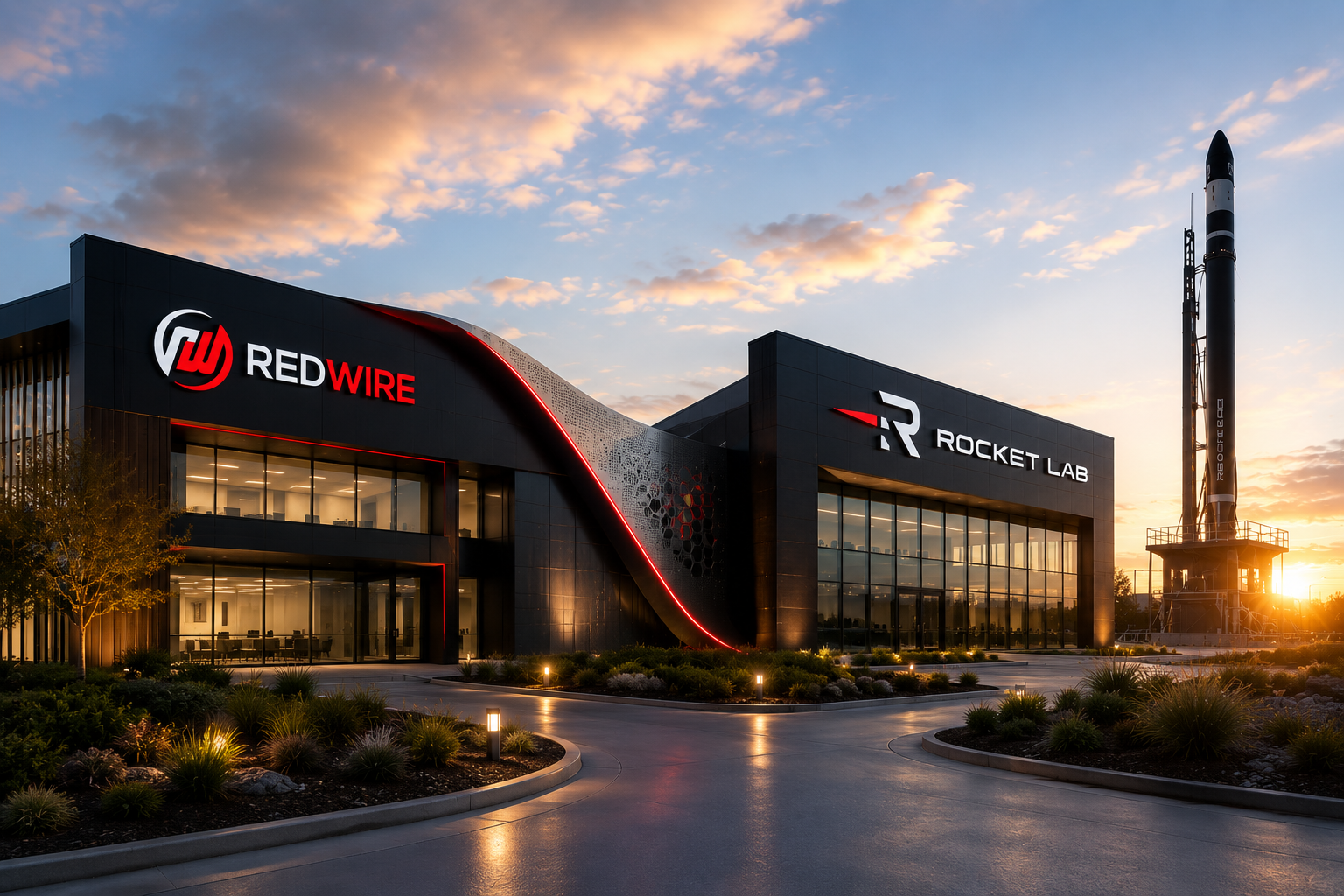
hero

The space economy has evolved from a speculative investment theme into a rapidly expanding industry attracting billions of dollars in government and private-sector funding.

Among publicly traded space companies, Redwire (NYSE: RDW) and Rocket Lab USA (NASDAQ: RKLB) have emerged as two prominent players offering different approaches to capitalizing on the industry’s growth.

While Redwire focuses primarily on the infrastructure that powers spacecraft and satellites, Rocket Lab combines launch services, satellite manufacturing, and space systems into a comprehensive end-to-end platform.

Redwire’s Infrastructure Strategy

Redwire specializes in the technologies that enable spacecraft operations, including solar arrays, avionics systems, sensors, and autonomous technologies.

The company serves government agencies, defense organizations, and commercial customers involved in satellite and space missions.

In fiscal 2025, Redwire generated $335.4 million in revenue, representing 10% year-over-year growth. However, the company reported a net loss of approximately $226 million, highlighting the ongoing challenges of scaling operations while investing in future growth.

Although Redwire maintains a relatively healthy balance sheet with low leverage and a current ratio of approximately 1.6, free cash flow remained negative at roughly $190.8 million.

Another concern is customer concentration. Two major customers accounted for nearly 40% of total revenue, exposing the company to contract and budget risks.

Rocket Lab’s Expanding Space Platform

Rocket Lab has evolved beyond its roots as a launch provider.

Today, the company operates a vertically integrated business that includes launch services, spacecraft manufacturing, satellite components, and future satellite-based services.

Revenue reached nearly $602 million in fiscal 2025, representing an impressive 38% year-over-year increase. Net losses improved relative to prior years as the company continued scaling operations.

Rocket Lab also maintains a strong liquidity position with a current ratio of approximately 4.1 and low debt levels. While free cash flow remained negative at approximately $321.8 million, much of the spending reflects investments in its next-generation Neutron rocket program.

The company continues to benefit from increasing demand for commercial launches, government missions, and satellite manufacturing services.

Comparing the Risks

Both companies face significant execution risks.

For Redwire, dependence on government contracts and a relatively small customer base creates vulnerability to changing budgets and procurement decisions. Competition from established defense contractors also remains intense.

Rocket Lab faces different challenges. Launch failures, manufacturing delays, and setbacks involving the development of Neutron could affect growth projections. The company also competes directly against industry leaders such as SpaceX and established aerospace firms.

However, Rocket Lab’s broader business diversification may provide greater resilience over time.

Why Rocket Lab Stands Out

Rocket Lab’s investment appeal extends beyond rocket launches.

The company is building an integrated space ecosystem that includes spacecraft platforms, satellite operations, mission services, and future data-driven opportunities. This diversified strategy expands its addressable market and reduces reliance on any single revenue stream.

Recent financial performance highlights this advantage. On a trailing twelve-month basis, Rocket Lab generated approximately $680 million in revenue, growing 46% year over year. Redwire generated roughly $371 million in revenue with growth of 34%.

The stronger growth rate and larger revenue base help justify Rocket Lab’s premium valuation.

Outlook

Both Redwire and Rocket Lab offer compelling exposure to the growing space economy, but Rocket Lab appears better positioned for long-term growth in 2026.

Its combination of launch services, satellite manufacturing, spacecraft systems, and future space-based services provides multiple avenues for expansion. While valuation remains elevated and profitability challenges persist, Rocket Lab’s scale, growth trajectory, and vertically integrated business model make it the stronger choice for investors seeking exposure to the next phase of commercial space development.|


Comparison, examination, and analysis between investment houses

Leave your details, and an expert from our team will get back to you as soon as possible

    * This article, in whole or in part, does not contain any promise of investment returns, nor does it constitute professional advice to make investments in any particular field.

    To read more about the full disclaimer, click here
    SKN | Nvidia CEO Sees Robotics as South Korea’s Next Major Growth Opportunity
    • omer bar
    • 6 Min Read
    • ago 2 weeks

    SKN | Nvidia CEO Sees Robotics as South Korea’s Next Major Growth Opportunity SKN | Nvidia CEO Sees Robotics as South Korea’s Next Major Growth Opportunity

    Nvidia Chief Executive Officer Jensen Huang said robotics could become the next major growth industry in South Korea, underscoring the

    • ago 2 weeks
    • 6 Min Read

    Nvidia Chief Executive Officer Jensen Huang said robotics could become the next major growth industry in South Korea, underscoring the

    SKN | Could the U.S. Take Equity Stakes in AI Leaders as Washington Expands Industrial Strategy?
    • omer bar
    • 8 Min Read
    • ago 2 weeks

    SKN | Could the U.S. Take Equity Stakes in AI Leaders as Washington Expands Industrial Strategy? SKN | Could the U.S. Take Equity Stakes in AI Leaders as Washington Expands Industrial Strategy?

    The U.S. government is reportedly exploring the possibility of taking equity stakes in artificial intelligence companies, according to NOTUS, marking

    • ago 2 weeks
    • 8 Min Read

    The U.S. government is reportedly exploring the possibility of taking equity stakes in artificial intelligence companies, according to NOTUS, marking

    SKN | Could the U.S. Take Equity Stakes in AI Leaders as Washington Expands Industrial Strategy?
    • Ronny Mor
    • 7 Min Read
    • ago 2 weeks

    SKN | Could the U.S. Take Equity Stakes in AI Leaders as Washington Expands Industrial Strategy? SKN | Is Rivian Finally Challenging Tesla’s EV Dominance With the New R2 SUV

    Rivian Achieves a Milestone Once Considered Tesla’s Territory For more than a decade, Tesla has maintained one of the strongest

    • ago 2 weeks
    • 7 Min Read

    Rivian Achieves a Milestone Once Considered Tesla’s Territory For more than a decade, Tesla has maintained one of the strongest

    SKN | Could the U.S. Take Equity Stakes in AI Leaders as Washington Expands Industrial Strategy?
    • Lior mor
    • 7 Min Read
    • ago 2 weeks

    SKN | Could the U.S. Take Equity Stakes in AI Leaders as Washington Expands Industrial Strategy? SKN | Is DocuSign Losing Its Growth Edge as Investors Reassess the Digital Agreement Leader?

    DocuSign's position as a pioneer in digital agreements transformed how businesses manage contracts and signatures worldwide. However, the company now

    • ago 2 weeks
    • 7 Min Read

    DocuSign's position as a pioneer in digital agreements transformed how businesses manage contracts and signatures worldwide. However, the company now