


- sagi habasov
- •
- 7 Min Read
- •
- 16 seconds ago
Key Points
- Federal Reserve Governor Stephen Miran sees inflation becoming more persistent but still supports multiple rate cuts.
- Markets expect no cuts in 2026, creating a growing disconnect between investor expectations and policy views.
- Energy shocks and labor market cooling are complicating the Fed’s path forward.

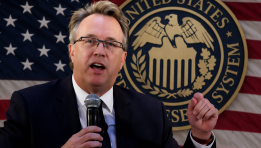
The Federal Reserve’s policy outlook is becoming increasingly complex as conflicting signals from inflation and economic growth reshape expectations. Stephen Miran, a Federal Reserve governor, acknowledged that inflation has become more problematic in recent months, yet he continues to advocate for multiple interest rate cuts this year. His stance highlights a growing divergence between policymakers and market expectations, as investors currently price in little to no easing in the near term.
Inflation Trends Become More Challenging
Miran’s latest remarks point to a subtle but important shift in the inflation narrative. While headline concerns around the Iran conflict have dominated market attention, he emphasized that inflation pressures had already been broadening before the geopolitical shock. A wider range of sectors is now contributing to price increases, making inflation less concentrated and harder to contain.
This evolving composition raises concerns for policymakers, as persistent inflation across multiple categories tends to be more resistant to monetary tightening. Despite this, Miran does not believe the recent energy-driven price increases will significantly alter the longer-term inflation trajectory, particularly over a 12- to 18-month horizon where policy decisions typically take effect.
Policy Debate Intensifies as Data Sends Mixed Signals
The divergence within the Federal Reserve reflects the broader uncertainty surrounding the U.S. economy. While Miran has scaled back his expectations from four rate cuts to three, he remains more dovish than both market pricing and many of his colleagues. In contrast, traders currently anticipate no rate cuts in 2026, underscoring a widening gap between policy expectations and investor sentiment.
Miran’s framework balances two opposing forces: a cooling labor market and still-elevated inflation. He now views interest rates as being above neutral—meaning they may be unnecessarily restrictive—and has adjusted his stance toward a neutral policy setting. This shift suggests a more cautious approach, but one that still leans toward eventual easing as economic conditions soften.
At the same time, other policymakers, including John Williams, have pointed to early signs that higher energy costs are feeding through to broader prices, including transportation, food, and consumer goods. This dynamic raises the risk of a more persistent inflation cycle, complicating the Fed’s ability to act decisively.
Energy Shock Adds a Layer of Uncertainty
The ongoing geopolitical tensions in the Middle East have introduced an additional layer of uncertainty into the Fed’s decision-making process. While Miran does not yet see a lasting inflationary impact from higher energy prices, he acknowledged that prolonged disruptions could shift expectations and force a policy response.
Energy shocks historically pose a difficult challenge for central banks, as they can simultaneously slow economic growth while pushing prices higher. This creates the risk of a stagflation-like environment, where traditional policy tools become less effective. For now, Miran appears confident that inflation expectations remain anchored, but he is closely monitoring wage trends and supply chain dynamics for signs of escalation.
Outlook Hinges on Data and Policy Alignment
Looking ahead, the Federal Reserve’s path will depend heavily on incoming economic data and how quickly inflation moderates relative to labor market conditions. If inflation continues to ease toward the Fed’s 2% target, Miran’s call for rate cuts could gain broader support. However, if price pressures persist or intensify, policymakers may be forced to maintain a restrictive stance for longer than anticipated.
The disconnect between market expectations and Fed guidance also presents a potential source of volatility. As investors reassess the likelihood and timing of rate cuts, asset prices could experience sharp adjustments. In this environment, clarity on inflation trends and policy direction will be critical in shaping market behavior and economic outcomes.
Comparison, examination, and analysis between investment houses
Leave your details, and an expert from our team will get back to you as soon as possible
* This article, in whole or in part, does not contain any promise of investment returns, nor does it constitute professional advice to make investments in any particular field.
To read more about the full disclaimer, click here
- omer bar
- •
- 7 Min Read
- •
- ago 6 hours
SKN | Is the Iran War Pushing the U.S. Economy Toward Stagflation?
Geopolitical Shock Begins to Impact the Economy Concerns about the economic fallout from the Iran conflict are intensifying, as John
- ago 6 hours
- •
- 7 Min Read
Geopolitical Shock Begins to Impact the Economy Concerns about the economic fallout from the Iran conflict are intensifying, as John
- omer bar
- •
- 8 Min Read
- •
- ago 13 hours
SKN | Can China’s Economy Sustain Growth Near 5% Despite Rising Global Geopolitical Tensions?
China’s economy has shown unexpected resilience, with growth hovering around the 5% mark despite heightened geopolitical tensions and an increasingly
- ago 13 hours
- •
- 8 Min Read

China’s economy has shown unexpected resilience, with growth hovering around the 5% mark despite heightened geopolitical tensions and an increasingly

- sagi habasov
- •
- 7 Min Read
- •
- ago 2 days
SKN | Will Persistent Inflation Trigger a Wave of Restaurant Closures Across Global Markets?
Rising inflation is placing increasing strain on the global restaurant industry, with prominent restaurateur José Andrés warning that continued cost
- ago 2 days
- •
- 7 Min Read

Rising inflation is placing increasing strain on the global restaurant industry, with prominent restaurateur José Andrés warning that continued cost

- orshu
- •
- 5 Min Read
- •
- ago 6 days
SKN | US Tariff Revenue Slumps—What a 30% Drop Signals for Trade and Economic Momentum
US tariff revenue fell sharply in March, dropping by more than $4 billion and extending a broader decline that
- ago 6 days
- •
- 5 Min Read
US tariff revenue fell sharply in March, dropping by more than $4 billion and extending a broader decline that


