


- Ronny Mor
- •
- 7 Min Read
- •
- 1 month ago
Key Points
- The Supreme Court will review Helms-Burton Act claims involving Exxon and major cruise lines.
- Exxon seeks over $1 billion for assets nationalized by Cuba in 1960.
- The ruling may clarify sovereign immunity limits and corporate liability for “trafficking.”
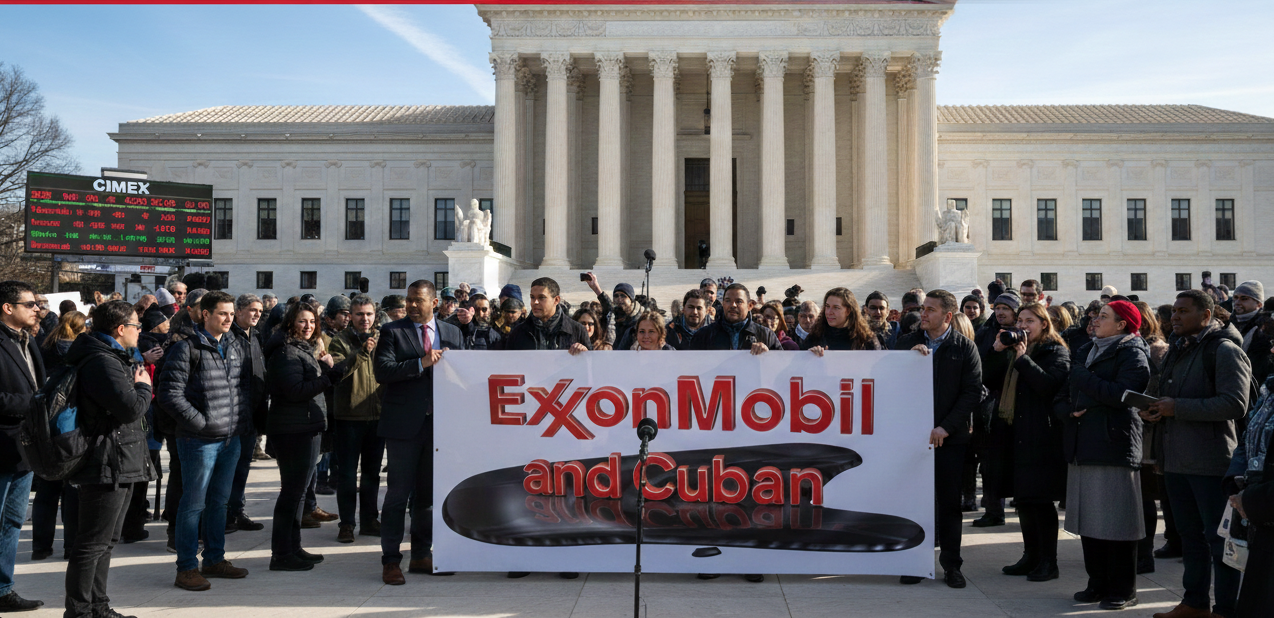
The U.S. Supreme Court is set to examine the reach of the Helms-Burton Act in two closely watched cases that could redefine how American companies pursue compensation for property seized by Cuba after the 1959 revolution. At stake are more than $1 billion in claims by ExxonMobil and significant liability questions involving major cruise operators. The hearings come as Washington intensifies pressure on Havana, adding geopolitical weight to a legal battle that blends foreign policy, sovereign immunity, and corporate restitution.
Exxon’s Billion-Dollar Claim and Sovereign Immunity
In one case, ExxonMobil is seeking over $1 billion in damages from Cuban state-owned entities, alleging that oil and gas assets nationalized in 1960 remain unlawfully held and exploited. The company sued Corporación CIMEX in 2019 after the Trump administration lifted a long-standing presidential suspension that had prevented lawsuits under the Helms-Burton Act.
Lower courts ruled that Cuban state-owned enterprises could invoke foreign sovereign immunity, a doctrine generally shielding foreign governments and their agents from U.S. lawsuits unless specific exceptions apply. Exxon has appealed, arguing that the Helms-Burton framework was intended precisely to pierce such protections when “trafficking” in confiscated property is alleged.
The Supreme Court’s interpretation could significantly affect how broadly U.S. courts can assert jurisdiction over foreign state entities, particularly in politically sensitive contexts.
The Cruise Line Liability Test
The second case centers on whether Carnival, Royal Caribbean, Norwegian Cruise Line, and MSC Cruises can be held liable for using Havana port facilities that were confiscated from an American concessionaire in 1960. The plaintiff, Havana Docks, held a 99-year concession granted in 1934 that was revoked following Fidel Castro’s rise to power.
A federal judge initially imposed judgments exceeding $100 million against the cruise operators, finding that their use of the docks between 2016 and 2019 constituted unlawful “trafficking.” However, an appellate court later reversed those rulings, determining that Havana Docks’ concession had expired in 2004, well before the cruise companies began using the facilities.
The Supreme Court’s review may clarify how expiration dates, property rights continuity, and statutory definitions intersect under Helms-Burton — issues that could influence numerous pending and future claims.
Legal Interpretation Meets Geopolitical Strategy
When Congress enacted the Helms-Burton Act in 1996, it authorized lawsuits but allowed presidents to suspend that provision for national security reasons. For over two decades, successive administrations avoided activating the litigation mechanism to prevent diplomatic friction with allies whose companies operate in Cuba. The Trump administration reversed that stance in 2019, opening the door to corporate claims.
The Court’s decision now arrives amid renewed policy tension toward Cuba. A ruling favoring corporate plaintiffs could embolden additional lawsuits against foreign companies or state entities engaged with Cuban assets. Conversely, a narrower reading may reaffirm limits on extraterritorial litigation and sovereign immunity.
For investors and multinational corporations, the outcome carries implications beyond Cuba. It may shape how U.S. courts balance statutory compensation rights against international comity and diplomatic considerations. Companies operating in jurisdictions with contested property histories will closely monitor the precedent.
Looking ahead, the Supreme Court’s interpretation will likely influence not only compensation prospects for Exxon and Havana Docks but also the broader enforceability of U.S. sanctions-linked statutes. In a world where geopolitics and corporate liability increasingly intersect, this case could redefine the legal terrain for cross-border asset disputes.
Comparison, examination, and analysis between investment houses
Leave your details, and an expert from our team will get back to you as soon as possible
* This article, in whole or in part, does not contain any promise of investment returns, nor does it constitute professional advice to make investments in any particular field.
To read more about the full disclaimer, click here
- Lior mor
- •
- 6 Min Read
- •
- ago 1 week
SKN | Is NVIDIA Facing a Renewed Credibility Test as $1B Crypto Revenue Lawsuit Moves Forward?
NVIDIA is once again under legal and investor scrutiny, as a U.S. federal judge certified a class-action lawsuit alleging the
- ago 1 week
- •
- 6 Min Read

NVIDIA is once again under legal and investor scrutiny, as a U.S. federal judge certified a class-action lawsuit alleging the

- sagi habasov
- •
- 7 Min Read
- •
- ago 3 weeks
SKN | Adobe Agrees to $150 Million Settlement Over Online Subscription Practices
Adobe Inc. has agreed to pay $150 million to settle allegations related to violations of online shopper protection laws,
- ago 3 weeks
- •
- 7 Min Read

Adobe Inc. has agreed to pay $150 million to settle allegations related to violations of online shopper protection laws,

- Ronny Mor
- •
- 6 Min Read
- •
- ago 3 weeks
SKN | Why Is Anthropic Fighting the Pentagon’s “Supply-Chain Risk” Label in U.S. Court?
Anthropic, one of the fastest-growing artificial intelligence startups, has asked a U.S. appeals court to temporarily block the Pentagon’s decision
- ago 3 weeks
- •
- 6 Min Read

Anthropic, one of the fastest-growing artificial intelligence startups, has asked a U.S. appeals court to temporarily block the Pentagon’s decision
- Lior mor
- •
- 6 Min Read
- •
- ago 3 weeks
SKN | Will Costco Be Forced to Refund Customers After Trump Tariffs Were Struck Down?
Costco is facing a proposed nationwide class-action lawsuit from customers who argue they deserve a share of potential tariff refunds
- ago 3 weeks
- •
- 6 Min Read

Costco is facing a proposed nationwide class-action lawsuit from customers who argue they deserve a share of potential tariff refunds

