


- Ronny Mor
- •
- 7 Min Read
- •
- 4 months ago
Key Points
- Singapore and Nasdaq launched a unified dual-listing framework to simplify cross-border capital raising for major companies.
- MAS unveiled incentives including a S$30 million “Value Unlock” program and S$2.85 billion fund allocation to boost market competitiveness.
- Analysts say reforms are promising but warn that liquidity constraints and limited enforcement clarity could slow Singapore’s equity re-rating.
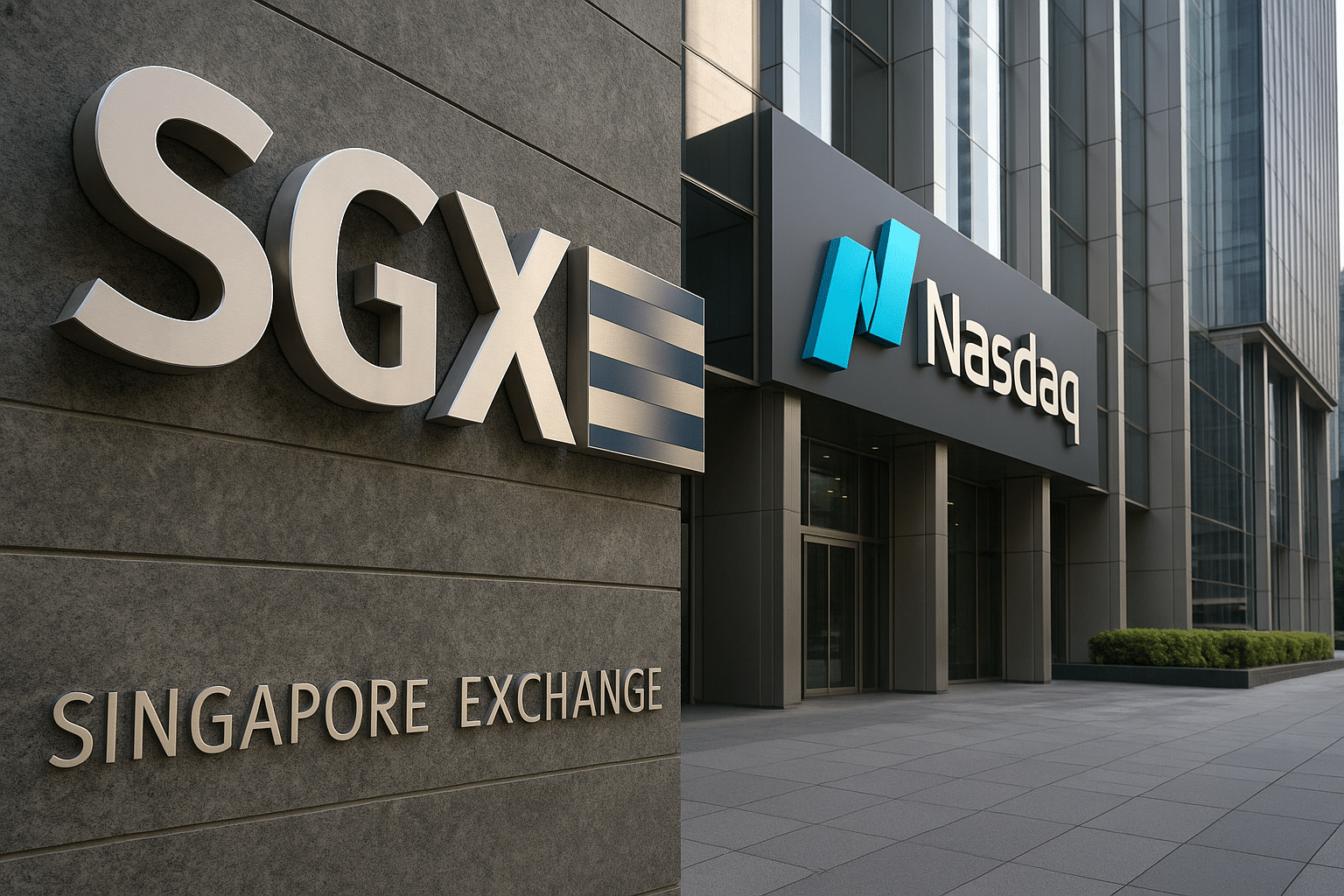
Singapore Takes an Aggressive Step to Reenergize Its Equity Market
Singapore is intensifying its bid to strengthen its position as a global financial hub, unveiling a comprehensive partnership with Nasdaq designed to streamline dual listings between the U.S. and the city-state. The joint initiative introduces a “Global Listing Board,” allowing companies valued above S$2 billion (about USD 1.5 billion) to list simultaneously in Singapore and the U.S. using a unified regulatory and documentation process.
SGX and Nasdaq describe the arrangement as a “first-of-its-kind” bridge that harmonizes requirements across both exchanges. By mid-2026, companies will be able to file a single set of documents meeting the standards of both regulators — a move aimed at reducing friction, accelerating capital-raising, and widening investor access across time zones.
SGX CEO Loh Boon Chye emphasized that investors will benefit from near-continuous price discovery as trading spans Asian and U.S. market hours. Nasdaq CEO Adena Friedman highlighted that the partnership is tailored for Asian enterprises pursuing global exposure without the complexity of navigating multiple regulatory regimes.
A Broader Strategy Backed by New Government Incentives
The dual-listing framework aligns closely with Singapore’s wider government push to reinvigorate domestic equities. On the same day, MAS announced several measures aimed at strengthening the competitiveness and liquidity of the local market.
Chief among them is a S$30 million “Value Unlock” package intended to help listed companies sharpen corporate strategy, enhance investor communications, and optimize capital structures — areas where investors have long argued Singapore corporates lag behind global peers. MAS also allocated an additional S$2.85 billion to six asset managers in Singapore, building on its S$1.1 billion deployment earlier in the year, with the goal of increasing institutional participation in local equities and growing the fund-management ecosystem.
Data suggests appetite is beginning to return. Average daily turnover in the third quarter of 2025 rose 16% year-on-year to S$1.53 billion, the highest volume since early 2021. Activity in mid-cap and small-cap stocks has also picked up, and IPO fundraising has already surpassed S$2 billion this year.
Opportunities and Constraints as Singapore Sets Its Ambitions Higher
While the reforms are widely seen as a positive, analysts caution that structural challenges remain. CGS International notes that dual listings could expand regional investor reach but warns that SGX’s liquidity still lags far behind that of Nasdaq, limiting immediate transformational impact.
Goldman Sachs analysts, meanwhile, argue that the success of the “Value Unlock” initiative will depend on clear guidelines and strong enforcement. They point to Japan and South Korea, where aggressive reforms — including dividend tax changes and corporate-governance mandates — triggered powerful equity re-ratings. Singapore’s STI has risen roughly 30% since its equities review group was formed in 2024, but still trails Japan and South Korea, where markets climbed about 60% after their respective reforms.
For Singapore, the question now is whether regulatory streamlining, government incentives, and cross-border collaboration are enough to meaningfully shift corporate behavior and investor sentiment. If the SGX-Nasdaq bridge gains traction, it could showcase Singapore as a preferred Asian hub for globally ambitious companies. But sustained execution and deeper liquidity will be essential.
Comparison, examination, and analysis between investment houses
Leave your details, and an expert from our team will get back to you as soon as possible
* This article, in whole or in part, does not contain any promise of investment returns, nor does it constitute professional advice to make investments in any particular field.
To read more about the full disclaimer, click here
- Ronny Mor
- •
- 8 Min Read
- •
- ago 10 minutes
SKN | Asian Markets Split as Korea and Japan Rally While China and Hong Kong Slide in Tuesday Morning Trade
Asian equities opened Tuesday’s trading session with mixed momentum as investors weighed diverging economic signals across the region. While Japan
- ago 10 minutes
- •
- 8 Min Read

Asian equities opened Tuesday’s trading session with mixed momentum as investors weighed diverging economic signals across the region. While Japan

- orshu
- •
- 6 Min Read
- •
- ago 17 hours
SKN | Tel Aviv Indices Retreat as Investors Weigh Economic Signals and Sector Pressures
The Tel Aviv shווקי opened lower as investors navigated mixed economic signals and sector-specific pressures. The TA-35 led the declines,
- ago 17 hours
- •
- 6 Min Read

The Tel Aviv shווקי opened lower as investors navigated mixed economic signals and sector-specific pressures. The TA-35 led the declines,
- orshu
- •
- 7 Min Read
- •
- ago 22 hours
SKN | Global Growth Resilience and Critical Inflation Data to Anchor Final Trading Week of Q1
The global financial markets enter the final full trading week of March 2026 with a dual focus on consolidating recent
- ago 22 hours
- •
- 7 Min Read
The global financial markets enter the final full trading week of March 2026 with a dual focus on consolidating recent

- sagi habasov
- •
- 6 Min Read
- •
- ago 23 hours
SKN | Stocks and Treasuries Slide as Iran Tensions Escalate: Market Wrap
Equity and bond markets fell as renewed conflict fears between the United States and Iran weighed on investor sentiment. The
- ago 23 hours
- •
- 6 Min Read

Equity and bond markets fell as renewed conflict fears between the United States and Iran weighed on investor sentiment. The

