





- orshu
- •
- 7 Min Read
- •
- 58 minutes ago
Key Points
- Wall Street closed sharply lower after the Federal Reserve kept interest rates unchanged, while internal divisions among policymakers added uncertainty to the outlook.
- Artificial intelligence-related chip stocks extended recent losses ahead of highly anticipated earnings reports from Microsoft and Meta Platforms.
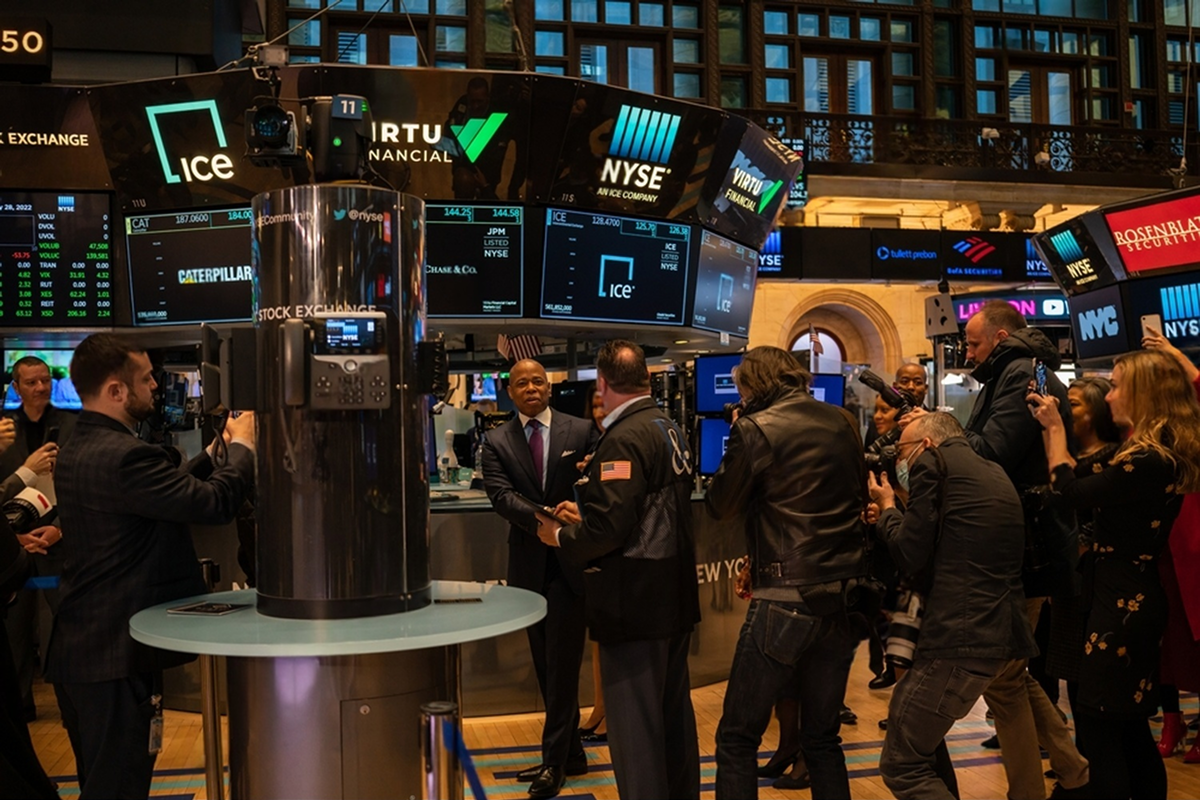
U.S. equities ended Wednesday’s session with broad-based losses after the Federal Reserve left its benchmark interest rate unchanged while signaling a less unified policy outlook than markets had anticipated. The decision coincided with continued weakness across artificial intelligence-related semiconductor stocks, amplifying pressure on technology-heavy indexes ahead of earnings from several of the industry’s largest companies.
The market reaction reflected a combination of monetary policy uncertainty and growing investor scrutiny of AI valuations following months of exceptional gains. With technology companies preparing to report quarterly results, investors are increasingly demanding evidence that heavy AI investment is translating into sustainable financial performance.
Fed Holds Rates Steady but Policy Divisions Draw Attention
The Federal Reserve maintained its benchmark interest rate within a range of 3.50% to 3.75%, a decision that was widely expected by financial markets. However, attention quickly shifted to the unusually divided vote within the Federal Open Market Committee (FOMC), where three of the twelve voting members favored raising rates by a quarter percentage point instead of leaving policy unchanged.
The dissents suggest that policymakers remain divided over the balance between controlling inflation and supporting economic growth. Although the Fed left rates unchanged, the split reinforced expectations that inflation risks remain a significant concern, even as economic activity shows signs of moderation.
For investors, the outcome increases uncertainty surrounding the timing and direction of future monetary policy decisions, particularly if inflation remains persistent during the second half of the year.
Technology Shares Lead the Market Lower
Technology stocks accounted for much of Wednesday’s market weakness as AI-related semiconductor companies continued their recent pullback. The decline comes ahead of quarterly earnings reports from Microsoft and Meta Platforms, two companies viewed as leaders in the commercialization of artificial intelligence.
Investors are increasingly evaluating whether the industry’s substantial investments in AI infrastructure, cloud computing, and advanced semiconductor capacity can generate returns sufficient to justify elevated valuations. The recent decline reflects growing caution rather than a broad reassessment of AI’s long-term potential.
The Nasdaq 100 has now fallen 11% from its record high reached in June, indicating that investors have become more selective following one of the strongest technology rallies in recent years. Higher financing costs and increased earnings expectations have also contributed to greater volatility across growth-oriented sectors.
Earnings Season Becomes the Next Major Catalyst
With monetary policy largely in line with expectations, market attention is rapidly shifting toward corporate earnings. Results from major technology companies are expected to provide critical insight into enterprise spending, cloud demand, AI monetization, and capital expenditure trends that will shape investor sentiment over the coming months.
The performance of Microsoft and Meta is particularly significant because both companies have committed tens of billions of dollars toward artificial intelligence infrastructure. Their financial results and forward guidance could influence not only their own valuations but also broader confidence in AI-related investments across the technology sector.
For investors in Israel, developments on Wall Street remain highly relevant given the country’s extensive exposure to global technology, cybersecurity, semiconductor design, and software development. Many Israeli companies maintain commercial relationships with leading U.S. technology firms, making shifts in enterprise spending and AI investment important indicators for the broader innovation ecosystem.
Looking ahead, investors will monitor upcoming earnings from major technology companies, additional inflation data, and future Federal Reserve communications for clearer signals on monetary policy. The combination of corporate performance, AI investment returns, and evolving interest rate expectations is likely to remain the primary driver of market sentiment as investors assess whether the recent technology correction represents a temporary pullback or the beginning of a more prolonged period of consolidation.
Comparison, examination, and analysis between investment houses
Leave your details, and an expert from our team will get back to you as soon as possible
* This article, in whole or in part, does not contain any promise of investment returns, nor does it constitute professional advice to make investments in any particular field.
To read more about the full disclaimer, click here
- orshu
- •
- 8 Min Read
- •
- ago 2 hours
SKN | Wall Street Slides on Broad Sell-Off as Dow Drops More Than 2% on July 29
Wall Street suffered a broad-based sell-off on Wednesday, July 29, 2026, with all major U.S. equity indices closing sharply lower.
- ago 2 hours
- •
- 8 Min Read

Wall Street suffered a broad-based sell-off on Wednesday, July 29, 2026, with all major U.S. equity indices closing sharply lower.
- orshu
- •
- 7 Min Read
- •
- ago 6 hours
SKN | European Markets Close Mixed as UK Equities Outperform While Continental Indexes Retreat
European equity markets ended the July 29 trading session with mixed results as investors balanced corporate earnings, economic data,
- ago 6 hours
- •
- 7 Min Read

European equity markets ended the July 29 trading session with mixed results as investors balanced corporate earnings, economic data,
- orshu
- •
- 6 Min Read
- •
- ago 10 hours
SKN | U.S. Markets Trade Mixed as Small Caps and S&P 500 Advance While Dow Extends Decline
U.S. equity markets traded with mixed momentum on July 29 as investors balanced a busy corporate earnings calendar with
- ago 10 hours
- •
- 6 Min Read

U.S. equity markets traded with mixed momentum on July 29 as investors balanced a busy corporate earnings calendar with
- orshu
- •
- 6 Min Read
- •
- ago 15 hours
SKN | European Markets End Mixed as U.K. Strength Offsets Weakness Across Regional Benchmarks
European markets closed with mixed results on July 29, 2026, as gains in the United Kingdom and Germany helped offset
- ago 15 hours
- •
- 6 Min Read

European markets closed with mixed results on July 29, 2026, as gains in the United Kingdom and Germany helped offset


