


- Lior mor
- •
- 9 Min Read
- •
- 4 hours ago
Key Points
- VONG offers broader diversification with exposure to nearly 400 large-cap growth stocks.
- QQQ provides concentrated exposure to the Nasdaq-100 and its mega-cap technology leaders.
- Cost structure and valuation differences may influence which ETF better fits a growth-focused portfolio.
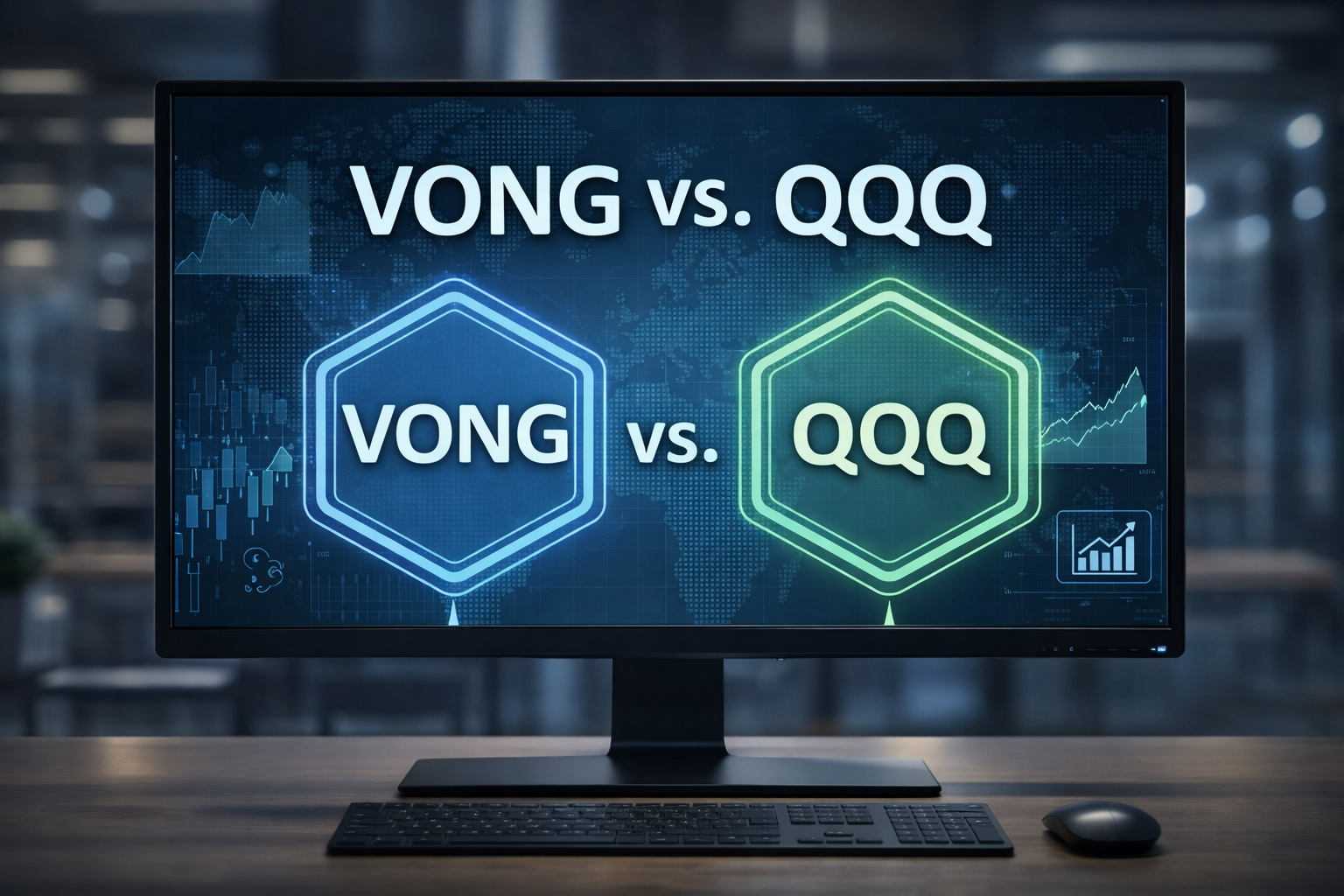
Technology stocks have entered a volatile phase in early 2026, with the tech-heavy Nasdaq-100 index slipping about 1.2% year-to-date and slightly underperforming the broader S&P 500. For investors looking to buy the dip in growth stocks, exchange-traded funds (ETFs) remain one of the simplest ways to gain diversified exposure to leading technology companies.
Two popular choices stand out for investors seeking large-cap growth exposure: the Vanguard Russell 1000 Growth ETF (VONG) and the Invesco QQQ Trust (QQQ). While both funds offer strong exposure to major technology companies driving the artificial intelligence and cloud computing boom, they differ in diversification, weighting strategies, and cost structures.
VONG: A Broad Growth Portfolio With Heavy Tech Exposure
The Vanguard Russell 1000 Growth ETF provides exposure to a large basket of U.S. growth companies, holding approximately 391 stocks across multiple sectors. Despite this wide diversification, technology still dominates the portfolio, accounting for roughly 59.7% of the ETF’s holdings.
The fund’s largest positions reflect the dominant forces shaping the modern tech landscape. Nvidia represents about 12.7% of the portfolio, followed by Apple at 10.8%, Microsoft at 9.2%, Amazon at 4.8%, and Broadcom at 4.6%. These companies sit at the center of several key trends including artificial intelligence infrastructure, cloud computing, and advanced semiconductors.
VONG has also delivered solid historical performance. Over the past year, the ETF gained around 24%, slightly trailing the Nasdaq-100’s performance. Over longer time horizons, the fund has averaged annual returns of roughly 26% over three years, 14.3% over five years, and about 18.1% over the past decade.
One of VONG’s biggest advantages is cost efficiency. With an expense ratio of just 0.06%, it offers one of the cheapest ways for investors to access a diversified portfolio of growth stocks.
QQQ: Direct Exposure to the Nasdaq-100 Leaders
The Invesco QQQ Trust takes a more concentrated approach by tracking the Nasdaq-100 index. Instead of hundreds of holdings, the fund includes roughly 102 stocks representing the largest non-financial companies listed on the Nasdaq exchange.
Like VONG, QQQ is heavily tilted toward technology, with about 59.8% of its portfolio allocated to the tech sector. Its top holdings include many of the same companies found in VONG, such as Nvidia, Apple, Microsoft, and Amazon. Tesla also ranks among its largest positions, highlighting the ETF’s focus on innovation-driven companies.
QQQ has built a strong reputation among investors due to its long-term performance. As of early 2026, the fund delivered average annual returns of approximately 20.1% over the past year, 28.2% over the past three years, 14.8% over five years, and about 20.4% over the past decade.
The ETF’s expense ratio stands at 0.18%. While higher than VONG’s, it remains relatively low compared with actively managed funds.
Valuation and Structural Differences
Although the two ETFs hold many of the same companies, their structure creates subtle valuation differences. The Nasdaq-100 index tracked by QQQ currently trades at a price-to-earnings ratio of roughly 33.3, while the Vanguard Russell 1000 Growth ETF sits closer to 35.0.
This suggests QQQ may offer slightly more attractive valuation levels relative to earnings, though the difference is relatively small. Much of the discrepancy stems from differences in index methodology, stock weighting, and the broader range of companies included in VONG’s portfolio.
Another important difference is diversification. With nearly four times as many holdings, VONG spreads risk across a wider group of companies. QQQ, in contrast, is more concentrated in the largest technology firms, which can amplify both gains and volatility.
Which ETF Might Fit Different Investors
For investors seeking lower fees and broader diversification, VONG may represent a compelling option. Its exposure to hundreds of growth stocks reduces reliance on a small number of mega-cap companies while still maintaining significant technology exposure.
QQQ may appeal more to investors who want targeted exposure to the Nasdaq-100’s biggest innovators. Because it focuses on the largest technology leaders, the ETF can benefit strongly when mega-cap growth stocks dominate market performance.
Both funds therefore provide strong exposure to companies leading the artificial intelligence revolution, though they approach that exposure in different ways.
Market Trends to Watch for Growth ETFs
The future performance of both VONG and QQQ will likely depend on several macro and technological trends. Continued investment in artificial intelligence infrastructure, semiconductor innovation, and cloud computing could support earnings growth for many of the companies held in both funds.
At the same time, interest-rate policy, geopolitical tensions, and shifts in investor sentiment toward growth stocks could influence ETF performance. If leadership broadens beyond mega-cap technology companies, broader funds like VONG may benefit. If the largest tech firms continue to dominate the market, more concentrated ETFs like QQQ could outperform.
Comparison, examination, and analysis between investment houses
Leave your details, and an expert from our team will get back to you as soon as possible
* This article, in whole or in part, does not contain any promise of investment returns, nor does it constitute professional advice to make investments in any particular field.
To read more about the full disclaimer, click here
- omer bar
- •
- 7 Min Read
- •
- ago 10 hours
SKN | Bitcoin ETF Momentum Accelerates as Institutional Investors Turn to the iShares Bitcoin Trust (IBIT)
The rapid expansion of spot Bitcoin exchange-traded funds has transformed how investors access cryptocurrency markets. Among the most prominent products
- ago 10 hours
- •
- 7 Min Read
The rapid expansion of spot Bitcoin exchange-traded funds has transformed how investors access cryptocurrency markets. Among the most prominent products
- omer bar
- •
- 6 Min Read
- •
- ago 3 days
SKN | MAGS vs QQQ: Is Concentrated Exposure to the Magnificent Seven Worth the Risk?
Investors seeking exposure to the technology sector often turn to popular index funds such as the Nasdaq-100 ETF, but some
- ago 3 days
- •
- 6 Min Read
Investors seeking exposure to the technology sector often turn to popular index funds such as the Nasdaq-100 ETF, but some

- sagi habasov
- •
- 7 Min Read
- •
- ago 3 days
SKN | Institutional Bitcoin Access Expands as the iShares Bitcoin Trust ETF Gains Market Influence
The rapid expansion of spot Bitcoin exchange-traded funds is reshaping how institutional investors access cryptocurrency markets. Among the leading vehicles
- ago 3 days
- •
- 7 Min Read

The rapid expansion of spot Bitcoin exchange-traded funds is reshaping how institutional investors access cryptocurrency markets. Among the leading vehicles
- sagi habasov
- •
- 6 Min Read
- •
- ago 4 days
SKN | Are Nuclear Energy ETFs Emerging as Safe-Haven Plays Amid the Global Energy Crisis?
The intensifying conflict involving Iran has triggered renewed turbulence in global energy markets, pushing oil prices sharply higher and exposing
- ago 4 days
- •
- 6 Min Read

The intensifying conflict involving Iran has triggered renewed turbulence in global energy markets, pushing oil prices sharply higher and exposing

