





- Lior mor
- •
- 8 Min Read
- •
- 1 hour ago
Key Points
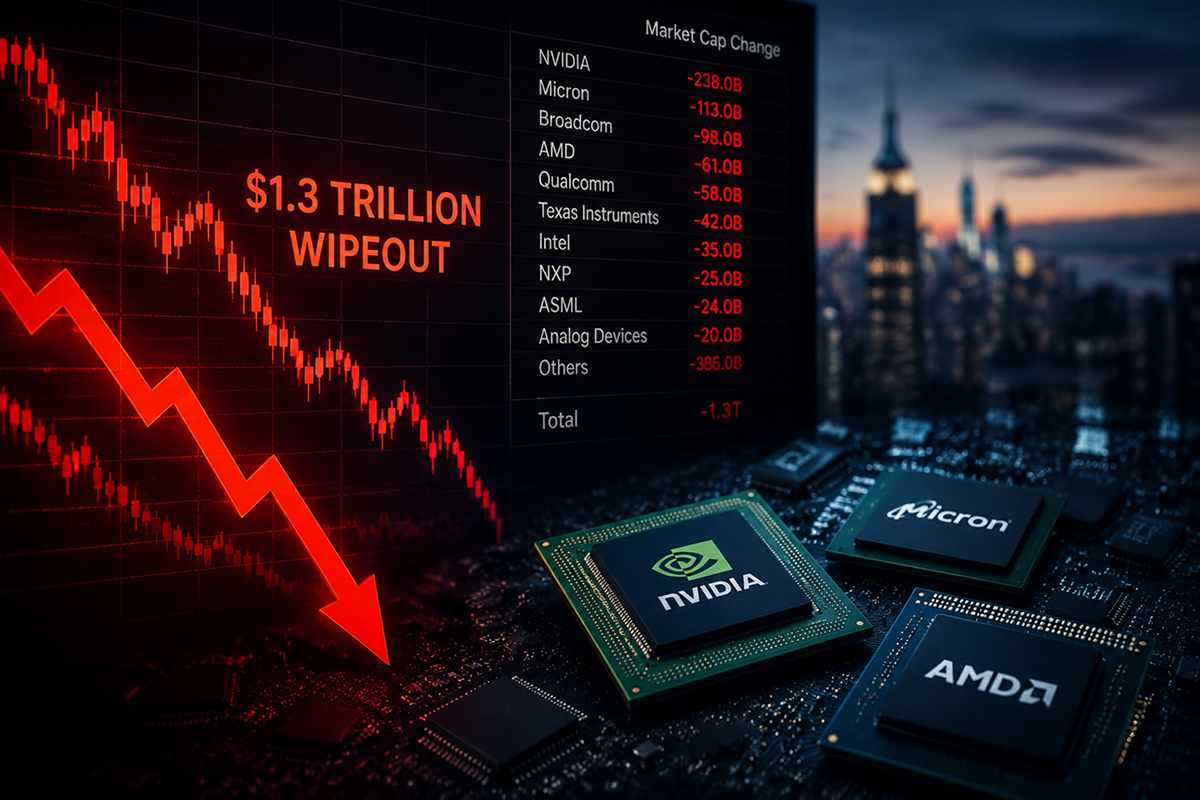
- Massive Wipeout: The top twenty chip companies lost approximately $1.3 trillion in aggregate value over a few days in late July.
- Market Psychology: Historical data proves that panic selling during market downturns extracts a heavy toll on long-term returns.
- Shifting Focus: Building a portfolio anchored by stable core stocks helps mitigate behavioral biases and absorb market shocks.
The aggressive wave of sell-offs that recently washed over the semiconductor sector has left Wall Street with a glaring warning sign regarding the future trajectory of the broader stock market. While the S&P 500 managed to absorb the initial shocks by demonstrating relative stability, the sheer scale of value destruction in the technology sector illustrates how rapidly investor sentiment can reverse. This event resurfaces one of the central debates in behavioral finance: how investors should operate in the face of market weakness, and why the instinctive reaction to flee to safe havens may prove to be the most severe strategic mistake of all.
The Epicenter of the Noise in AI Stocks
Between July 24 and July 28, a veritable storm swept through the technology giants. Recent data indicates that the world’s twenty leading chip stocks collectively shed a phenomenal $1.3 trillion in aggregate value. At the center of this storm were the companies most synonymous with the artificial intelligence revolution. Graphics processing giant Nvidia recorded a valuation wipeout of $238 billion, while memory maker Micron Technology lost approximately $113 billion. Although the S&P 500 exhibited impressive resilience and was not fully dragged into this localized crash, this dynamic raises concerns that sustained weakness in the market’s growth engines could gradually seep into other economic sectors.
The Statistics of Volatility and the Panic Trap
When markets begin to tremble, the natural human inclination is to reduce exposure in an attempt to preserve capital. However, a deep analysis of financial history reveals a fascinating paradox: fleeing from risk tends to severely impair future profit potential. The reason lies in the fact that many of the strongest trading days on Wall Street occur right in the midst of bear markets or during the earliest stages of a recovery. An examination of market data between 1996 and 2025 reveals that 48% of the fifty best days for the S&P 500 took place during a bear market. Furthermore, 28% of those peak days were recorded in the first two months of a new bull market, a period when many investors are still licking their wounds and hesitant to re-enter the arena.
The Economic Cost of Market Timing
Attempting to time market entry and exit points repeatedly proves to be an expensive endeavor. To illustrate the magnitude of this impact on returns, one can look at a hypothetical $10,000 investment in the S&P 500 in 1996. Had the investor maintained their position continuously until 2025, their capital would have swelled to just over $192,000. Conversely, missing just the ten best trading days during that exact same period would have brutally slashed returns, leaving the investor with a mere $85,490. The gap widens severely the more up-days are missed: sitting out the 20 best days would have shrunk the portfolio to $49,551, and missing the 30 best days would leave the investor with only $31,123.
Building Psychological and Financial Resilience
The most effective way to neutralize the psychological biases that lead to hasty selling is proactive preparation through the construction of a portfolio based on strong convictions and solid economic fundamentals. Trimming speculative positions and shifting weight toward companies with stable cash flows helps reduce anxiety during times of crisis. One strategy widely adopted by investment managers is the integration of “Dividend Kings”—companies that have proven their ability to consecutively increase their profit distributions for at least 50 years. These companies, alongside consumer staples corporations, provide an economic anchor. The logic is straightforward: even during periods of macroeconomic turbulence, consumers will continue to purchase basic necessities, a fact that empowers investors to stay in the market even when the screens bleed red.
Looking toward the horizon, the semiconductor shakeup provides investors with a sharp reminder that volatility is an inseparable part of the capital market’s life cycle, and not necessarily a signal to abandon ship. Wall Street teaches that the real danger lies not in aggressive price corrections, but in the counter-reactions of the investors managing the capital. The ultimate test for portfolio managers and retail investors alike will be their capacity to absorb short-term shocks, adhere to a cohesive core strategy, and avoid sharp movements that could erase the growth potential of the coming years. At the end of the day, the market rewards those who have the wisdom to hold their positions even as the leading indices begin to lose altitude.
Comparison, examination, and analysis between investment houses
Leave your details, and an expert from our team will get back to you as soon as possible
* This article, in whole or in part, does not contain any promise of investment returns, nor does it constitute professional advice to make investments in any particular field.
To read more about the full disclaimer, click here
- Ronny Mor
- •
- 8 Min Read
- •
- ago 2 hours
SKN | Is the Old Continent Offering the Investment Opportunity of the Year?
Amidst a complex geopolitical landscape and ongoing security escalations, European capital markets are displaying remarkable resilience, setting new records
- ago 2 hours
- •
- 8 Min Read

Amidst a complex geopolitical landscape and ongoing security escalations, European capital markets are displaying remarkable resilience, setting new records

- orshu
- •
- 6 Min Read
- •
- ago 2 days
SKN | South Korea’s KOSPI Surges as Semiconductor Rally Fuels Global Technology Optimism
South Korea’s KOSPI Composite Index recorded a significant surge, rising nearly 15% as global semiconductor stocks rallied and investors
- ago 2 days
- •
- 6 Min Read
South Korea’s KOSPI Composite Index recorded a significant surge, rising nearly 15% as global semiconductor stocks rallied and investors

- Lior mor
- •
- 6 Min Read
- •
- ago 2 days
SKN | S&P 500 Turns Lower as Rising Treasury Yields Pressure Global Equity Markets
The S&P 500 reversed earlier gains and turned lower as a renewed rise in the U.S. 10-year Treasury yield
- ago 2 days
- •
- 6 Min Read
The S&P 500 reversed earlier gains and turned lower as a renewed rise in the U.S. 10-year Treasury yield
- orshu
- •
- 7 Min Read
- •
- ago 2 days
SKN | S&P 500 and Nasdaq Extend Rally as Technology Drives Gains Despite Small-Cap Weakness
Wall Street extended its rebound as investors continued favoring large-cap technology and growth stocks. The Nasdaq led the major U.S.
- ago 2 days
- •
- 7 Min Read
Wall Street extended its rebound as investors continued favoring large-cap technology and growth stocks. The Nasdaq led the major U.S.


