





- omer bar
- •
- 7 Min Read
- •
- 3 hours ago
Key Points
- SpaceX's accelerated inclusion in the Nasdaq-100 prompted billions of dollars in automatic purchases by index funds, affecting millions of retirement investors.
- The stock reportedly declined from approximately $160 to $120 following its index inclusion, resulting in significant unrealized losses for passive investors.
- The event has renewed debate over index construction, forced buying, and the risks associated with passive investment strategies.
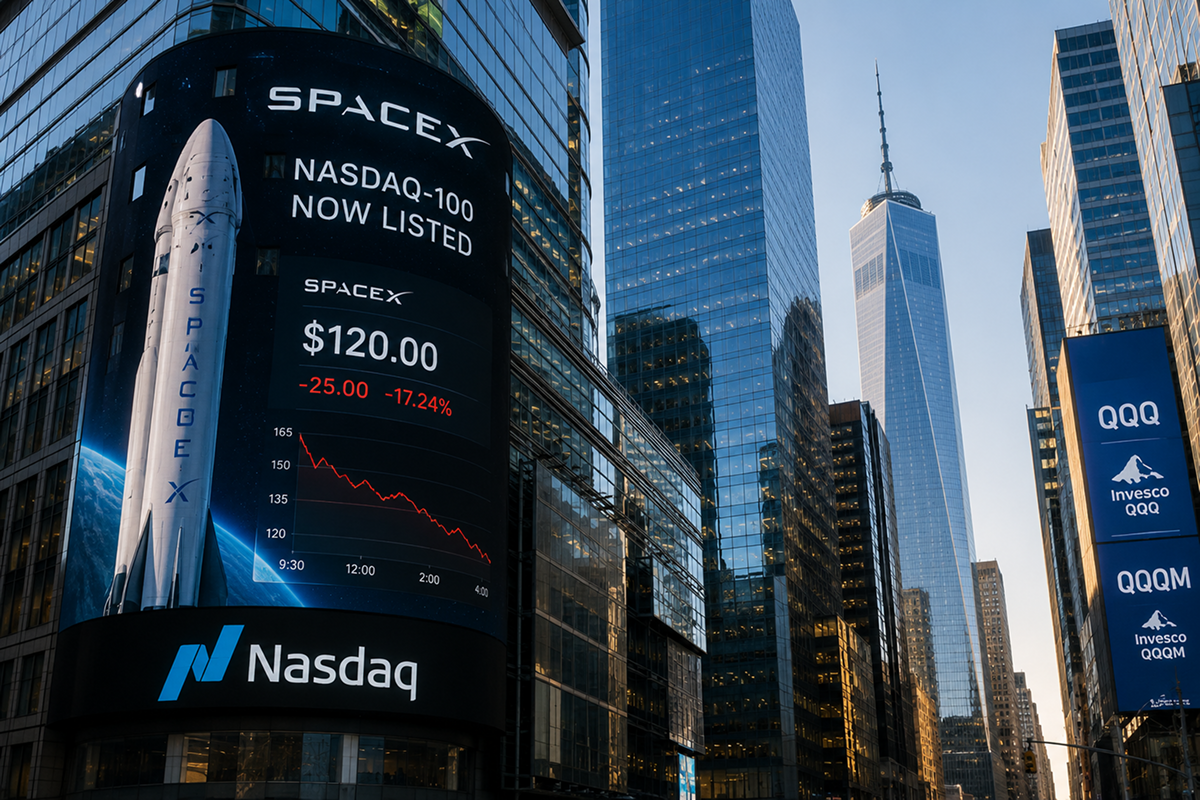
SpaceX’s rapid addition to the Nasdaq-100 has become one of the most closely watched examples of how modern index investing can influence market dynamics. Following a fast-track inclusion shortly after its initial public offering, index-tracking funds were required to purchase billions of dollars’ worth of SpaceX shares regardless of valuation or short-term market conditions.
The episode has drawn attention not only because of the stock’s subsequent decline but also because it illustrates how passive investment vehicles can create significant buying pressure that is disconnected from traditional fundamental analysis.
Fast-Track Index Inclusion Triggered Automatic Buying
On July 7, 2026, SpaceX entered the Nasdaq-100 after qualifying under Nasdaq’s accelerated inclusion rules, becoming one of the fastest companies ever added to the benchmark following its public listing. As a result, exchange-traded funds and index funds tracking the Nasdaq-100—including products such as QQQ and QQQM—were required to purchase SpaceX shares in order to mirror the index composition.
According to market estimates cited in the source material, passive funds absorbed between approximately $22 billion and $27 billion of SpaceX shares during the rebalancing process, with JPMorgan estimating that approximately $4.3 billion of those purchases came from QQQ alone.
Unlike active portfolio managers, index funds generally have limited discretion during index changes, making these transactions mechanical rather than investment-driven.
Share Price Decline Highlights Passive Investment Risks
Following the index inclusion, SpaceX shares reportedly declined from approximately $160 to $120. Based on estimates presented in the source, this movement translated into more than $1 billion in unrealized losses for retirement accounts that acquired the stock through Nasdaq-100 index funds.
It is important to note that these losses remain unrealized unless investors sell their holdings, and index funds are generally designed to track long-term benchmark performance rather than short-term price fluctuations. Nevertheless, the episode illustrates how passive investors may acquire securities at elevated prices when index rebalancing creates concentrated buying demand.
The event has also fueled broader discussions regarding whether accelerated index inclusion rules may unintentionally increase short-term volatility around newly listed companies.
Different Index Rules Produced Different Outcomes
While Nasdaq-100 investors automatically gained exposure to SpaceX, investors tracking the S&P 500 were unaffected because the company reportedly did not satisfy the index’s profitability and public float requirements. The contrast highlights how different benchmark methodologies can lead to materially different portfolio exposures, even among broadly diversified passive investment strategies.
For institutional investors, index eligibility criteria—including market capitalization, liquidity, profitability, and public float—remain important factors influencing capital flows and trading activity. Changes to these rules can have substantial effects on both individual securities and passive investment products.
For investors in Israel, the development serves as a reminder that passive investing, while offering broad diversification and relatively low costs, is not entirely insulated from structural market events. Global index methodology changes can influence portfolio composition regardless of an investor’s individual views on a company’s valuation or near-term prospects.
Looking ahead, investors will continue monitoring SpaceX’s trading performance, future index rebalancing activity, and any additional changes to benchmark inclusion policies. Market participants will also assess whether accelerated index admissions become more common for newly public companies and how such changes may affect liquidity, valuation, and passive investment strategies. As index investing continues to grow globally, understanding the mechanics behind benchmark construction may become increasingly important for both institutional and long-term individual investors.
Comparison, examination, and analysis between investment houses
Leave your details, and an expert from our team will get back to you as soon as possible
* This article, in whole or in part, does not contain any promise of investment returns, nor does it constitute professional advice to make investments in any particular field.
To read more about the full disclaimer, click here
- Ronny Mor
- •
- 7 Min Read
- •
- ago 3 hours
SKN | Rocket Lab’s Neutron Rocket Could Define the Company’s Next Growth Chapter
Rocket Lab USA, Inc. (NASDAQ: RKLB) is approaching one of the most important milestones in its corporate history as
- ago 3 hours
- •
- 7 Min Read
Rocket Lab USA, Inc. (NASDAQ: RKLB) is approaching one of the most important milestones in its corporate history as
- Ronny Mor
- •
- 7 Min Read
- •
- ago 3 hours
SKN | BlackRock, Ford, Google, and Carhartt Launch Skilled Trades Alliance to Strengthen America’s Workforce
BlackRock, Carhartt, Ford Motor Company, and Google have announced a new partnership aimed at expanding the nation's skilled trades workforce
- ago 3 hours
- •
- 7 Min Read

BlackRock, Carhartt, Ford Motor Company, and Google have announced a new partnership aimed at expanding the nation's skilled trades workforce
- Ronny Mor
- •
- 6 Min Read
- •
- ago 17 hours
SKN | How Does the iShares Russell 2000 ETF Reflect the Outlook for U.S. Small-Cap Companies?
The iShares Russell 2000 ETF has become a closely watched vehicle for investors seeking exposure to the performance of U.S.
- ago 17 hours
- •
- 6 Min Read

The iShares Russell 2000 ETF has become a closely watched vehicle for investors seeking exposure to the performance of U.S.

- sagi habasov
- •
- 6 Min Read
- •
- ago 22 hours
SKN | Coca-Cola’s Fairlife Production Disruption Raises Cybersecurity Concerns as Investors Assess Dividend Risks
A ransomware attack affecting Coca-Cola’s Fairlife production operations has drawn investor attention to the growing cybersecurity challenges facing major consumer
- ago 22 hours
- •
- 6 Min Read

A ransomware attack affecting Coca-Cola’s Fairlife production operations has drawn investor attention to the growing cybersecurity challenges facing major consumer


