




- orshu
- •
- 9 Min Read
- •
- 1 hour ago


Key Points
- The Kospi has climbed more than 20% from its July low, returning to the commonly used threshold for a bull market after a sharp sell-off pushed it into bear-market territory.
- Semiconductor giants Samsung Electronics and SK Hynix are driving the rebound as stronger U.S. technology earnings and continued AI infrastructure spending revive expectations for memory-chip demand.
- Analysts see stronger fundamentals supporting the recovery, but heavy index concentration, elevated retail participation and uncertainty over AI spending leave the market vulnerable to renewed volatility.
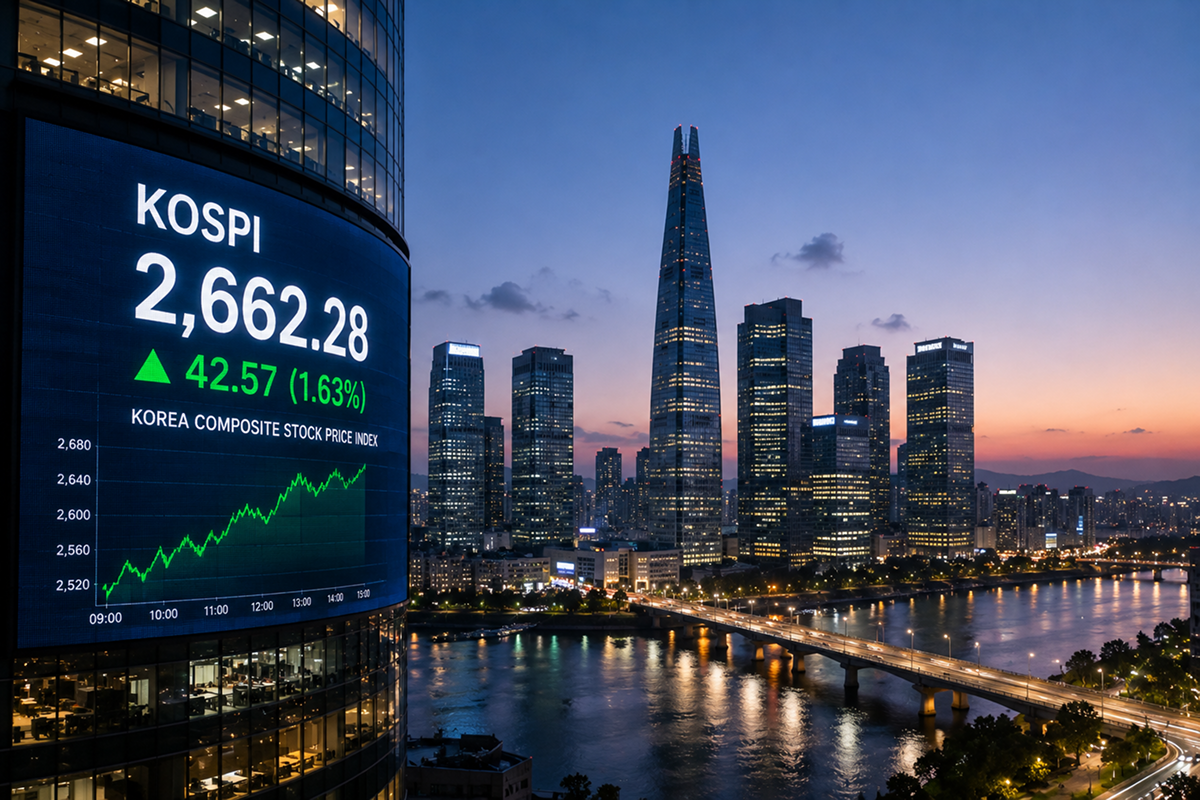
South Korea’s Kospi has staged a powerful recovery from its July sell-off, climbing more than 20% from its recent low and returning to bull-market territory. The speed of the rebound reflects renewed confidence in the country’s semiconductor leaders, but it also raises a critical question for global investors: whether the rally is being supported by sustainable earnings growth or is becoming increasingly dependent on AI-driven market sentiment.
Semiconductors Drive the Kospi Rebound
The recovery has been closely linked to renewed strength in South Korea’s major semiconductor companies, which have an outsized influence on the benchmark. Samsung Electronics and SK Hynix have benefited from improving expectations for memory-chip demand as global technology companies continue to commit substantial capital to artificial intelligence infrastructure.
Strong U.S. technology earnings have reinforced that narrative. Better-than-expected results from major technology companies have helped restore confidence that spending on data centers and AI infrastructure can remain strong, supporting expectations for higher demand for advanced memory products used in AI systems.
The fundamental backdrop has therefore remained more resilient than the sharp market decline suggested. Peter Kim, head of global investment strategy at KB Securities, said the AI rally and strong earnings had remained intact during the sell-off, arguing that the recovery reflected a return to fundamentals after technical factors and fund flows had temporarily dominated trading.
Technical Rebound Meets a Stronger Fundamental Case
The speed of the Kospi’s recovery was partly driven by the unwinding of leveraged positions and forced selling that had contributed to the earlier decline. Regulatory tightening and adjustments by brokerages to margin and risk requirements have helped reduce some of the pressure that amplified the previous sell-off.
As forced selling subsided, buyers returned to the market, while concerns about missing the rebound contributed to stronger demand. This technical component is important because it means the 20% recovery threshold does not necessarily represent a completely new market regime.
Jung In Yun of Fibonacci Asset Management Global cautioned against interpreting the rebound solely as the beginning of a new bull market. His assessment is that the recovery reflects both a technical normalization following forced selling and a genuine improvement in market stability, with semiconductor earnings and improved risk appetite providing fundamental support.
Korea’s Market Concentration Creates a Major Risk
The strength of the semiconductor sector is also one of the Kospi’s principal vulnerabilities. The benchmark’s dependence on a relatively small number of major technology companies means that any deterioration in the AI investment narrative could have an amplified effect on the broader index.
Phillip Wool, head of research at Rayliant Global Advisors, described Korea’s equity market as increasingly synonymous with the AI hardware trade. He warned that weaker capital-expenditure guidance from major technology companies, declining token prices or renewed Federal Reserve tightening expectations could trigger another pullback.
This concentration creates both an opportunity and a risk. Stronger semiconductor earnings can lift the entire benchmark, but disappointment from the same companies can quickly reverse sentiment. The elevated participation of retail investors and increasingly ambitious market expectations add another layer of sensitivity to changes in momentum.
Corporate Reform Adds a Longer-Term Support
Beyond the semiconductor cycle, South Korea has another potential structural support: its Value-Up program and corporate-governance reforms. Billy Leung, investment strategist at Global X ETFs, said these initiatives have helped address the longstanding “Korea discount,” referring to the tendency of South Korean companies to trade at lower valuations than comparable global peers.
Improved shareholder policies and governance could potentially support a broader revaluation of Korean equities over time. However, the durability of the current rally will still depend heavily on corporate earnings, particularly among the semiconductor companies that dominate the benchmark.
Looking ahead, investors will watch semiconductor earnings revisions, AI infrastructure spending, hyperscaler capital-expenditure guidance and Federal Reserve policy expectations for evidence of whether the Kospi can sustain its recovery. A period of consolidation after such a rapid rebound could be a normal part of the market’s adjustment rather than a sign that the broader trend has ended. The more important test will be whether improving earnings and corporate reforms can gradually broaden the rally beyond a concentrated group of AI-related stocks. If fundamentals continue to strengthen, the bull-market recovery could become more durable; if AI spending expectations weaken, the Kospi’s concentration could once again amplify market volatility.
Comparison, examination, and analysis between investment houses
Leave your details, and an expert from our team will get back to you as soon as possible
* This article, in whole or in part, does not contain any promise of investment returns, nor does it constitute professional advice to make investments in any particular field.
To read more about the full disclaimer, click here
- Lior mor
- •
- 7 Min Read
- •
- ago 1 hour
SKN | OpenAI’s Revenue Run Rate Tops $40 Billion as IPO Ambitions Move Closer
OpenAI’s annualized revenue run rate has crossed $40 billion, marking a significant acceleration in the artificial-intelligence company’s commercial expansion
- ago 1 hour
- •
- 7 Min Read
OpenAI’s annualized revenue run rate has crossed $40 billion, marking a significant acceleration in the artificial-intelligence company’s commercial expansion

- omer bar
- •
- 8 Min Read
- •
- ago 2 hours
SKN | Anthropic Explores Decart AI Acquisition as Demand for Claude Drives Infrastructure Expansion
Anthropic is in discussions to acquire Decart AI, an Nvidia-backed artificial intelligence startup, according to a source familiar with
- ago 2 hours
- •
- 8 Min Read
Anthropic is in discussions to acquire Decart AI, an Nvidia-backed artificial intelligence startup, according to a source familiar with

- Ronny Mor
- •
- 7 Min Read
- •
- ago 4 hours
SKN | Lenovo Surges 20% as AI Infrastructure Drives Record Revenue and Profit Growth
Lenovo Group delivered one of its strongest quarterly performances in years, highlighting the accelerating impact of artificial intelligence infrastructure
- ago 4 hours
- •
- 7 Min Read
Lenovo Group delivered one of its strongest quarterly performances in years, highlighting the accelerating impact of artificial intelligence infrastructure

- sagi habasov
- •
- 8 Min Read
- •
- ago 7 hours
SKN | Ondas Raises 2026 Revenue Outlook as Defense-Tech Demand Drives Record Growth
Ondas Inc. (NASDAQ: ONDS) delivered another sharp acceleration in growth during the second quarter of 2026, as demand for
- ago 7 hours
- •
- 8 Min Read
Ondas Inc. (NASDAQ: ONDS) delivered another sharp acceleration in growth during the second quarter of 2026, as demand for


