





- sagi habasov
- •
- 7 Min Read
- •
- 9 hours ago
Key Points
- Electric vehicle startup Slate Auto has officially opened pre-orders for its modular electric pickup truck, featuring a base price of $24,950.
- Company CEO Peter Parisi declared that every vehicle produced will yield positive gross margins, with the ultimate objective of achieving positive free cash flow by 2027.
- The company circumvents the massive losses plaguing its competitors by eliminating complex connectivity systems and expensive paint shops, shifting instead to a highly customizable DIY accessory model.
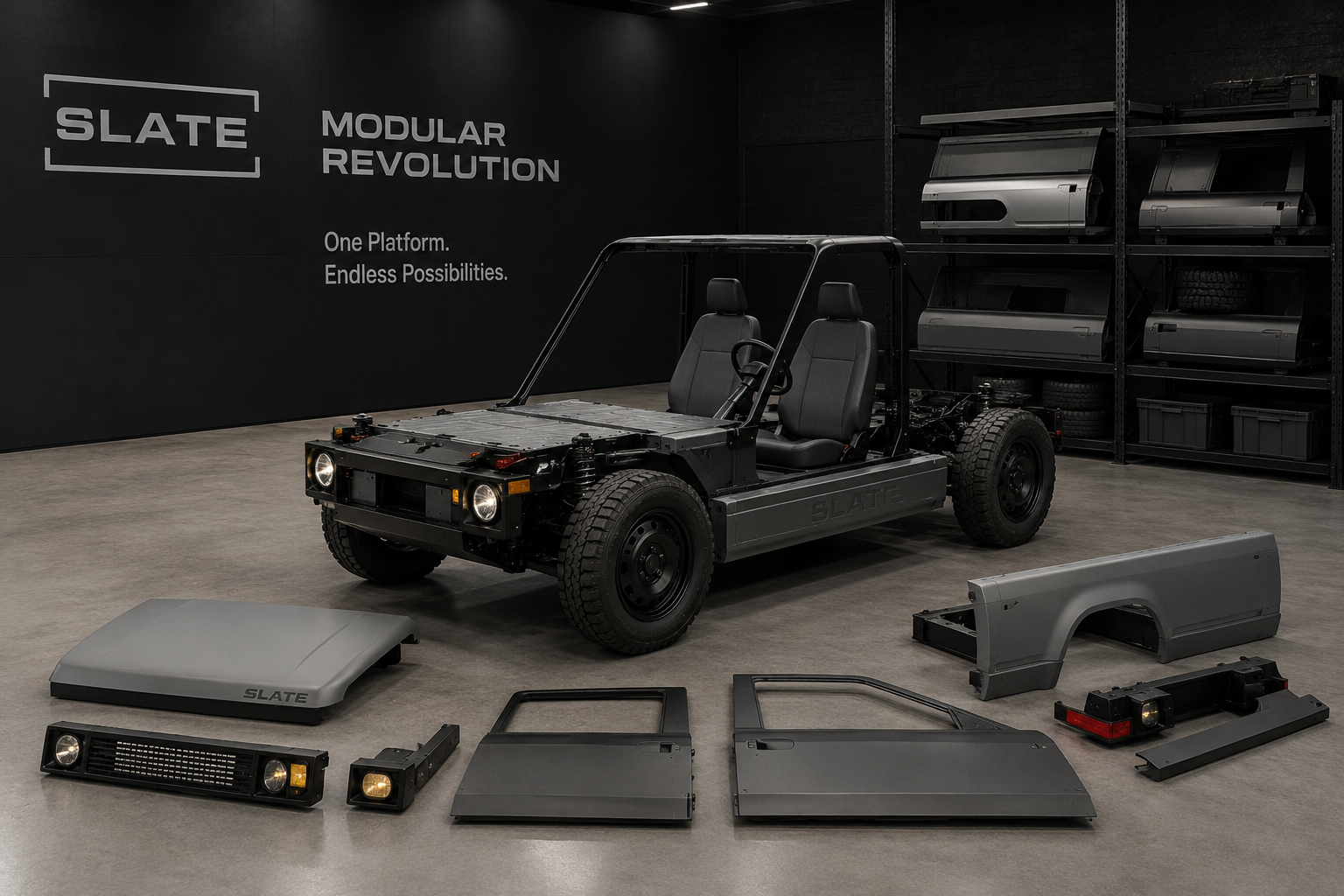
The opening of Slate Auto’s pre-order book marks a new chapter in the electric vehicle (EV) industry’s race to make mass-market adoption affordable, while simultaneously attempting to crack the profitability equation that has stymied numerous manufacturers before them. While the EV startup ecosystem has weathered severe turbulence in recent years—marked by bankruptcies of players like Fisker and Lordstown Motors, alongside multi-billion dollar losses and sweeping layoffs at Rivian and Lucid—Slate Auto is deploying a diametrically opposed strategy. Backed by prominent figures including Amazon founder Jeff Bezos and Los Angeles Dodgers controlling owner Mark Walter, the Michigan-based startup is anchoring its future on radical simplicity, low production overhead, and a highly accessible target price.
The enterprise’s commercial architecture relies on a unique flagship product: a two-seat electric pickup truck offering an estimated range of 200 miles (approximately 320 kilometers), 181 horsepower, and 200 lb-ft of torque. The baseline trim is so fundamentally spartan that its windows are fixed and speakers are an optional add-on. A conversion into a five-passenger sport utility vehicle (SUV) is available for an additional $5,000. Executive leadership, helmed by Peter Parisi—formerly a Vice President at Amazon Marketplace—asserts that the venture’s financial break-even point stands at roughly 80,000 vehicles annually. This figure sits just slightly above half of the maximum 150,000-unit capacity projected for the company’s assembly facility in Warsaw, Indiana.
A substantial portion of these capital savings stems from the decision to bypass expensive and complex traditional manufacturing processes. The startup’s vehicles are constructed with injection-molded composite exterior panels and bypass the paint shop entirely; instead, the company offers over 100 standard vinyl wrap options priced under $500. Furthermore, the vehicle foregoes central infotainment systems or built-in modems, relying on a small driver information display for speed and range, and encouraging consumers to utilize their own smartphones or tablets for navigation and media. This modular paradigm enables a completely uniform assembly line, transferring the customization experience to the consumer via a catalog of over 175 accessories, including roof racks and stereo systems.
Alongside these strategic opportunities, Slate Auto confronts notable commercial and structural headwind hurdles within both the domestic U.S. and global markets. The decision to focus exclusively on a two-door configuration and rear-wheel-drive represents a significant macroeconomic wager, given that industry data indicates two-door variants comprise only a nominal fraction of SUV and truck sales in the United States. Moreover, the company operates on a direct-to-consumer sales and service model, omitting a traditional franchised dealership network—a move that ensures absolute control over the client experience and reduces distribution costs, but requires intensive capital expenditures to build out an independent service infrastructure. Concurrently, competitive pressures are poised to intensify as legacy automotive giants like Ford and Stellantis prepare to enter the affordable electric truck segment in the coming years.
Having secured over $1.3 billion across three funding rounds, the company is currently navigating a controlled low-rate initial production phase, manually assembling roughly three vehicles per day ahead of broader factory automation. The chief executive noted that initial customer deliveries are slated to commence in the fourth quarter of this year, with the subsequent production year dedicated to scaling output. Regarding a potential initial public offering (IPO), leadership maintains that while public market options are continually evaluated, a 2027 listing is likely premature. The company’s immediate priority remains validating its baseline manufacturing scaling and demonstrating sustained cash-flow positivity prior to approaching public equity markets.
Comparison, examination, and analysis between investment houses
Leave your details, and an expert from our team will get back to you as soon as possible
* This article, in whole or in part, does not contain any promise of investment returns, nor does it constitute professional advice to make investments in any particular field.
To read more about the full disclaimer, click here

