


- omer bar
- •
- 7 Min Read
- •
- 2 months ago
Key Points
- Fourth-quarter revenue surged 73% to $68.1 billion.
- First-quarter outlook of $78 billion topped consensus estimates.
- Investor skepticism centers on durability of long-term AI spending.
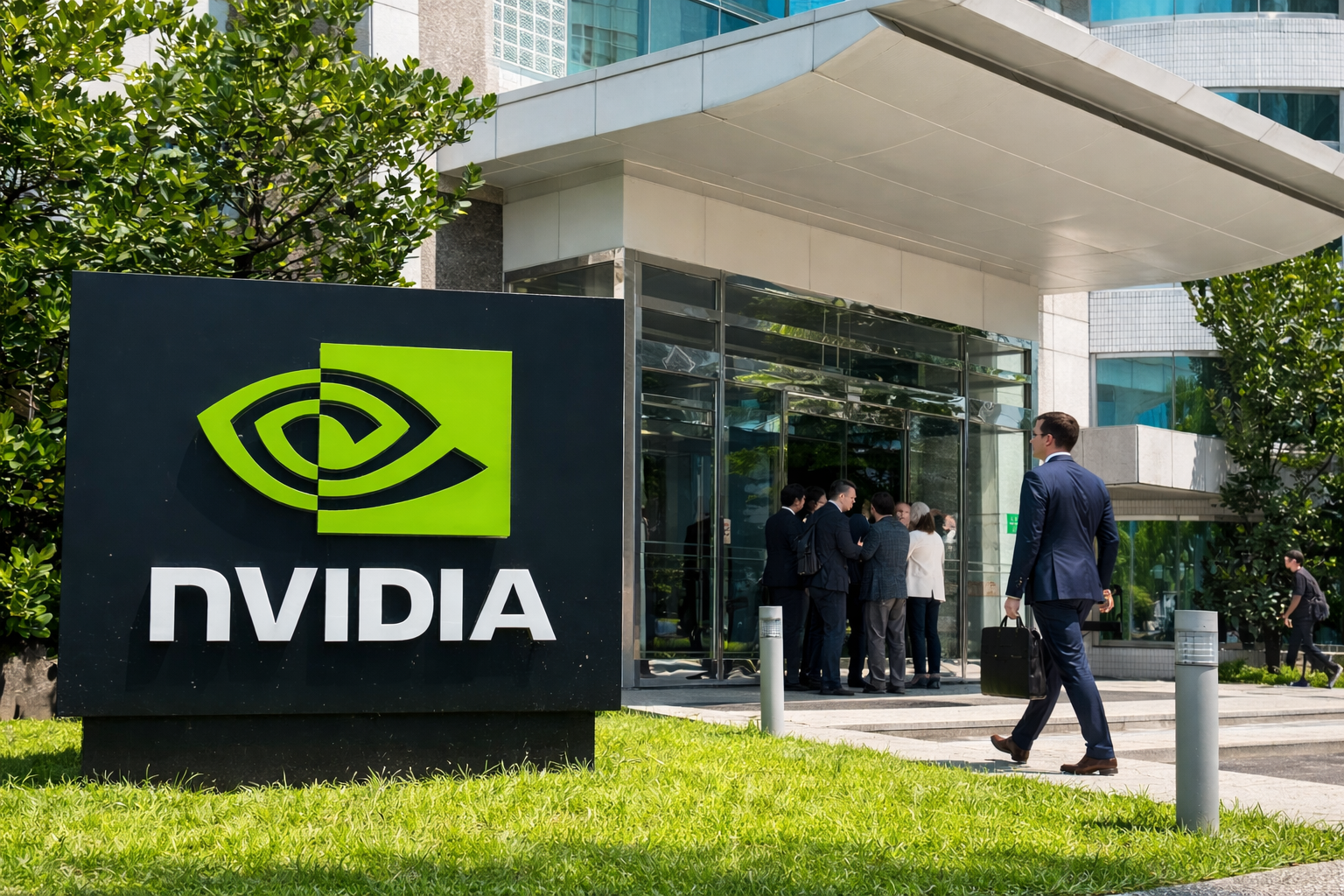
Nvidia once again posted blockbuster numbers, but the market’s reaction was notably restrained. Despite a 73% year-over-year surge in fourth-quarter revenue and a first-quarter outlook well above consensus, shares slipped as much as 1.5% during the earnings call before stabilizing. The muted response underscores a critical shift in investor psychology: strong results are no longer enough. In a market questioning the durability of the AI boom, expectations have become extraordinarily high.
Blowout Quarter, Elevated Expectations
Nvidia reported fiscal fourth-quarter revenue of $68.1 billion, topping estimates of $65.9 billion. Adjusted earnings came in at $1.62 per share, ahead of the $1.53 consensus. Gross margin reached 75.2%, also exceeding projections.
For the fiscal first quarter, Nvidia guided revenue to approximately $78 billion, comfortably above the $72.8 billion average forecast. However, some bullish projections had approached $80 billion, suggesting that the bar was set even higher internally among institutional investors.
The numbers confirm continued dominance in AI accelerator chips, where Nvidia remains the clear market leader. Yet valuation compression reflects a repricing of growth duration rather than immediate fundamentals.
AI Durability Under Scrutiny
After transforming into one of the world’s most valuable companies, Nvidia now faces skepticism about how long hyperscalers and enterprise clients can sustain aggressive AI capital expenditures.
CEO Jensen Huang addressed this directly, emphasizing that customers are monetizing their compute investments and generating growing cash flows. He argued that demand for capacity remains tightly linked to revenue growth among AI developers, reinforcing confidence in continued spending.
CFO Colette Kress also pushed back against concerns about supply constraints. The company, she said, has secured inventory and long-term supply commitments extending into 2027. Production of its Blackwell architecture and its successor, Rubin, is expected to surpass earlier projections. Nvidia had previously outlined a potential $500 billion revenue opportunity for these platforms by the end of 2026.
Despite these assurances, markets remain cautious. When a stock becomes the core infrastructure provider for an entire technological revolution, even slight moderation in growth rates can trigger multiple compression.
China, Tariffs and Strategic Expansion
Geopolitical risk adds another layer of uncertainty. Nvidia continues to face export restrictions in China, historically one of its largest markets. Limited licenses have been granted for H200 processor shipments, but regulatory approval from Beijing remains unclear. The chips are also subject to a 25% tariff when imported into the United States.
For now, Nvidia excludes Chinese data center revenue from forward forecasts, reflecting ongoing unpredictability.
Strategically, Nvidia has expanded beyond accelerators into networking, general-purpose processors, and full AI computing systems. This vertical integration deepens customer reliance and strengthens its ecosystem moat, but it also raises expectations for sustained execution.
Looking ahead, Nvidia’s challenge is no longer proving growth — it is proving endurance. With fiscal first-quarter revenue projected near $78 billion, the company continues to redefine scale in semiconductor history. Yet investors appear to be demanding visibility not just into the next quarter, but into the longevity of AI-driven infrastructure spending.
In this environment, even exceptional results can produce lukewarm reactions when valuations already reflect perfection. Nvidia remains at the center of the AI economy — but the market is clearly asking: how long can this pace continue?
Comparison, examination, and analysis between investment houses
Leave your details, and an expert from our team will get back to you as soon as possible
* This article, in whole or in part, does not contain any promise of investment returns, nor does it constitute professional advice to make investments in any particular field.
To read more about the full disclaimer, click here
- Ronny Mor
- •
- 7 Min Read
- •
- ago 17 hours
SKN | HSBC Disappoints on Bottom Line: Do Credit Losses Overshadow Efficiency Gains?
In this article: Analysis of Q1 2026 financial results. The impact of the macroeconomic environment on credit losses. Review of
- ago 17 hours
- •
- 7 Min Read

In this article: Analysis of Q1 2026 financial results. The impact of the macroeconomic environment on credit losses. Review of

- omer bar
- •
- 5 Min Read
- •
- ago 1 day
SKN | Pinterest Surges 17% After Earnings Beat and Strong Revenue Outlook
Stock Rally Driven by Earnings Strength Pinterest surged 17% after delivering first-quarter results that exceeded expectations on both revenue and
- ago 1 day
- •
- 5 Min Read

Stock Rally Driven by Earnings Strength Pinterest surged 17% after delivering first-quarter results that exceeded expectations on both revenue and

- Arik Arkadi Sluzki
- •
- 6 Min Read
- •
- ago 1 day
SKN | Palantir Revenue Surges 85% on Strong US Demand—Is AI-Driven Growth Accelerating?
Palantir Technologies Inc. (NYSE: PLTR) reported a sharp 85% increase in revenue, fueled by strong demand across its US
- ago 1 day
- •
- 6 Min Read
Palantir Technologies Inc. (NYSE: PLTR) reported a sharp 85% increase in revenue, fueled by strong demand across its US

- orshu
- •
- 6 Min Read
- •
- ago 1 day
SKN | AMD Q1 Earnings Preview—Can Data Center Growth Sustain Momentum in the AI Race?
Advanced Micro Devices Inc. (NASDAQ: AMD) is set to report its first-quarter earnings, with market attention centered on the
- ago 1 day
- •
- 6 Min Read
Advanced Micro Devices Inc. (NASDAQ: AMD) is set to report its first-quarter earnings, with market attention centered on the


