





- sagi habasov
- •
- 9 Min Read
- •
- 1 hour ago
Key Points
- The Hardware Boom Continues: Mega-partnerships and aggressive price targets place memory chipmakers at the forefront of the tech revolution.
- Long-Term Caution: Macroeconomic forecasts point to a potential S&P 500 correction by late 2027 amid historical expectation gaps.
- Casualties of Automation: Software firms and gig-economy platforms suffer downgrades as artificial intelligence begins to erode traditional core businesses.
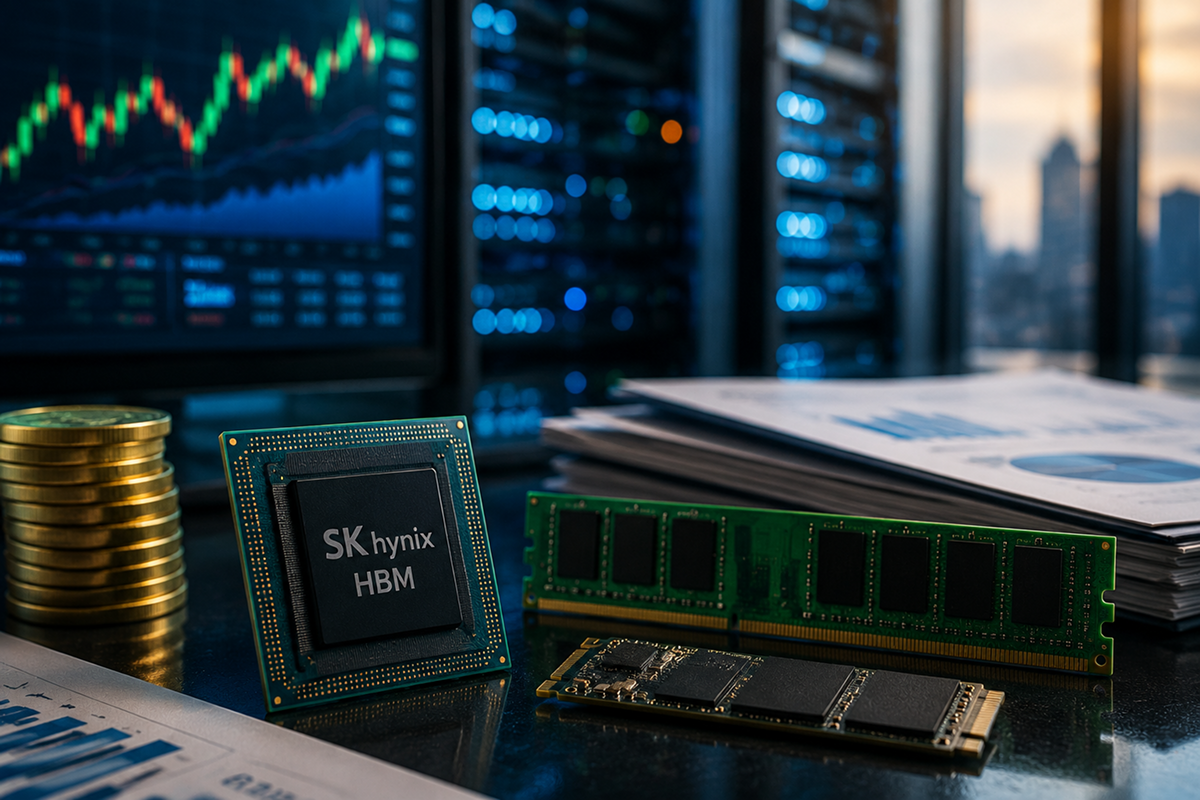
Capital markets received a stark reminder this week that the artificial intelligence revolution is not a monolith, and its economic impacts are highly asymmetrical. While hardware and infrastructure providers bask in massive capital inflows and sweeping upgrades, companies reliant on digital services and traditional platforms are increasingly forced into a defensive posture. This dichotomy—ruthlessly separating the “infrastructure builders” from the “casualties of automation”—was vividly reflected in a series of dramatic moves by major Wall Street investment banks in recent days. Investors, who until recently moved in herds toward any ticker associated with AI, are now required to exercise profound selectivity. Market psychology is transitioning from blind euphoria to rigorous performance scrutiny, acknowledging that astronomical expectations may inevitably collide with complex economic realities toward the end of the decade.
Memory as the New Oil: The Hardware Surge
UBS made waves this week by initiating coverage on SK Hynix with a Buy rating and an aggressive $204 price target. This bold move is anchored in the thesis that the broader market is fundamentally underpricing a deep structural shift in the memory industry’s profitability. Analysts project that bit demand, increasingly driven by the development of Agentic AI, will surge sharply in the coming years. Although sector equities recently pulled back, models suggest that long-term agreements being signed today will secure unprecedented margin profiles exceeding 40% over the next decade. Behaviorally, it appears many investors remain captive to the historical cyclicality paradigm of memory chips, struggling to internalize the permanent structural shift catalyzed by the current data revolution.
Between Optimism and Reality: The Fate of the S&P 500
At Capital Economics, the recent volatility in tech mega-caps is viewed as a byproduct of temporary panic driven by noise, rather than a fundamental trend reversal. Economists estimate the AI rally will resume in the near term, potentially pushing the S&P 500 to record highs of 8,250 by the end of 2026. However, the longer-term picture clouds over, necessitating strategic realignment. There is a tangible risk that inflated earnings expectations will eventually meet harsh reality, a dynamic that could trigger a deep correction, dragging the index down to 6,500 by the end of 2027. Leading risk factors include China’s progress in the technological arms race and growing concerns over “circular funding”—a scenario where cloud giants fund startups simply so those startups can purchase compute power back from them.
Strategic Alliances: Hundreds of Billions Change Hands
Simultaneously, Bernstein reinforced its bullish stance on memory makers, a move validated by a series of historic announcements at the South Korean government’s AI summit in San Francisco. Mega-partnerships totaling over $700 billion among players like Samsung, SK Hynix, Nvidia, and Broadcom illustrate the absolute dependence of large language models on physical infrastructure. These agreements, securing tech supply chains and foundry services years in advance, signal to the market that future bottlenecks will be concentrated in manufacturing capacity. Bernstein views recent price pullbacks as an exceptionally attractive entry point, emphasizing that while a Chinese threat exists in NAND memory, the premium DRAM market remains fortified due to restricted access to advanced EUV lithography equipment.
The Silent Casualties: When Automation Bites the Business Model
While hardware manufacturers project record forecasts, segments of the software and platform economy are beginning to pay the steep price of technological advancement. TD Cowen downgraded financial software giant Intuit to a Hold, citing concerns that free AI-driven tools will cannibalize the company’s core tax preparation and accounting operations. Similarly, freelance marketplace Fiverr absorbed severe blows with sharp downgrades from both Oppenheimer and Goldman Sachs. The accelerating adoption of large language models is rapidly rendering high-volume, low-value tasks obsolete—tasks that historically served as the platform’s primary growth engine. These cases exemplify the capital market’s process of creative destruction, where new technology forces incumbents to execute sharp pivots or risk commercial irrelevance.
Looking ahead, it is evident that the U.S. tech sector is entering a necessary and inevitable maturation phase. The euphoria that characterized the breakout stages of AI is gradually making way for cold, selective, cash-flow-based analysis. Both retail and institutional investors must sharply distinguish between the companies building the physical infrastructure and fortifying their margins, and those that will be forced to fight for their commercial existence against ever-improving algorithms. Wall Street’s true test over the next two years will not lie in identifying the trend itself, but in the surgical ability to price in who is extracting tangible economic value from the revolution, and who is destined to be left behind once the music stops.
Comparison, examination, and analysis between investment houses
Leave your details, and an expert from our team will get back to you as soon as possible
* This article, in whole or in part, does not contain any promise of investment returns, nor does it constitute professional advice to make investments in any particular field.
To read more about the full disclaimer, click here
- omer bar
- •
- 7 Min Read
- •
- ago 5 hours
SKN | Amazon Fair Value Climbs as AWS Strength and AI Investments Reinforce Long-Term Outlook
Amazon.com Inc. continues to attract investor attention as analysts modestly raised the company's estimated fair value, reflecting growing confidence
- ago 5 hours
- •
- 7 Min Read

Amazon.com Inc. continues to attract investor attention as analysts modestly raised the company's estimated fair value, reflecting growing confidence

- orshu
- •
- 6 Min Read
- •
- ago 7 hours
SKN | AMD Challenges Nvidia on AI Inference Efficiency as MI355X Narrows the Competitive Gap
The race to dominate artificial intelligence infrastructure is expanding beyond raw chip performance to include deployment efficiency and operating
- ago 7 hours
- •
- 6 Min Read
The race to dominate artificial intelligence infrastructure is expanding beyond raw chip performance to include deployment efficiency and operating
- orshu
- •
- 6 Min Read
- •
- ago 19 hours
SKN | Robinhood’s Prediction Markets Become a Major Growth Engine as Q2 Revenue Overtakes Crypto Trading
Robinhood Markets continues to expand beyond its origins as a commission-free stock brokerage, with prediction markets emerging as one
- ago 19 hours
- •
- 6 Min Read

Robinhood Markets continues to expand beyond its origins as a commission-free stock brokerage, with prediction markets emerging as one

- Arik Arkadi Sluzki
- •
- 5 Min Read
- •
- ago 20 hours
SKN | Can Ondas Holdings Close the Gap Between Its Market Price and Analyst Expectations?
Ondas Holdings has emerged as one of several small-cap technology companies attracting investor attention due to the widening gap
- ago 20 hours
- •
- 5 Min Read

Ondas Holdings has emerged as one of several small-cap technology companies attracting investor attention due to the widening gap


