


- Lior mor
- •
- 8 Min Read
- •
- 2 months ago
Key Points
- Amazon is quietly testing a large-format physical store concept that mirrors Walmart’s Supercenter model.
- Walmart’s dense store network continues to drive impulse purchases that Amazon struggles to replicate online.
- The success or failure of Amazon’s experiment could reshape how the two retail giants compete in the next decade.
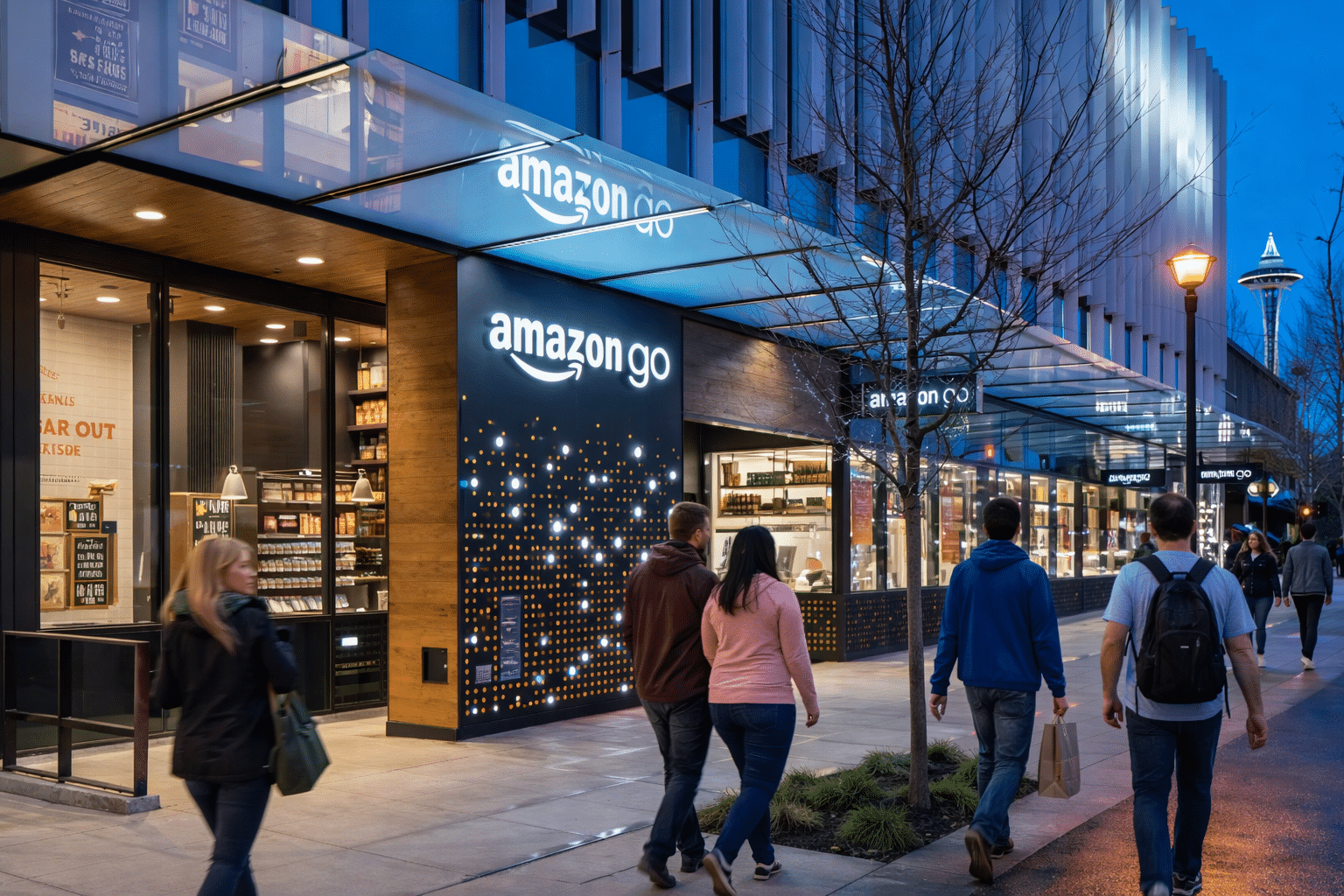
At the heart of the challenge is consumer behavior. Amazon excels at targeted recommendations driven by past purchases, but those systems often narrow rather than expand shopping intent. Physical stores, by contrast, encourage discovery. A walk through a Walmart aisle can spark impulse purchases that have little to do with a shopper’s original plan, a dynamic that continues to underpin Walmart’s sales resilience.
Walmart’s Store Network as a Structural Advantage
Walmart has built an unmatched physical presence over decades. Roughly 90% of Americans live within 10 miles of a Walmart or Sam’s Club location, a statistic that underscores how deeply embedded the retailer is in everyday life. This proximity makes frequent, low-friction visits possible and gives Walmart a steady stream of in-store traffic that fuels both planned and unplanned spending.
That reach has also allowed Walmart to blur the line between digital and physical retail, using stores as fulfillment hubs while still benefiting from traditional browsing behavior. It is an advantage that has proven difficult—if not impossible—for online-first rivals to replicate.
Amazon’s Quiet Supercenter-Style Experiment
Amazon is now signaling, quietly, that it may be ready to try. Local reports have revealed plans for a massive, one-story retail location in Orland Park, Illinois, spanning roughly 229,000 square feet—larger than a typical Walmart Supercenter. Unlike Amazon’s highly publicized past launches, this move has unfolded with minimal fanfare, surfacing mainly through zoning meetings and local news coverage.
Company representatives have described the project as a new retail concept that combines elements of Amazon Fresh, Whole Foods, and its online ecosystem. The emphasis appears to be on safety, convenience, and a smoother customer experience, suggesting Amazon is studying not just Walmart’s scale, but also how modern shoppers navigate physical space.
A Mixed Track Record in Physical Retail
Amazon’s history with brick-and-mortar experiments is uneven. Its curated bookstores and 4-Star locations showed early promise, while Amazon Go’s checkout-free technology demonstrated genuine innovation. Yet many of those concepts were ultimately scaled back or shuttered, reflecting the difficulty of translating Amazon’s data-driven strengths into consistently profitable physical formats.
Those setbacks help explain why the new mega-store concept is being tested quietly. Rather than declaring a bold strategic pivot, Amazon appears to be probing whether a large-format store—closer to Walmart’s core model—can unlock the kind of impulse-driven sales its online platform often misses.
Strategic Implications for the Retail Landscape
If successful, Amazon’s move could mark a subtle but meaningful shift in U.S. retail strategy. A large-format store would not just compete on groceries or essentials, but on discovery, convenience, and habit formation. It would also represent an acknowledgment that algorithms alone may not fully replace the psychology of physical browsing.
At the same time, scaling such stores nationally would be capital-intensive and operationally complex, areas where Walmart’s decades of experience still loom large.
What Comes Next
For now, Amazon’s supercenter-style experiment remains just that—an experiment. Investors and competitors alike will be watching whether the Illinois location becomes a one-off test or the blueprint for a broader rollout. The outcome could determine whether Amazon remains primarily a digital retail powerhouse or evolves into a more direct, physical challenger to Walmart on its own turf.
Comparison, examination, and analysis between investment houses
Leave your details, and an expert from our team will get back to you as soon as possible
* This article, in whole or in part, does not contain any promise of investment returns, nor does it constitute professional advice to make investments in any particular field.
To read more about the full disclaimer, click here
- omer bar
- •
- 7 Min Read
- •
- ago 11 minutes
SKN | Asian Markets Rally in Morning Session as KOSPI, Hang Seng, and Nikkei Lead Regional Gains
Asian markets are trading firmly higher during the Wednesday morning session, March 11, as major regional benchmarks post gains across
- ago 11 minutes
- •
- 7 Min Read

Asian markets are trading firmly higher during the Wednesday morning session, March 11, as major regional benchmarks post gains across

- orshu
- •
- 7 Min Read
- •
- ago 4 hours
SKN | Insider Move Signals Strategy Shift? Gold.com Director Benjamin Sells $1.39 Million in Company Stock
A recent insider transaction involving Gold.com director Benjamin has drawn attention from investors after regulatory filings revealed the sale
- ago 4 hours
- •
- 7 Min Read

A recent insider transaction involving Gold.com director Benjamin has drawn attention from investors after regulatory filings revealed the sale

- sagi habasov
- •
- 4 Min Read
- •
- ago 6 hours
SKN | Amazon Eyes $50 Billion Bond Offering to Fund Expansion and Debt Refinancing
Amazon is preparing to sell almost $50 billion in bonds, a move aimed at refinancing existing debt and bolstering
- ago 6 hours
- •
- 4 Min Read
Amazon is preparing to sell almost $50 billion in bonds, a move aimed at refinancing existing debt and bolstering
- orshu
- •
- 5 Min Read
- •
- ago 6 hours
SKN | Gold Advances as Dollar Weakness Revives Bullion Demand Amid Rate Uncertainty
Gold prices edged higher as weakness in the U.S. dollar improved the appeal of bullion for global investors. The
- ago 6 hours
- •
- 5 Min Read

Gold prices edged higher as weakness in the U.S. dollar improved the appeal of bullion for global investors. The

