


- Ronny Mor
- •
- 7 Min Read
- •
- 9 seconds ago
Key Points
- Goldman Sachs has reportedly barred its Hong Kong bankers from using Anthropic’s AI tools, according to a source
- The decision reflects rising internal controls and regulatory caution around generative AI in financial institutions
- The move highlights growing divergence in how global banks deploy AI across regions and business units

Goldman Sachs has reportedly restricted its Hong Kong-based bankers from using artificial intelligence tools developed by Anthropic, according to a source familiar with the matter. The decision comes as global financial institutions increasingly integrate generative AI into research, productivity, and client-facing workflows, while simultaneously tightening internal governance frameworks around data security and model risk. For global investors, including those in Israel’s financial and technology sectors, the development underscores the accelerating tension between AI adoption and regulatory compliance in the banking industry.
AI Adoption Meets Compliance Boundaries in Global Banking
The reported restriction reflects a broader trend within large financial institutions, where enthusiasm for productivity gains from generative AI is being balanced against heightened concerns over data leakage, intellectual property protection, and regulatory exposure.
While banks have been experimenting with AI tools to enhance research efficiency, automate reporting, and support client analysis, internal policies often vary significantly by jurisdiction. Hong Kong, as a major international financial hub with strict regulatory oversight, has become a focal point for cautious implementation strategies.
According to the source, Goldman Sachs’ decision does not necessarily indicate a rejection of AI technologies broadly, but rather a targeted restriction on specific third-party tools perceived as posing elevated data governance risks.
Financial Institutions Tighten Controls on Generative AI Platforms
The move highlights a growing industry-wide shift toward stricter controls on external AI platforms such as Anthropic, OpenAI, and other large language model providers. Banks are increasingly classifying generative AI tools as high-risk software due to the potential for sensitive client data exposure or unintended model outputs.
Major financial institutions globally have been building internal AI systems or deploying “walled garden” solutions that allow controlled use of machine learning models within secure environments. This approach is designed to preserve competitive advantages while complying with regulatory expectations around data protection and operational risk.
For global markets, the divergence in AI adoption strategies among major banks reflects an early-stage governance framework forming around one of the most rapidly expanding technology sectors.
Regional Differences Highlight Fragmented AI Regulation Landscape
The reported restriction in Hong Kong also underscores the fragmented nature of global AI regulation. While jurisdictions such as the United States and the European Union are moving toward structured AI governance frameworks, implementation timelines and enforcement standards remain inconsistent.
Financial hubs like Hong Kong, Singapore, and London are particularly sensitive to cross-border data flows and compliance requirements, prompting institutions to adopt more conservative AI deployment strategies in certain regions compared with others.
For Israeli financial institutions and technology firms operating in global markets, these developments are relevant given Israel’s increasing role in AI development, fintech infrastructure, and cybersecurity solutions. Regulatory divergence across regions may influence how AI-enabled financial tools are designed, deployed, and scaled internationally.
Outlook: AI Governance Expected to Become a Core Financial Industry Constraint
Looking ahead, the trajectory of AI adoption in banking will likely be shaped by the evolving balance between innovation efficiency and regulatory risk management. Financial institutions are expected to expand internal AI capabilities while limiting reliance on open external models in sensitive environments.
Key risks include fragmented AI governance standards across jurisdictions, rising compliance costs, and potential operational inefficiencies resulting from restricted tool usage. On the other hand, stronger regulatory clarity could eventually support broader institutional confidence and standardized AI deployment frameworks.
For global investors, including those in Israel, the development highlights the increasing importance of AI governance as a structural factor influencing both technology sector growth and financial industry transformation. The interaction between innovation and regulation is expected to remain a defining theme across capital markets in the coming years.
Comparison, examination, and analysis between investment houses
Leave your details, and an expert from our team will get back to you as soon as possible
* This article, in whole or in part, does not contain any promise of investment returns, nor does it constitute professional advice to make investments in any particular field.
To read more about the full disclaimer, click here
- omer bar
- •
- 8 Min Read
- •
- ago 58 minutes
SKN | Could Elon Musk’s Court Testimony Influence the Future Trajectory of Artificial Intelligence Regulation?
Elon Musk’s testimony in an ongoing legal proceeding has drawn global attention as the case touches on fundamental questions about
- ago 58 minutes
- •
- 8 Min Read
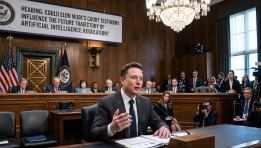
Elon Musk’s testimony in an ongoing legal proceeding has drawn global attention as the case touches on fundamental questions about

- Lior mor
- •
- 7 Min Read
- •
- ago 2 hours
SKN | What Does King Charles’ Meeting With US Tech Leaders Signal for Startup Growth and Innovation Challenges?
King Charles has met with senior US technology executives to discuss structural challenges facing startups, including access to capital, regulatory
- ago 2 hours
- •
- 7 Min Read

King Charles has met with senior US technology executives to discuss structural challenges facing startups, including access to capital, regulatory
- Lior mor
- •
- 7 Min Read
- •
- ago 4 hours
SKN | Storage Sector Surges as Seagate Outlook Reinforces AI Infrastructure Investment Cycle
The storage and data infrastructure sector saw a notable rally following an optimistic forecast from Seagate Technology, which reinforced expectations
- ago 4 hours
- •
- 7 Min Read

The storage and data infrastructure sector saw a notable rally following an optimistic forecast from Seagate Technology, which reinforced expectations
- omer bar
- •
- 7 Min Read
- •
- ago 8 hours
SKN | Why SanDisk Stock Just Dropped—Cyclical Weakness or a Deeper Shift in Memory Markets?
Shares tied to SanDisk, now operating under Western Digital (NASDAQ: WDC), moved lower as investors reacted to shifting dynamics
- ago 8 hours
- •
- 7 Min Read

Shares tied to SanDisk, now operating under Western Digital (NASDAQ: WDC), moved lower as investors reacted to shifting dynamics

