


- Ronny Mor
- •
- 7 Min Read
- •
- 1 hour ago
Key Points
- Amazon-owned Zoox is expanding robotaxi testing to Dallas and Phoenix as the autonomous mobility race intensifies.
- Alphabet’s Waymo currently leads the market with roughly 450,000 paid rides per week across multiple cities.
- Tesla is pursuing a lower-cost vision-only strategy but still faces regulatory and technological hurdles.
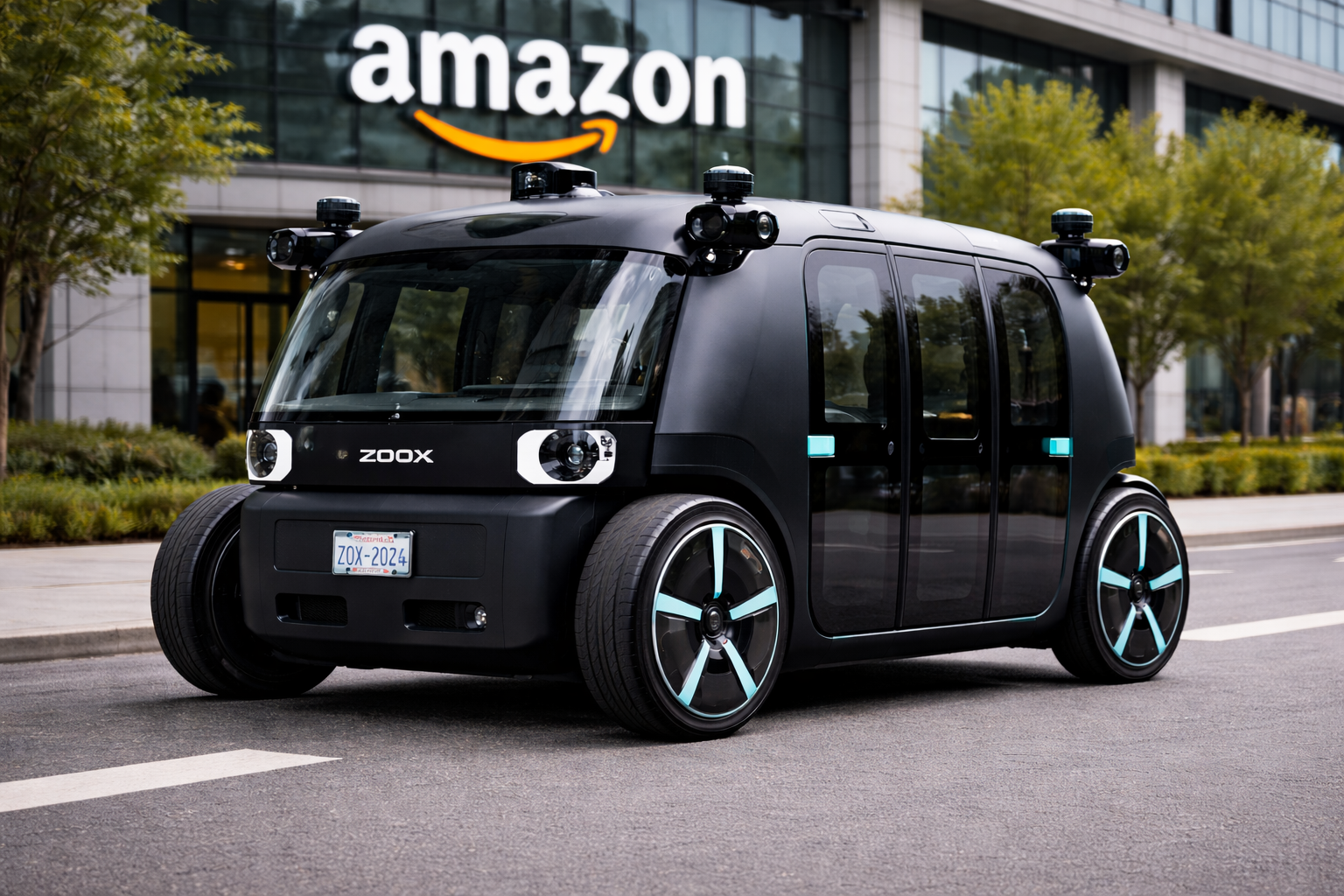
Amazon’s autonomous vehicle subsidiary Zoox is expanding its robotaxi footprint in the United States, signaling that the competition to dominate the emerging self-driving mobility market is accelerating. The company announced plans to deploy sensor-equipped vehicles in Dallas and Phoenix to map city streets and test its autonomous technology under complex real-world conditions. The move reflects a broader industry push among technology giants and automakers to scale robotaxi services across major metropolitan areas while racing to achieve regulatory approval and commercial viability.
Zoox Expands Testing as It Prepares for Commercial Service
Zoox plans to introduce a small fleet of retrofitted Toyota Highlander vehicles equipped with its full sensor suite to begin mapping operations in Dallas and Phoenix. These vehicles will initially operate with human safety drivers as the company gathers detailed data on road conditions, traffic behavior, and environmental variables.
The two cities were selected specifically to challenge Zoox’s autonomous systems. Both Dallas and Phoenix feature extensive suburban layouts, large highway networks, and varied weather patterns that can test the robustness of self-driving algorithms.
The company has already surpassed one million autonomous miles driven and has served more than 300,000 riders through its pilot programs in San Francisco and Las Vegas. In those cities, Zoox currently offers free public rides in limited service zones while refining the technology and gathering operational feedback. The company intends to begin charging passengers for rides in 2026, marking a shift toward a sustainable commercial model.
Waymo Maintains an Early Lead in the Robotaxi Market
Despite Zoox’s expansion, Alphabet’s Waymo remains the clear frontrunner in the U.S. robotaxi industry. Waymo currently operates services in multiple cities and is completing approximately 450,000 paid rides per week as of early 2026.
The company has aggressively scaled its operations and plans to expand services into several additional metropolitan areas, including Dallas, Houston, San Diego, and Washington. At the same time, Waymo continues testing in major global cities such as Tokyo, London, and New York.
Waymo’s strategy relies on a sophisticated combination of sensors, including lidar, radar, and cameras, to build a comprehensive understanding of the vehicle’s environment. This sensor-heavy approach is widely considered technologically robust but also increases the cost of each autonomous vehicle deployed.
The company’s early mover advantage and established ride volume have positioned it as the benchmark competitor in the autonomous mobility sector.
Tesla Pursues a Different Autonomous Strategy
Tesla, another major player in the robotaxi race, is pursuing a fundamentally different technological approach. Unlike Waymo and Zoox, Tesla relies primarily on camera-based vision systems rather than complex sensor arrays.
The company launched limited robotaxi services in Austin and the San Francisco Bay Area in 2025, though most vehicles still operate with human safety drivers. Only a small number of Tesla vehicles currently run without supervision in Austin.
Tesla’s vision-only strategy could ultimately prove more scalable because it significantly reduces hardware costs per vehicle. This has made the company’s long-term robotaxi ambitions attractive to investors. However, Tesla still faces significant regulatory hurdles, including approval for fully autonomous commercial operations in major markets such as California.
As the race intensifies, the next phase of competition will likely hinge on safety validation, regulatory acceptance, and the ability to scale services profitably. Companies that can demonstrate reliable autonomous systems while controlling costs may ultimately shape the future of urban transportation.
Key Points:
Comparison, examination, and analysis between investment houses
Leave your details, and an expert from our team will get back to you as soon as possible
* This article, in whole or in part, does not contain any promise of investment returns, nor does it constitute professional advice to make investments in any particular field.
To read more about the full disclaimer, click here
- omer bar
- •
- 7 Min Read
- •
- ago 5 hours
SKN | Is the AI Infrastructure Boom Accelerating? Nvidia-Backed Nscale Hits $14.6 Billion Valuation
The global race to build artificial intelligence infrastructure continues to accelerate as investors pour billions into companies developing the computing
- ago 5 hours
- •
- 7 Min Read
The global race to build artificial intelligence infrastructure continues to accelerate as investors pour billions into companies developing the computing
- omer bar
- •
- 7 Min Read
- •
- ago 6 hours
SKN | Can AI Teach Robots to Learn Like Humans? A New Tokyo Startup Bets on the Future of Physical AI
Artificial intelligence is beginning to move beyond the digital world and into physical industries, and a new robotics startup founded
- ago 6 hours
- •
- 7 Min Read
Artificial intelligence is beginning to move beyond the digital world and into physical industries, and a new robotics startup founded

- Ronny Mor
- •
- 7 Min Read
- •
- ago 18 hours
SKN | Apple’s $599 MacBook Neo: A Strategic Move That Could Pressure Microsoft and Google
Apple has introduced a new entry-level laptop that could reshape the competitive landscape of the personal computer market. The newly
- ago 18 hours
- •
- 7 Min Read

Apple has introduced a new entry-level laptop that could reshape the competitive landscape of the personal computer market. The newly
- omer bar
- •
- 8 Min Read
- •
- ago 2 days
SKN | Is Oracle’s $500 Billion Stargate AI Project Facing Headwinds as Infrastructure Demands Grow?
The technology sector is closely watching developments surrounding Oracle’s proposed $500 billion Stargate project, an ambitious initiative designed to
- ago 2 days
- •
- 8 Min Read
The technology sector is closely watching developments surrounding Oracle’s proposed $500 billion Stargate project, an ambitious initiative designed to

