


- omer bar
- •
- 7 Min Read
- •
- 1 hour ago
Key Points
- A Tokyo-based startup founded by former Google researchers is developing self-learning robotics AI.
- Japan’s strong robotics manufacturing sector provides an ideal testing ground for physical AI systems.
- Self-learning machines could transform automation by allowing robots to acquire skills autonomously.
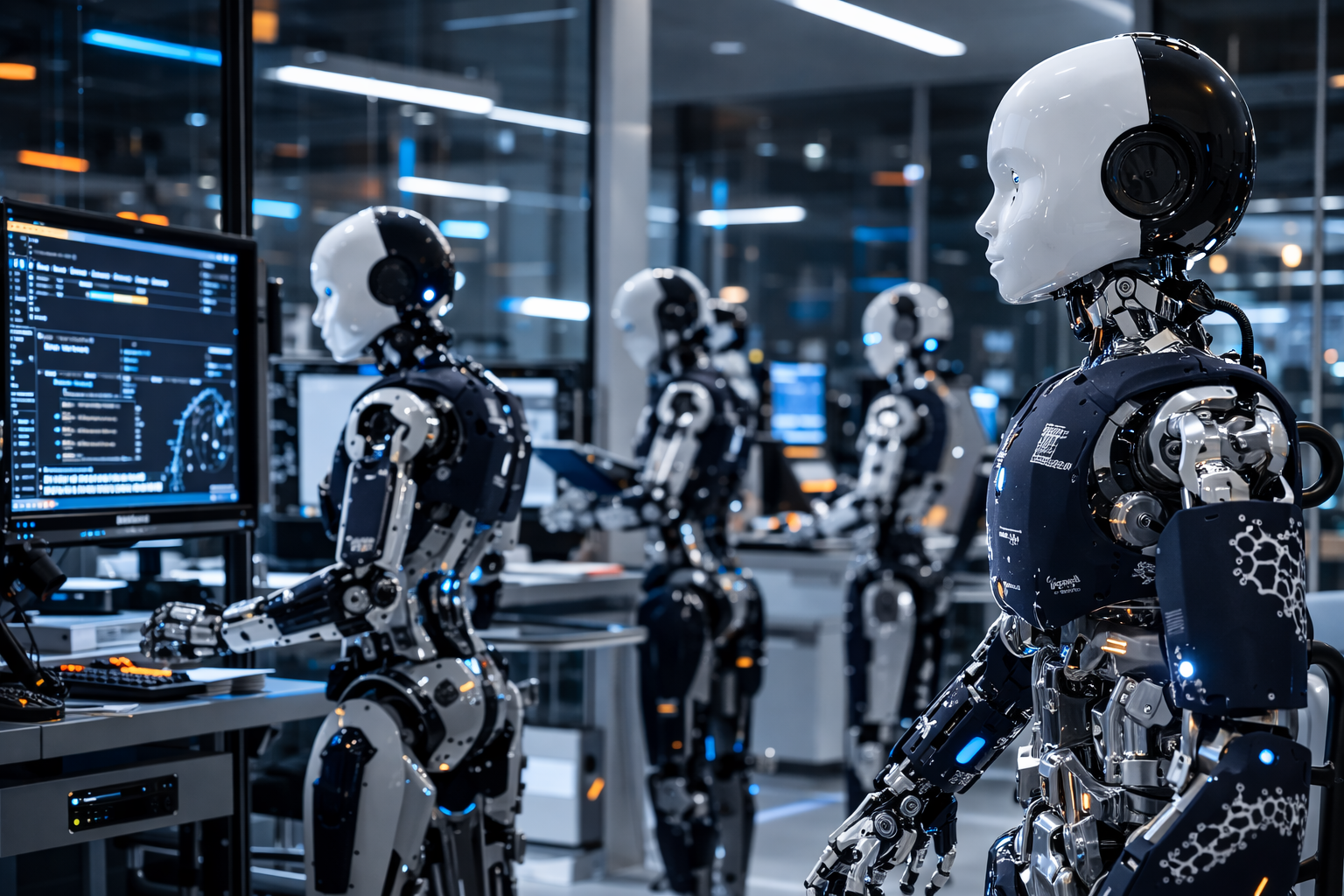
Artificial intelligence is beginning to move beyond the digital world and into physical industries, and a new robotics startup founded by former Google researchers is betting that Japan will be the ideal proving ground. Integral AI Inc., a five-year-old Silicon Valley-born company, has established operations in Tokyo with the goal of developing AI models that can teach industrial robots to learn new tasks independently. The move reflects a broader shift in the AI race, where the next frontier is not just software but “physical AI” — machines capable of understanding, learning, and performing complex tasks in the real world.
Bridging Japan’s Robotics Strength With Advanced AI
Japan occupies a unique position in the global robotics industry. The country is home to several of the world’s largest industrial robot manufacturers and automation companies, supplying nearly one-third of global industrial robots. Firms such as Fanuc, Yaskawa Electric, Mitsubishi Electric, and Kawasaki Heavy Industries have built a global reputation for advanced manufacturing technology.
Despite this leadership in robotics hardware, Japan has historically lagged behind the United States in artificial intelligence development and large-scale computing infrastructure. Integral AI’s founders see this gap as an opportunity rather than a weakness.
By combining Japan’s manufacturing expertise with advanced machine learning systems, the company hopes to create robots capable of learning new skills through observation and natural language instructions. The startup has already collaborated with automotive supplier Denso to train industrial robots through demonstration-based learning, allowing machines to acquire new tasks without extensive programming.
Self-Learning Robots Could Transform Manufacturing
The startup’s long-term vision extends far beyond incremental automation improvements. Its research focuses on AI models inspired by the brain’s neocortex, designed to process information more efficiently and continuously learn without losing previously acquired knowledge.
Such models could dramatically expand the capabilities of industrial robots. Instead of relying on rigid pre-programmed instructions, machines could interpret simple commands from human operators and determine the necessary steps to complete a task.
For example, a technician might instruct a robot using a natural language prompt such as “assemble this component” or “prepare a coffee,” with the machine autonomously learning the required sequence of actions. Over time, the system could refine its understanding and perform increasingly sophisticated tasks.
This approach could significantly reduce the time and cost required to deploy automation systems, making advanced robotics more accessible across industries ranging from manufacturing to logistics and healthcare.
Global AI Race Expands Into Physical Systems
Integral AI’s ambitions arrive at a moment when the global AI race is shifting toward real-world applications. While large technology companies continue investing billions into language models and digital platforms, a growing number of researchers believe the next breakthrough will come from systems that interact with the physical environment.
The startup has begun discussions with several major Japanese corporations, including automotive manufacturers and technology companies, about potential partnerships aimed at advancing intelligent manufacturing systems.
Although the company has raised only modest funding so far compared with the massive budgets of major technology firms, its leadership believes the key challenge lies in developing a fundamentally new AI architecture rather than simply scaling existing models.
Looking ahead, the development of self-learning robots could reshape the future of industrial production. If machines become capable of autonomously adapting to new tasks and environments, manufacturing systems may evolve toward flexible, intelligent factories where robots not only build products but also design and improve the processes themselves.
Comparison, examination, and analysis between investment houses
Leave your details, and an expert from our team will get back to you as soon as possible
* This article, in whole or in part, does not contain any promise of investment returns, nor does it constitute professional advice to make investments in any particular field.
To read more about the full disclaimer, click here
- Ronny Mor
- •
- 7 Min Read
- •
- ago 13 hours
SKN | Apple’s $599 MacBook Neo: A Strategic Move That Could Pressure Microsoft and Google
Apple has introduced a new entry-level laptop that could reshape the competitive landscape of the personal computer market. The newly
- ago 13 hours
- •
- 7 Min Read

Apple has introduced a new entry-level laptop that could reshape the competitive landscape of the personal computer market. The newly

- omer bar
- •
- 8 Min Read
- •
- ago 2 days
SKN | Is Oracle’s $500 Billion Stargate AI Project Facing Headwinds as Infrastructure Demands Grow?
The technology sector is closely watching developments surrounding Oracle’s proposed $500 billion Stargate project, an ambitious initiative designed to
- ago 2 days
- •
- 8 Min Read

The technology sector is closely watching developments surrounding Oracle’s proposed $500 billion Stargate project, an ambitious initiative designed to

- sagi habasov
- •
- 7 Min Read
- •
- ago 2 days
SKN | Qualcomm Claims ‘Significant Advantage’ Over Nvidia in Edge AI Race as Competition Intensifies
The competition to dominate the next phase of artificial intelligence computing is intensifying as Qualcomm asserts it holds a
- ago 2 days
- •
- 7 Min Read

The competition to dominate the next phase of artificial intelligence computing is intensifying as Qualcomm asserts it holds a
- Ronny Mor
- •
- 7 Min Read
- •
- ago 3 days
SKN | Why Is Nvidia Awarding CEO Jensen Huang a $4 Million Bonus as AI Spending Accelerates?
Nvidia has introduced a new executive compensation framework that underscores both its confidence in the artificial intelligence boom and the
- ago 3 days
- •
- 7 Min Read
Nvidia has introduced a new executive compensation framework that underscores both its confidence in the artificial intelligence boom and the

