


- orshu
- •
- 8 Min Read
- •
- 1 hour ago
Key Points
- Asian equities are mixed in Friday morning trade, with South Korea leading losses and Japan under pressure.
- Currency markets show strength in the Japanese Yen while the Australian Dollar weakens.
- Investors remain cautious ahead of month-end positioning and regional holidays, including Taiwan’s Peace Memorial Day.
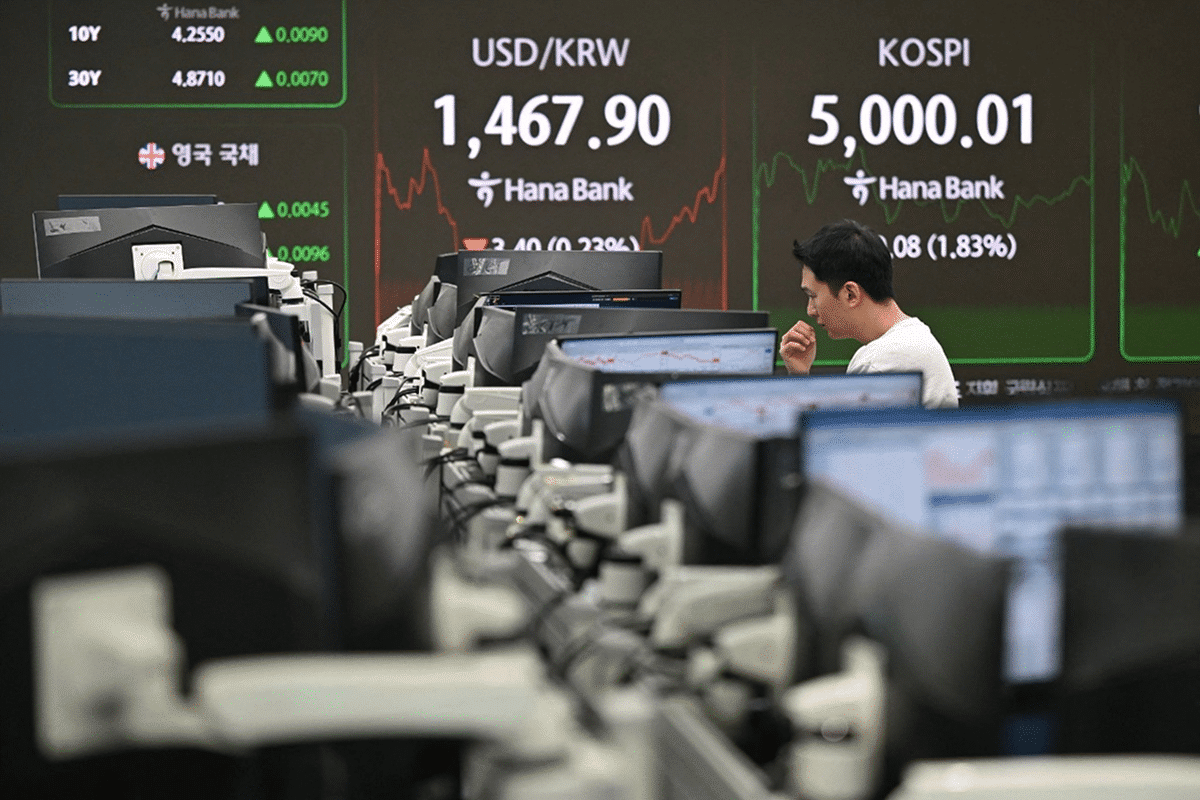
Asian markets opened Friday’s session on a cautious note, reflecting diverging regional dynamics and currency movements. While Australian equities are modestly higher and Hong Kong holds steady, South Korean and Japanese benchmarks are under pressure. Currency fluctuations, particularly in the Japanese Yen and Australian Dollar, are adding another layer of complexity for global and Israeli investors monitoring Asia-Pacific exposure.
Japan and Korea Lead Regional Weakness
Japan’s Nikkei 225 is down 0.70 percent in morning trading, even as the Japanese Yen Index rises 0.17 percent. The firmer yen is weighing on export-oriented stocks, particularly in technology and automotive sectors, as a stronger currency typically compresses overseas earnings when repatriated. The move comes amid renewed demand for safe-haven assets, suggesting some defensive positioning ahead of key global macro developments.
In South Korea, the KOSPI Composite Index is the region’s weakest performer, declining 1.63 percent. The pullback reflects profit-taking in semiconductor and battery names after recent rallies, as well as lingering concerns over global tech demand. Given Korea’s heavy exposure to memory chips and electronics exports, any slowdown in U.S. or Chinese demand could quickly feed into earnings expectations.
For Israeli institutional investors with allocations to Asian technology supply chains, today’s performance highlights the sensitivity of these markets to currency shifts and global demand trends. The combination of a stronger yen and declining Korean equities suggests risk appetite is uneven as February draws to a close.
Australia and China Show Relative Stability
In contrast, Australia’s S&P/ASX 200 is up 0.08 percent, supported by selective strength in financials and resource stocks. However, the Australian Dollar Index is down 0.25 percent, indicating some pressure on the currency even as equities hold modest gains. A softer Australian dollar can support exporters and commodity producers, particularly in iron ore and energy, sectors closely watched by global investors.
Mainland China’s SSE Composite Index is nearly flat, down just 0.01 percent, while Hong Kong’s Hang Seng is unchanged. The muted movement suggests investors are awaiting clearer policy signals from Beijing and additional economic data before taking stronger directional bets. Ongoing discussions around stimulus measures and property sector stabilization remain central to sentiment.
Meanwhile, India’s S&P BSE Sensex is marginally lower by 0.03 percent, reflecting consolidation after a period of strong performance. Indian equities continue to attract global capital flows due to structural growth themes, though valuations remain elevated compared to regional peers.
Currency and Regional Dynamics in Focus
Currency markets are playing a crucial role in shaping equity performance. The strength in the Japanese yen contrasts with weakness in the Australian dollar, underlining diverging monetary expectations and capital flows within the region. For global asset allocators, currency-adjusted returns are increasingly relevant, especially amid volatile cross-border flows.
It is also worth noting that Taiwan’s markets are closed in observance of Peace Memorial Day. The Taiwan Stock Exchange is not trading today, temporarily reducing liquidity and trading volumes across parts of the regional technology complex. Given Taiwan’s central role in the semiconductor supply chain, its closure may contribute to lighter volumes in related names across Asia.
For Israeli investors tracking semiconductor exposure, Taiwan’s holiday serves as a reminder of the interconnected nature of Asian markets, where even a single exchange closure can influence short-term liquidity and price discovery.
Outlook: Month-End Positioning and Policy Signals Ahead
As the February 27 Friday session progresses, attention will likely shift toward month-end portfolio rebalancing, currency volatility, and upcoming macro data releases. Investors will be watching for signals from central banks in Japan and Australia, as well as any fresh policy guidance from China.
Key risks include continued yen appreciation, which could further pressure Japanese exporters, and sustained weakness in Korean technology shares. On the opportunity side, stability in Chinese equities and resilience in Australian resources may offer selective entry points.
For sophisticated global and Israeli investors, the coming sessions will hinge on whether Asia can stabilize into month-end or whether currency-driven volatility sets the tone for March. Monitoring capital flows, policy rhetoric, and sector rotation will be essential in navigating the evolving Asia-Pacific landscape.
Comparison, examination, and analysis between investment houses
Leave your details, and an expert from our team will get back to you as soon as possible
* This article, in whole or in part, does not contain any promise of investment returns, nor does it constitute professional advice to make investments in any particular field.
To read more about the full disclaimer, click here
- Lior mor
- •
- 6 Min Read
- •
- ago 4 hours
SKN | EMCOR (EME) Pulls Back: Profit-Taking or Early Warning for Industrial Infrastructure Stocks?
EMCOR Group (NYSE: EME) traded down in recent sessions, prompting investors to reassess whether the decline reflects routine consolidation
- ago 4 hours
- •
- 6 Min Read

EMCOR Group (NYSE: EME) traded down in recent sessions, prompting investors to reassess whether the decline reflects routine consolidation

- orshu
- •
- 7 Min Read
- •
- ago 5 hours
SKN | US Markets Turn Mixed on February 26, 2026 as Tech Slides and Volatility Rebounds
U.S. equity markets closed mixed on Thursday, February 26, 2026, as renewed weakness in technology stocks weighed on major benchmarks
- ago 5 hours
- •
- 7 Min Read

U.S. equity markets closed mixed on Thursday, February 26, 2026, as renewed weakness in technology stocks weighed on major benchmarks
- orshu
- •
- 6 Min Read
- •
- ago 7 hours
SKN | American Airlines (AAL) Jumps Over 6%: Strategic Expansion or Short-Term Rebound?
American Airlines Group Inc. (NASDAQ: AAL) climbed above 6% intraday, trading near $14.14 as of mid-afternoon U.S. market hours.
- ago 7 hours
- •
- 6 Min Read

American Airlines Group Inc. (NASDAQ: AAL) climbed above 6% intraday, trading near $14.14 as of mid-afternoon U.S. market hours.
- orshu
- •
- 6 Min Read
- •
- ago 10 hours
SKN | Israel Market Close Today, February 26, 2026: Broad Selloff Deepens as Large Caps and Value Stocks Slide
Israeli financial markets closed today, February 26, 2026, with another wave of selling that deepened the corrective phase seen earlier
- ago 10 hours
- •
- 6 Min Read

Israeli financial markets closed today, February 26, 2026, with another wave of selling that deepened the corrective phase seen earlier

