


- orshu
- •
- 6 Min Read
- •
- 4 hours ago
Key Points
- Hong Kong’s Hang Seng surged 2.35%, leading regional gains as South Korea and India also advanced.
- Japan’s Nikkei fell 1.12% while mainland China extended weakness, reflecting uneven sentiment.
- Major exchanges in Shanghai and Shenzhen remained closed for Chinese New Year, while Tokyo was shut for Emperor’s Birthday, limiting regional liquidity.
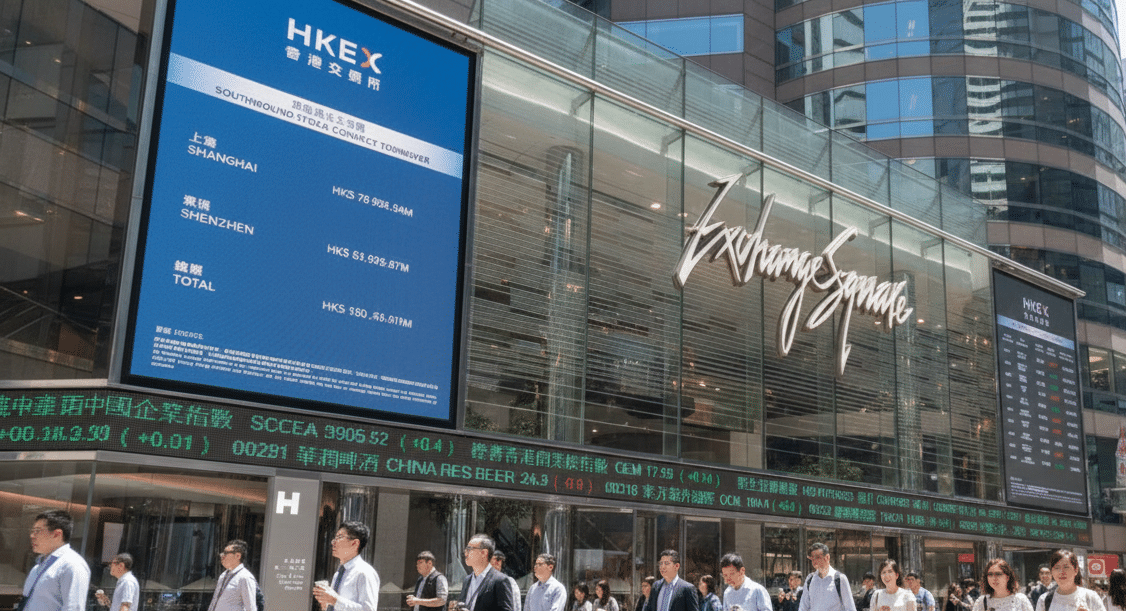
Asian markets ended February 23, 2026, on a mixed note as strong gains in Hong Kong and South Korea contrasted with declines in Japan and mainland China. Trading conditions remained influenced by holiday-related closures in key financial centers, which continued to shape liquidity and investor participation across the region.
The absence of full regional participation resulted in fragmented performance, with domestic factors driving movements rather than synchronized cross-border flows.
Hong Kong Leads with Strong Rally
Hong Kong’s Hang Seng Index climbed 2.35% to 27,034.80, delivering the strongest performance among major Asian benchmarks. The rally suggests renewed buying interest in technology and financial shares, possibly reflecting bargain hunting after recent consolidation.
South Korea’s KOSPI Composite Index rose 0.65% to 5,846.09, extending recent upward momentum. The steady advance indicates improving investor confidence and continued inflows into Korean equities.
India’s S&P BSE Sensex gained 0.58% to 83,294.66, reflecting stable domestic sentiment despite broader regional volatility. The modest increase signals resilience in financial and consumer-focused sectors.
Japan and China Weigh on Regional Tone
Japan’s Nikkei 225 declined 1.12% to 56,825.70, marking one of the session’s weaker performances. However, the Tokyo Stock Exchange was officially closed in observance of Emperor’s Birthday, reducing trading participation and limiting broader price discovery.
Mainland China’s SSE Composite Index fell 1.26% to 4,082.07, continuing its recent softness. Ongoing caution persists as investors assess economic signals amid holiday-thinned conditions.
Meanwhile, currency markets showed limited volatility. The Japanese Yen Index slipped 0.03% to 64.50, suggesting relative stability, while the Australian Dollar Index rose 0.43% to 70.84, indicating moderate risk appetite.
Australia’s S&P/ASX 200 fell 0.61% to 9,026.00, diverging from gains in parts of the region. The decline may reflect sector-specific weakness, particularly in resource and export-related stocks.
Holiday Closures Limit Regional Liquidity
Several major exchanges remained closed, significantly affecting overall regional activity:
• China — Shanghai Stock Exchange — Chinese New Year
• China — Shenzhen Stock Exchange — Chinese New Year
• Japan — Tokyo Stock Exchange — Emperor’s Birthday
The continued closure of Shanghai and Shenzhen restricted mainland trading flows, while Tokyo’s holiday further reduced participation from one of Asia’s largest equity markets. As a result, liquidity remained uneven and volatility was shaped by localized movements rather than broad regional coordination.
Outlook
As markets progressively reopen and liquidity normalizes, investors will look for clearer direction across Asia. The strong rebound in Hong Kong suggests improving risk appetite, but continued weakness in mainland China and Japan highlights lingering caution.
Upcoming economic releases, currency trends, and global market cues will likely determine whether Asia extends gains or re-enters consolidation. A stabilization in Chinese equities and a rebound in Japan once full trading resumes could strengthen regional momentum. Until then, market performance is expected to remain selective, with volatility influenced by shifting capital flows and post-holiday positioning adjustments.
Comparison, examination, and analysis between investment houses
Leave your details, and an expert from our team will get back to you as soon as possible
* This article, in whole or in part, does not contain any promise of investment returns, nor does it constitute professional advice to make investments in any particular field.
To read more about the full disclaimer, click here
- orshu
- •
- 7 Min Read
- •
- ago 2 minutes
SKN | U.S. Stocks Trade Mixed as VIXS Jumps Above 20: Calm Before a Broader Volatility Spike?
U.S. markets opened February 23 with a cautious tone, as volatility picked up while major equity benchmarks showed mixed
- ago 2 minutes
- •
- 7 Min Read

U.S. markets opened February 23 with a cautious tone, as volatility picked up while major equity benchmarks showed mixed
- orshu
- •
- 5 Min Read
- •
- ago 6 hours
SKN | European Markets Rally Broadly as France Leads Strong Start to the Week
European markets opened the week on a strong footing on Monday, February 23, 2026, with broad-based gains across major indices.
- ago 6 hours
- •
- 5 Min Read

European markets opened the week on a strong footing on Monday, February 23, 2026, with broad-based gains across major indices.

- Ronny Mor
- •
- 7 Min Read
- •
- ago 17 hours
SKN | Is the AI Scare Trade Redefining Market Leadership Beyond Big Tech?
Wall Street is undergoing a notable shift as capital rotates out of mega-cap technology stocks and into sectors that lagged
- ago 17 hours
- •
- 7 Min Read

Wall Street is undergoing a notable shift as capital rotates out of mega-cap technology stocks and into sectors that lagged

- Lior mor
- •
- 7 Min Read
- •
- ago 3 days
SKN | Is Active Investing Back? Smart Money Outpaces Indexes Amid Tariff Whiplash and AI Turbulence
In a market defined by policy reversals, AI disruption fears, and geopolitical escalation, Wall Street’s “smart money” is finally outperforming
- ago 3 days
- •
- 7 Min Read

In a market defined by policy reversals, AI disruption fears, and geopolitical escalation, Wall Street’s “smart money” is finally outperforming

