


- Ronny Mor
- •
- 7 Min Read
- •
- 3 months ago
Key Points
- Amazon and Flipkart prepare major pushes into lending, targeting small businesses and consumers
- India’s fast-growth credit market offers opportunity but rising risks
- Data depth gives tech platforms an edge, but scaling safely remains a challenge
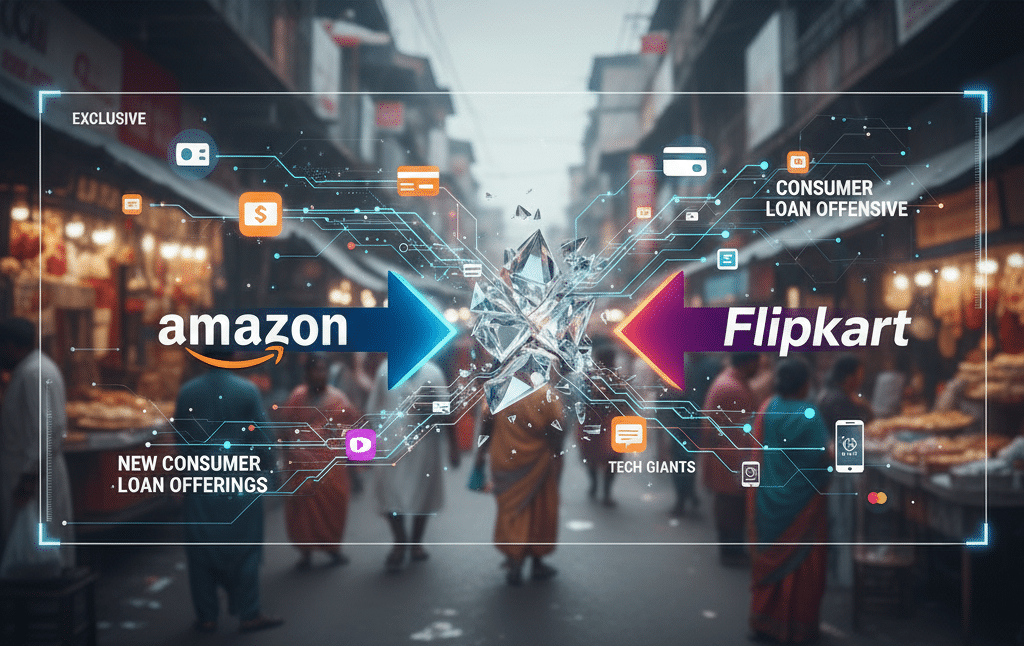
Amazon and Flipkart, India’s two dominant e-commerce platforms, are extending their rivalry deep into financial services as they prepare to roll out direct lending products that could reshape the country’s consumer credit landscape. Backed by unmatched customer data and regulatory approval for in-house lending units, the companies are positioning themselves to take on India’s banks at a time when digital borrowing is expanding rapidly but showing early signs of strain.
Amazon Targets Small Businesses With New Lending Push
Amazon’s lending strategy marks a return to small-business credit following its acquisition of Axio, a Bengaluru-based non-bank lender known for BNPL and personal loans. According to Mahendra Nerurkar, the company’s vice president for payments in emerging markets, India’s “digitally engaged customers and small businesses outside of top-tier cities” represent a major untapped market.
The initiative includes tailored working-capital credit and cash-management solutions aimed at merchants on Amazon’s marketplace. With millions of sellers relying on the platform for distribution, Amazon is betting that embedded lending—issued at the point of transaction—will offer a competitive advantage over legacy banks that lack comparable real-time data.
What makes Amazon’s move notable is the strategic timing. India’s small-business sector remains underserved by traditional lenders due to limited collateral and inconsistent financial records. Amazon’s vast ecosystem provides alternative credit indicators—sales metrics, customer reviews, payments history—that conventional banks cannot match. This creates a rare opportunity for scalable and data-driven underwriting, though the company must still navigate credit-quality risks in a slowing economy.
Flipkart Prepares BNPL and Consumer Durable Loans
Flipkart is pursuing a different route. Through Flipkart Finance, its non-bank lending unit registered earlier this year, the Walmart-owned company plans to introduce two pay-later products upon receiving final approval from the Reserve Bank of India. These include no-cost installment loans for online purchases and longer-tenor consumer durable loans carrying interest rates between 18% and 26%.
Though these rates exceed those offered by traditional banks, they align with the convenience-driven segment Flipkart aims to serve—shoppers seeking instant checkout credit without lengthy documentation. The strategy leverages Flipkart’s dominance in electronics and appliances, categories where BNPL adoption has surged nationwide.
With the consumer loan market expanding from $80 billion in 2020 to over $212 billion in 2025, Flipkart enters at a moment of enormous demand. But recent signs of deceleration and rising delinquencies highlight the risks of unsecured lending, particularly for new entrants with limited historical credit performance.
Data, Regulation, and Execution Will Determine Market Winners
The RBI’s decision to permit both firms to lend through wholly owned units represents a significant opening of India’s financial services sector to foreign-backed digital players. Combined with their deep integration into UPI payments and extensive consumer-data reservoirs, Amazon and Flipkart possess structural advantages over many banks.
Analysts argue that their biggest strengths—data, distribution, and embedded credit—could help them “make a dent” in India’s credit ecosystem. But success will depend on execution: risk management, borrower discipline, regulatory compliance, and the ability to scale without triggering asset-quality deterioration. For now, both companies are expanding carefully, signaling that this shift is strategic rather than experimental.
In the months ahead, investors and regulators will be watching how aggressively these platforms use their reach to grow lending volumes, whether competition pressures traditional banks to innovate, and how digital credit evolves in a landscape where tech companies increasingly blur the lines between commerce and finance.
Comparison, examination, and analysis between investment houses
Leave your details, and an expert from our team will get back to you as soon as possible
* This article, in whole or in part, does not contain any promise of investment returns, nor does it constitute professional advice to make investments in any particular field.
To read more about the full disclaimer, click here
- orshu
- •
- 6 Min Read
- •
- ago 7 days
SKN | Wayfair Shares Slide as Margin Pressures and Consumer Caution Weigh on Outlook
Wayfair shares moved lower in today’s session as investors reacted to lingering concerns about consumer spending trends and the
- ago 7 days
- •
- 6 Min Read
Wayfair shares moved lower in today’s session as investors reacted to lingering concerns about consumer spending trends and the
- orshu
- •
- 6 Min Read
- •
- ago 7 days
SKN | Etsy Rebounds After Prolonged Slump — Is This a Tactical Bounce or a Turning Point?
After months of sustained pressure, Etsy stock is staging a notable rebound, drawing renewed attention from institutional investors. The
- ago 7 days
- •
- 6 Min Read

After months of sustained pressure, Etsy stock is staging a notable rebound, drawing renewed attention from institutional investors. The

- Lior mor
- •
- 6 Min Read
- •
- ago 2 weeks
SKN | Uber Expands Into 7 New European Markets: Can Its Food Delivery Push Drive the Next Growth Leg?
Uber Technologies is expanding its food delivery footprint into seven additional European markets, signaling renewed ambition in a segment
- ago 2 weeks
- •
- 6 Min Read
Uber Technologies is expanding its food delivery footprint into seven additional European markets, signaling renewed ambition in a segment

- Ronny Mor
- •
- 7 Min Read
- •
- ago 2 weeks
SKN | Can Amazon Pharmacy Redefine U.S. Drug Delivery With Same-Day Service in 4,500 Cities?
Amazon is accelerating its push into healthcare, announcing that Amazon Pharmacy will expand same-day prescription delivery to 4,500 cities and
- ago 2 weeks
- •
- 7 Min Read

Amazon is accelerating its push into healthcare, announcing that Amazon Pharmacy will expand same-day prescription delivery to 4,500 cities and

