





- omer bar
- •
- 9 Min Read
- •
- 1 hour ago
Key Points
- AMD continues to outperform with accelerating AI-driven revenue growth, improving profitability, and expanding partnerships across cloud computing and enterprise AI.
- Intel is executing a long-term turnaround strategy through foundry expansion and major AI manufacturing partnerships but remains under pressure from ongoing losses and negative free cash flow.
- While Intel's transformation offers long-term potential, AMD currently presents the stronger investment case based on growth, financial performance, and AI market momentum.
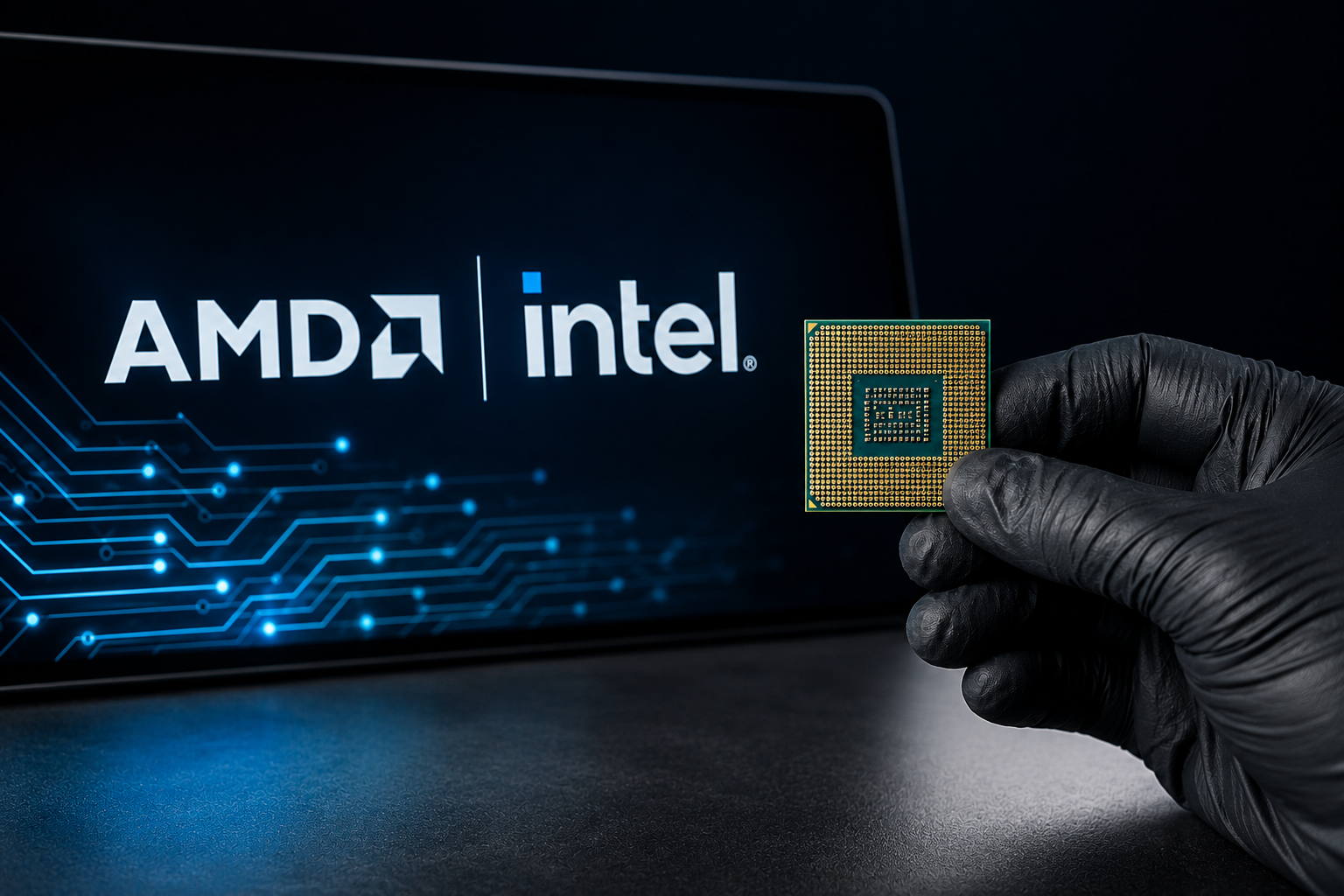
AMD Extends Its Lead in the AI Era
The semiconductor industry continues to evolve rapidly as artificial intelligence reshapes demand for advanced computing infrastructure. Among the sector’s leading competitors, Advanced Micro Devices (AMD) and Intel are pursuing distinctly different strategies to capitalize on this opportunity.
AMD has successfully transformed itself into one of the industry’s leading providers of high-performance processors and AI accelerators. The company continues expanding relationships with major cloud providers while strengthening its position through partnerships with OpenAI and Anthropic. Its acquisition of ZT Systems’ design business further enhances its ability to deliver integrated AI infrastructure solutions for enterprise customers.
The company’s financial performance reflects this momentum. Fiscal 2025 revenue increased 34% to more than $34.6 billion, while net income nearly tripled to approximately $4.4 billion. Free cash flow reached $5.5 billion, supported by a conservative balance sheet with a debt-to-equity ratio of just 0.1x. Although stock-based compensation remains a meaningful component of operating cash flow, AMD continues generating healthy profitability while investing aggressively in future growth.
Intel Pursues an Ambitious Turnaround Strategy
Intel remains one of the world’s largest semiconductor manufacturers but is in the midst of one of the industry’s most significant transformation efforts. The company is repositioning itself beyond traditional PC processors by expanding its foundry business and developing advanced AI-focused semiconductor manufacturing capabilities.
Recent initiatives include partnerships with SpaceX and Tesla on the Terafab AI chip manufacturing project, collaboration with Nvidia on its Crescent Island GPU platform, and an agreement with Alphabet’s Google division to develop AI-focused semiconductor solutions. Government funding and additional strategic investment have also strengthened Intel’s financial flexibility as it builds new manufacturing capacity in the United States.
Despite these initiatives, Intel continues to face financial challenges. Fiscal 2025 revenue declined slightly to approximately $52.9 billion, while the company reported a net loss of roughly $267 million. Negative free cash flow exceeding $4.9 billion reflects the significant capital required to expand manufacturing operations and execute its long-term strategy.
AI Growth Continues to Favor AMD
Artificial intelligence remains the industry’s primary growth catalyst, and AMD appears particularly well positioned to benefit from expanding demand.
Management expects AI-related chip demand to grow more than 30% annually, supported by the evolution from generative AI toward agentic AI and robotic AI applications. The company’s supply agreement with OpenAI, along with recent customer wins across healthcare and financial services, has further strengthened investor confidence in its long-term growth outlook.
Wall Street currently expects AMD to generate approximately $49.6 billion in revenue during fiscal 2026, representing growth of more than 40%, while net income is projected to reach approximately $8.7 billion.
Intel is also expected to return to stronger revenue growth, with analysts forecasting approximately $62.3 billion in 2026 sales. However, the company is still projected to post a significant net loss as it continues investing heavily in expanding domestic foundry capacity and advanced manufacturing technologies.
Investment Outlook
Both semiconductor companies offer compelling long-term opportunities, but they currently represent different investment profiles.
Intel provides investors with exposure to a potentially transformative turnaround supported by large-scale manufacturing investments, government incentives, and strategic partnerships. Success would position the company as a critical supplier of next-generation AI chips, although execution risks remain substantial.
AMD, by contrast, already demonstrates strong financial execution, expanding profitability, and accelerating AI-driven demand. Its growing ecosystem of enterprise customers, cloud providers, and artificial intelligence developers continues supporting one of the industry’s strongest growth trajectories.
While Intel’s long-term strategy may eventually restore its competitive position, AMD presently offers the stronger combination of revenue growth, earnings expansion, operational execution, and exposure to the accelerating artificial intelligence market.
Confidential Advisory: This article is for informational purposes only and should not be considered financial or investment advice. Investors should carefully evaluate company fundamentals, competitive positioning, valuation, and individual risk tolerance before making investment decisions.
Closing Insights
The semiconductor industry is entering a new phase where artificial intelligence infrastructure is becoming the primary driver of long-term demand. While Intel is laying the foundation for a future recovery through manufacturing expansion and strategic partnerships, AMD is already capitalizing on the current AI investment cycle with accelerating revenue, improving profitability, and expanding enterprise adoption. As the AI ecosystem continues to mature, execution and innovation are likely to remain the defining factors separating tomorrow’s industry leaders.
Comparison, examination, and analysis between investment houses
Leave your details, and an expert from our team will get back to you as soon as possible
* This article, in whole or in part, does not contain any promise of investment returns, nor does it constitute professional advice to make investments in any particular field.
To read more about the full disclaimer, click here
- sagi habasov
- •
- 7 Min Read
- •
- ago 28 minutes
SKN | Semiconductor Stocks Surge as AI Optimism Lifts Marvell, AMD, Micron and SK Hynix
Chip Stocks Lead Broad Market Rally Semiconductor stocks powered Wall Street higher on Tuesday, with the sector leading a broad
- ago 28 minutes
- •
- 7 Min Read
Chip Stocks Lead Broad Market Rally Semiconductor stocks powered Wall Street higher on Tuesday, with the sector leading a broad

- Lior mor
- •
- 7 Min Read
- •
- ago 2 hours
SKN | Palantir Raises Revenue Outlook as Commercial AI Business Accelerates
Palantir Delivers Another Exceptional Quarter Palantir Technologies posted another strong earnings report, sending its shares approximately 12% higher after reporting
- ago 2 hours
- •
- 7 Min Read

Palantir Delivers Another Exceptional Quarter Palantir Technologies posted another strong earnings report, sending its shares approximately 12% higher after reporting

- orshu
- •
- 6 Min Read
- •
- ago 12 hours
SKN | Asia Markets Mixed on August 4, 2026 as South Korea and Australia Rebound While Hong Kong and India Decline
Asian markets closed mixed on August 4, 2026, with renewed buying lifting South Korea and Australia after recent weakness, while
- ago 12 hours
- •
- 6 Min Read

Asian markets closed mixed on August 4, 2026, with renewed buying lifting South Korea and Australia after recent weakness, while
- Lior mor
- •
- 10 Min Read
- •
- ago 14 hours
SKN | Nvidia Sees $7.9 Trillion Semiconductor Opportunity as Agentic AI Fuels Demand for Advanced Chips
Nvidia CEO Jensen Huang believes the artificial intelligence revolution is entering its next phase, one that could transform the
- ago 14 hours
- •
- 10 Min Read
Nvidia CEO Jensen Huang believes the artificial intelligence revolution is entering its next phase, one that could transform the


