


- Lior mor
- •
- 7 Min Read
- •
- 3 hours ago
Key Points
- Walmart is up 20% in 2026, reaching a $1 trillion market cap, driven by grocery strength and digital expansion.
- Amazon is down 14% year-to-date amid layoffs and cost restructuring, prompting debate over growth versus efficiency.
- Investor sentiment currently favors stability and defensive retail exposure, but long-term competition remains dynamic.
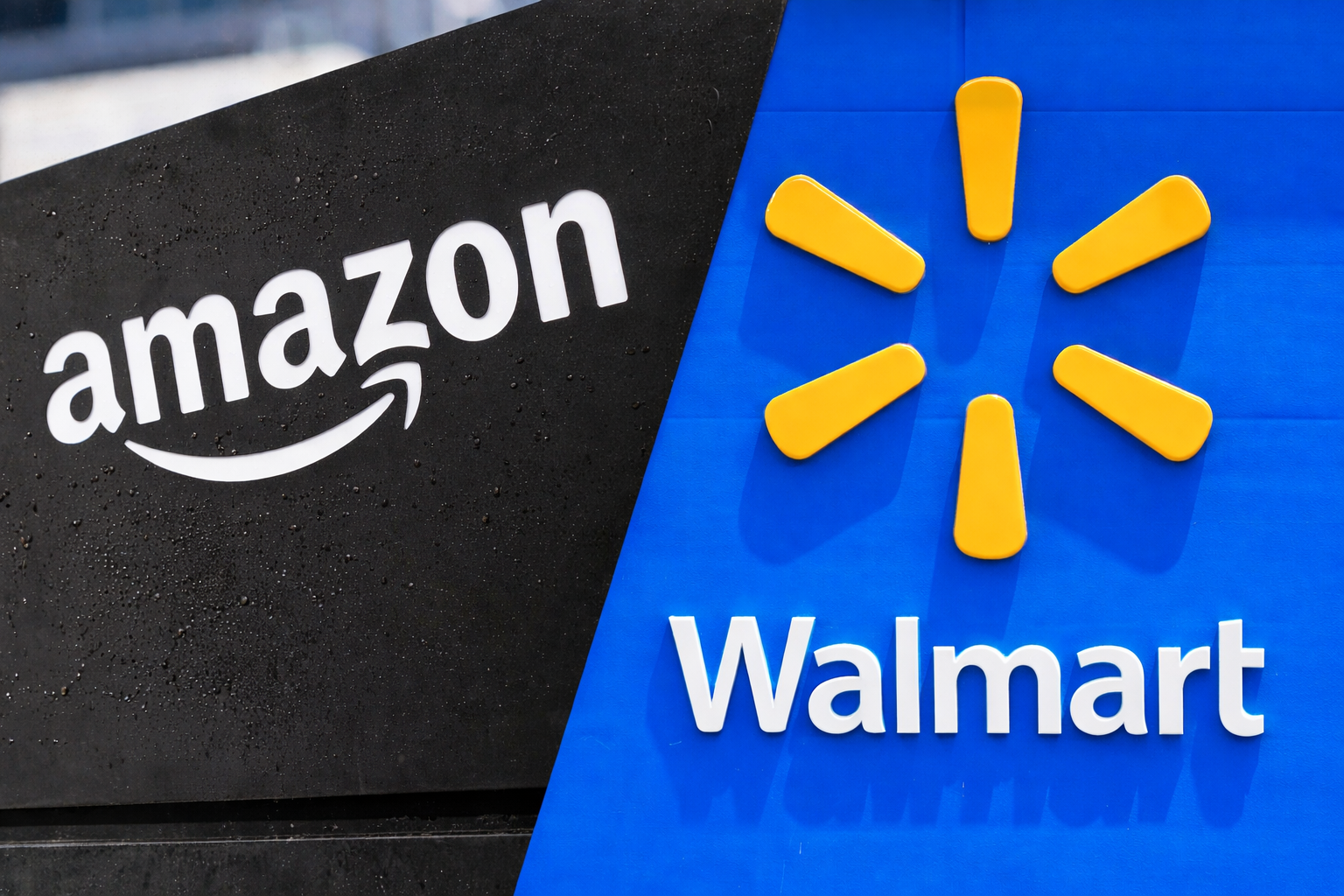
The battle for the American consumer has rarely been this intense. In 2026, Walmart has surged roughly 20% year-to-date, reaching a historic $1 trillion market capitalization, while Amazon has fallen about 14% amid cost-cutting efforts and workforce reductions. The divergence highlights a critical question for investors in both the U.S. and global markets: Is traditional retail regaining dominance, or is this simply a temporary rotation in a longer-term digital story?
Walmart’s Defensive Strength and Digital Acceleration
Walmart’s 2026 performance reflects more than just defensive positioning. While inflation has moderated, American consumers remain price-sensitive. Walmart’s scale in groceries—where it commands significant U.S. market share—provides steady foot traffic and predictable cash flow. Unlike discretionary-heavy retailers, groceries anchor repeat visits and strengthen cross-selling opportunities.
What is often overlooked is Walmart’s digital transformation. Its e-commerce segment has grown consistently, narrowing the historical gap with Amazon in last-mile logistics and third-party marketplace services. Same-day pickup, in-store fulfillment, and expanded advertising services have turned Walmart into a hybrid retail-tech platform. Advertising, in particular, has become a high-margin growth engine, mirroring Amazon’s earlier playbook.
Reaching a $1 trillion valuation signals investor confidence not only in revenue durability but in margin resilience. Walmart’s ability to monetize both physical and digital ecosystems positions it as a defensive growth stock in a volatile macro environment.
Amazon’s Reset: Cost Discipline or Structural Challenge?
Amazon’s 14% year-to-date decline comes amid layoffs and cost rationalization efforts. After years of aggressive expansion in fulfillment centers, streaming, and experimental ventures, the company is now focusing on efficiency.
Yet Amazon’s broader business mix complicates the narrative. While retail margins remain thin, its cloud division and advertising platform historically provide stronger profitability. The question for markets is whether near-term retail headwinds and softer consumer spending are overshadowing the company’s structural advantages.
Mass layoffs can be interpreted in two ways. On one hand, they signal slowing growth expectations. On the other, they represent operating discipline after pandemic-era overexpansion. Institutional investors often reward companies that proactively manage costs during uncertain cycles.
Consumer Behavior and Market Psychology
The divergence between Walmart and Amazon also reflects investor psychology. In periods of economic uncertainty, markets tend to favor predictable cash flow and tangible assets over high-growth narratives. Walmart’s grocery dominance appeals to risk-conscious capital, while Amazon’s more diversified but complex model invites scrutiny.
Additionally, consumer behavior is fragmenting. Price-sensitive shoppers may gravitate toward Walmart’s in-store value, while convenience-driven buyers remain loyal to Amazon’s ecosystem. The real competition is no longer just retail—it’s about data, logistics, and advertising share.
For investors in Israel and the U.S., the comparison underscores a broader theme: platform convergence. Walmart is becoming more digital, while Amazon is strengthening its physical and advertising footprint. The lines are blurring.
Looking ahead, earnings guidance, advertising growth rates, and consumer spending data will be critical signals. If economic growth stabilizes, Amazon could regain momentum. If consumer caution persists, Walmart’s steady model may continue to outperform.
Comparison, examination, and analysis between investment houses
Leave your details, and an expert from our team will get back to you as soon as possible
* This article, in whole or in part, does not contain any promise of investment returns, nor does it constitute professional advice to make investments in any particular field.
To read more about the full disclaimer, click here
- omer bar
- •
- 7 Min Read
- •
- ago 1 minute
SKN | Is Oracle a Once-in-a-Decade Opportunity — or Just Another AI Trade at Full Valuation?
Oracle Corporation (NYSE: ORCL) has reemerged as a central player in the global AI infrastructure race, delivering a sharp
- ago 1 minute
- •
- 7 Min Read
Oracle Corporation (NYSE: ORCL) has reemerged as a central player in the global AI infrastructure race, delivering a sharp

- Arik Arkadi Sluzki
- •
- 7 Min Read
- •
- ago 5 hours
SKN | Institutional Investor Cuts Stake in Global Electronics Supplier – Strategic Rebalance or Warning Signal?
A prominent investment manager has downsized its holdings in a global electronics supplier, according to a recent filing with
- ago 5 hours
- •
- 7 Min Read
A prominent investment manager has downsized its holdings in a global electronics supplier, according to a recent filing with

- Lior mor
- •
- 7 Min Read
- •
- ago 6 hours
SKN | NVIDIA Stock Holds Above $183 as AI Momentum Rebuilds – Can NVDA Extend Its February Breakout?
NVIDIA Corporation (NVDA) traded higher on February 17, gaining 0.61% to $183.89 as of late morning U.S. trading. The
- ago 6 hours
- •
- 7 Min Read
NVIDIA Corporation (NVDA) traded higher on February 17, gaining 0.61% to $183.89 as of late morning U.S. trading. The

- Ronny Mor
- •
- 7 Min Read
- •
- ago 7 hours
SKN | Are Software Stock Bulls Making a Dangerous Assumption About AI-Driven Growth?
Software equities have staged a powerful rally over the past year, fueled by optimism around artificial intelligence, recurring revenue
- ago 7 hours
- •
- 7 Min Read

Software equities have staged a powerful rally over the past year, fueled by optimism around artificial intelligence, recurring revenue

