


- omer bar
- •
- 6 Min Read
- •
- 4 hours ago
Key Points
- Amazon reported $717 billion in 2025 revenue, surpassing Walmart’s $713 billion.
- AWS generated nearly $129 billion, reinforcing Amazon’s high-margin diversification.
- Walmart remains operationally strong, with U.S. comparable sales up 4.6% and a $1 trillion valuation.
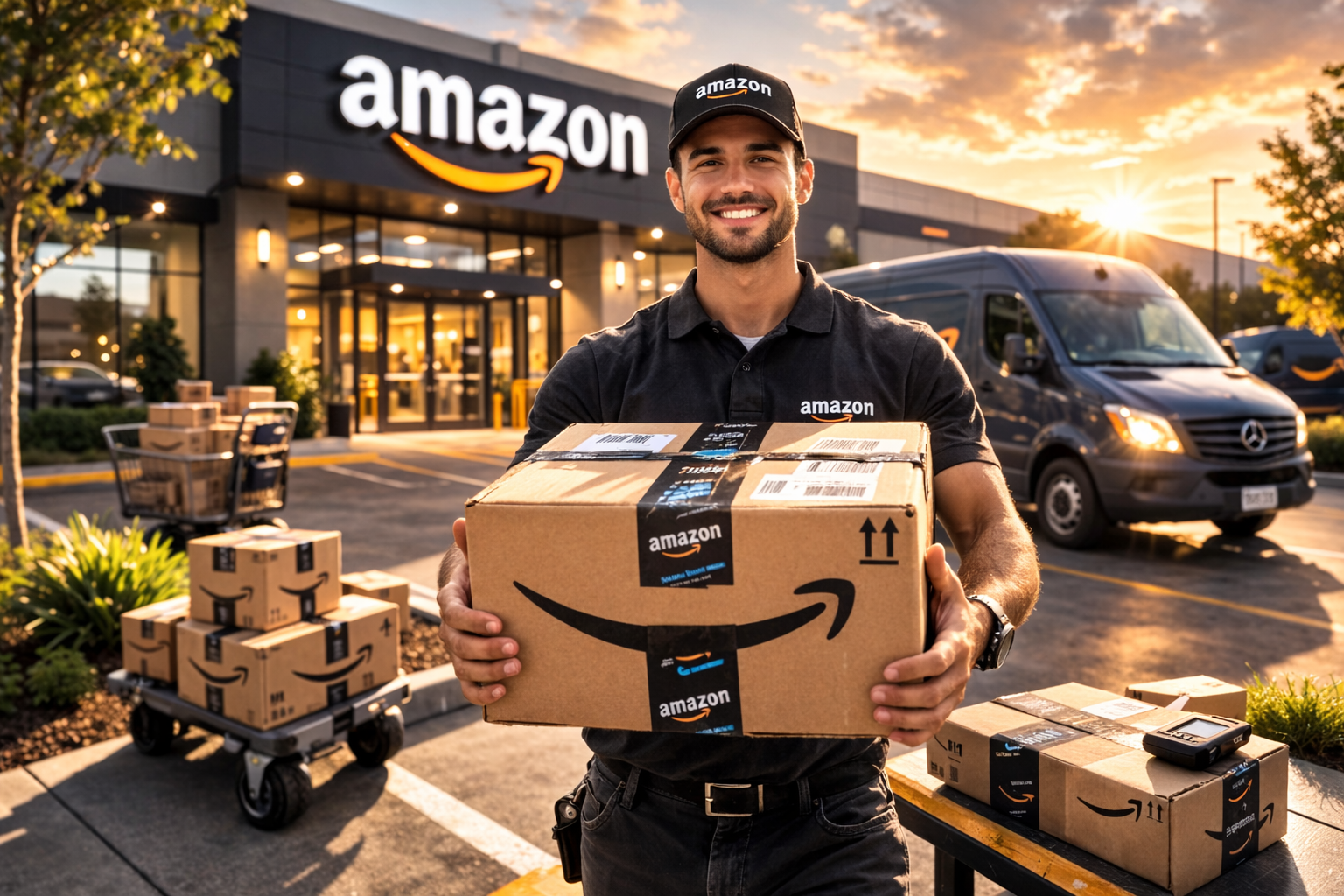
Amazon has officially ended Walmart’s 13-year reign as the world’s largest company by revenue, reporting $717 billion in 2025 sales compared with Walmart’s $713 billion. While the headline marks a symbolic milestone in global retail history, the deeper story lies in business model evolution. Amazon’s ascent reflects not only e-commerce scale, but also the growing dominance of cloud computing, digital advertising, and subscription ecosystems — sectors that carry structurally higher margins and capital-light scalability.
Diversification Drives Amazon’s Breakthrough
Amazon’s retail operations remain its largest revenue engine, generating approximately $464 billion from online stores, physical outlets, and third-party marketplace sales. However, the company’s strategic pivot beyond retail is what ultimately tipped the scales.
Amazon Web Services (AWS) delivered nearly $129 billion in revenue in 2025, providing computing infrastructure, storage solutions, and artificial intelligence capabilities to enterprises and governments globally. AWS continues to serve as Amazon’s primary profit driver, offsetting thinner margins in core retail operations and insulating overall earnings from cyclical consumer demand.
In addition, Amazon generated more than $100 billion from advertising and Prime subscriptions combined — a recurring revenue stream that enhances customer stickiness while boosting monetization efficiency. For investors, this revenue mix increasingly positions Amazon less as a traditional retailer and more as a diversified technology conglomerate.
Walmart’s Resilience and Strategic Repositioning
Despite relinquishing the revenue crown, Walmart remains financially robust. More than 90% of its revenue still stems from physical stores and e-commerce operations, underscoring its continued reliance on consumer retail fundamentals. Yet operational momentum remains strong.
U.S. comparable sales grew 4.6% last quarter, driven by increased transaction counts and continued share gains among middle- and upper-income households seeking value amid economic uncertainty. Walmart’s expanding omnichannel capabilities, including store-fulfilled delivery and marketplace growth, have narrowed the competitive gap with Amazon in convenience and speed.
Importantly, Walmart recently surpassed a $1 trillion market capitalization — becoming the first traditional retailer to reach that milestone. Its move to shift its stock listing to the Nasdaq further signals management’s intent to be viewed as a technology-enabled platform rather than solely a brick-and-mortar retailer.
A Broader Retail and Market Implication
For U.S. and Israeli investors alike, the leadership change reflects more than a numerical milestone. It highlights the structural premium markets assign to diversified revenue streams, scalable infrastructure, and AI-driven ecosystems. Amazon’s advantage lies in monetizing digital infrastructure alongside consumer demand, reducing dependence on discretionary retail cycles.
However, Walmart’s performance demonstrates that physical retail remains highly relevant when paired with data analytics, supply chain efficiency, and disciplined pricing. The competitive dynamic increasingly centers on ecosystem integration rather than store count.
Looking ahead, the key variable will be margin durability. Amazon must continue proving that AWS and advertising growth can outpace retail volatility, while Walmart must sustain traffic growth without sacrificing profitability in a value-sensitive environment. The retail battleground has shifted from shelves to servers — and the next decade may hinge less on store expansion and more on technological leverage.
Comparison, examination, and analysis between investment houses
Leave your details, and an expert from our team will get back to you as soon as possible
* This article, in whole or in part, does not contain any promise of investment returns, nor does it constitute professional advice to make investments in any particular field.
To read more about the full disclaimer, click here
- Ronny Mor
- •
- 6 Min Read
- •
- ago 1 minute
SKN | Walmart’s 1% Q4 Price Increase Signals Retail Discipline Amid Inflation Crosscurrents
Walmart’s finance chief disclosed that prices increased only around 1% across the board in the fourth quarter, a figure
- ago 1 minute
- •
- 6 Min Read
Walmart’s finance chief disclosed that prices increased only around 1% across the board in the fourth quarter, a figure

- sagi habasov
- •
- 6 Min Read
- •
- ago 7 hours
SKN | Walmart Earnings Beat Expectations — But Is Cautious Guidance Signaling Consumer Fatigue Ahead?
Walmart delivered a modest earnings beat in its first quarterly report under CEO John Furner, but investors are focusing less
- ago 7 hours
- •
- 6 Min Read

Walmart delivered a modest earnings beat in its first quarterly report under CEO John Furner, but investors are focusing less

- Lior mor
- •
- 7 Min Read
- •
- ago 9 hours
SKN | Can Walmart Sustain Its $1 Trillion Momentum as New CEO John Furner Delivers First Earnings?
Walmart enters its latest earnings season at a historic juncture. The retail giant is set to release quarterly results with
- ago 9 hours
- •
- 7 Min Read

Walmart enters its latest earnings season at a historic juncture. The retail giant is set to release quarterly results with

- omer bar
- •
- 6 Min Read
- •
- ago 11 hours
SKN | Is Airbus Losing Altitude? Delivery Target Miss and Boeing’s Comeback Pressure Shares
Airbus shares slid more than 5% after the European aerospace giant projected 870 commercial aircraft deliveries for 2026, slightly below
- ago 11 hours
- •
- 6 Min Read

Airbus shares slid more than 5% after the European aerospace giant projected 870 commercial aircraft deliveries for 2026, slightly below

